Nic Carter has taken another hiatus from speaking appearances after he single-handedly prompted the entire Bitcoin community to focus on risks of quantum computing.
His blog posts and tweets on the topic have earned millions of combined views since October 20.
His primary contention is not that quantum is a risk — everybody already agrees that quantum computers will eventually be able to calculate certain private keys belonging to Satoshi Nakamoto and other users who exposed their public keys.
Instead, Carter’s primary contention is that quantum is a near-term risk that requires immediate planning.
Rather than looking decades into the future, Carter put forward estimates as soon as 2028, and probably no later than 2033.
Sensing an urgency for developers to finalize a plan to protect Bitcoin as soon as possible, Carter took the time to explain how quantum computers could calculate private keys from exposed public keys, including deep dives into the mathematics and economic incentives that secure bitcoin (BTC).
Not afraid to sound a fire alarm about quantum
To his credit, Carter used his role as a prominent commentator who doesn’t shy away from controversial views to force Bitcoin users to take the threat of quantum seriously.
He didn’t apologize for investing in a quantum tooling startup that some people called a conflict of interest, asserting that his investment demonstrated his resolve to put his money where his mouth is.
Although he acknowledged that quantum research has been underway for years, he claims the Bitcoin community isn’t working fast enough.
For anyone who hasn’t read his lengthy, technical blogs about the topic, below is a summary of Carter’s critique of Bitcoin’s quantum vulnerabilities.
Summary of Nic Carter’s quantum critique of Bitcoin
First, Carter asserts that multiple governments are accelerating their timelines for quantum breakthroughs. He notes draft guidance from the US National Institute of Standards and Technology which recommends deprecating quantum-vulnerable cryptography like ECC256 by the year 2030.
Like many financial security systems, Bitcoin also uses ECC, elliptic curve cryptography.
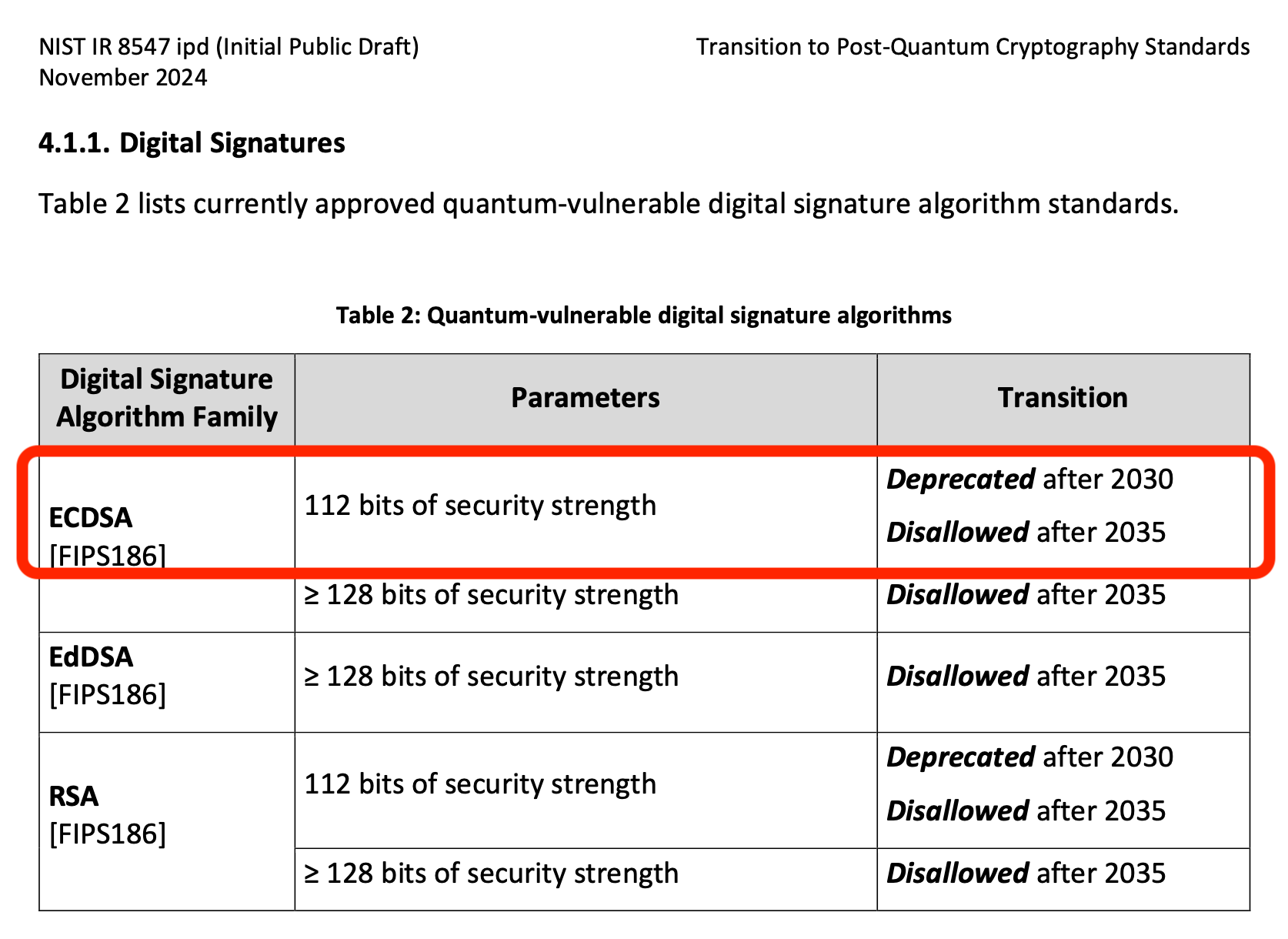
Second, Carter highlights that qubit counts — a key marker of computational power — are increasing rapidly thanks to a massive inflow of capital into quantum research.
Indeed, billions of dollars flowed into private quantum computing companies in 2025 alone, to say nothing of government-funded mathematics and cryptography institutes.
Third, Carter highlighted major quantum achievements from 2025 that flew under the radar of most Bitcoiners who assumed that any quantum risk was still decades away.
Fourth, Carter explained how the exposed public keys of old wallets, such as Satoshi’s BTC holdings, provide an immediate, multi-billion dollar bounty accessible to any quantum computing team.
Energized by this globally accessible reward with an instant payout, Carter estimates that a quantum computer will meaningfully break ECC as soon as 2028 and probably no later than 2033.
Finally, Carter explained the relationship between artificial intelligence (AI) research and quantum research, which aren’t isolated fields of research in his view.
Due to AI research and investment deals reaching hundreds of billions of dollars, the timelines of quantum advancement are advancing far more rapidly than most Bitcoiners have assumed.
A $600 billion bug bounty
Overall, Carter believes that about $600 billion worth of BTC at current market prices are vulnerable to quantum theft.
Even if the BTC price declines on the negative event, the payout is still a financial windfall to any quantum research team. The only way to protect these holdings from theft is to fork the protocol to adopt post-quantum signature schemes.
Read more: Nic Carter rejects Bitcoin maximalism, embraces Ethereum
Carter estimates coding, tooling, testing, and debate about this fork could take two to three years, so the time to start work on it is now. He doesn’t glibly assume, like Strategy founder Michael Saylor, that so-called “lost” and quantum-vulnerable BTC holdings can simply be removed from circulating supply.
Carter simply implores, “The Bitcoin community must decide what is to be done with them… We need time to discuss strategies, settle our differences, agree on a roadmap for both the protocol and the vulnerable coins, write the code, test the cryptography, and actually perform the migration.”
The time for that discussion, he says, isn’t many years in the future, but now.