An experimental orchestral project in Brazil aims to convert Bitcoin price data into live music, after receiving approval to raise funds through one of the country’s tax-incentive programs for cultural initiatives.
According to Brazil’s Federal Register, the authorization allows the project to seek up to 1.09 million reais ($197,000) from private companies and individual donors for an instrumental concert that uses financial data to generate music, drawing on concepts from art, mathematics, economics and physics.
The publication does not specify whether any blockchain or onchain infrastructure will be used in the performance. The performance will take place at the country’s federal capital, Brasília.
The project description says it will convert monetary figures into musical notation by using an algorithm to track Bitcoin (BTC) price movements and related technical data in real time during the performance. These data inputs are intended to guide melody, rhythm and harmony as the orchestra plays live.

The approach is designed to give audiences an audible representation of Bitcoin’s volatility by translating market behavior into sound, blending traditional orchestral instruments with rel=”” target=”_self” title=”https://cointelegraph.com/news/ai-can-compose-good-music-but-humanity-still-holds-the-creative-baton-wcit-2024″>AI can compose good music, but humanity still holds the creative baton
Earlier experiments in algorithmic crypto art
The Brazil initiative builds on earlier experiments in algorithmic art that have treated crypto-native and other real-world data streams as raw material for creative expression.
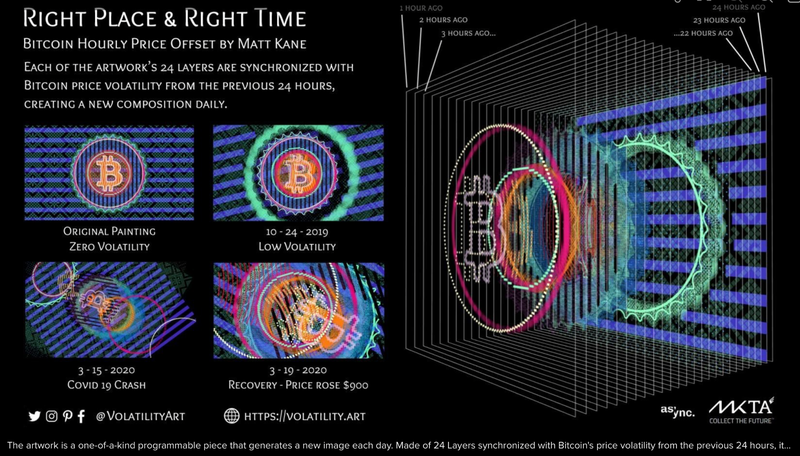
In 2020, a San Francisco–based group working in programmable digital art unveiled an artwork designed to change its appearance in line with Bitcoin’s price movements. The project, Right Place & Right Time by artist Matt Kane, used BTC market data as a live input, allowing shifts in the cryptocurrency’s value to drive visual changes in the piece.
The work was released through Async Art, a platform known for programmable NFTs, where Kane structured the artwork into a central “Master” image composed of multiple independent layers. Each layer responded to Bitcoin price action, with changes in the data influencing elements such as scale, rotation and positioning over time.
Another artist working in a similar vein is Refik Anadol, whose practice uses artificial intelligence, algorithms and large datasets to produce immersive installations that translate sources ranging from environmental data to archival records into continuously evolving visual works.
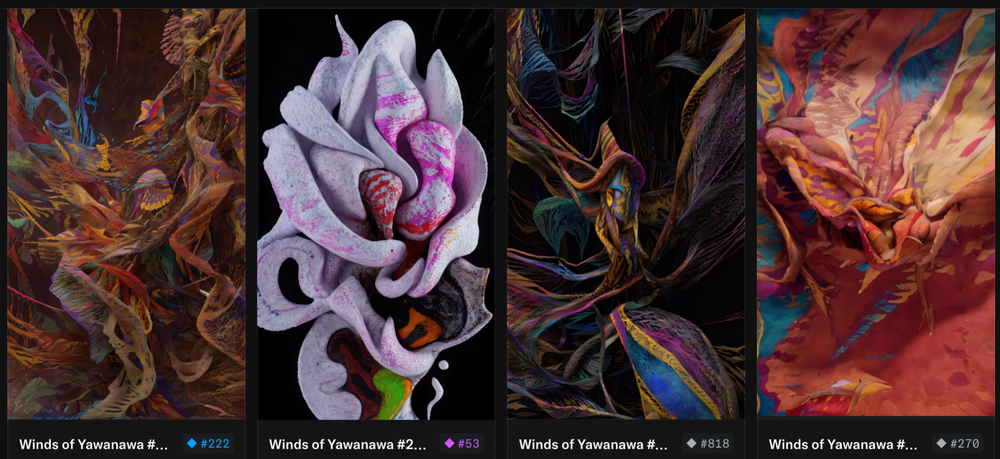
The artist has released several non-fungible projects in recent years, including Winds of Yawanawá, an NFT collection created and launched in July 2023 as a collaboration with the Yawanawá Indigenous community of the Brazilian Amazon, combining real-time environmental data and traditional art into a generative digital series.
Magazine: Quantum attacking Bitcoin would be a waste of time: Kevin O’Leary