South Korea’s won is crashing harder than any other currency in Asia this year. It’s down 2.5% against the dollar, making it the region’s worst performer.
The USD/KRW pair sits at 1,472.8 at press time, slightly lower on the day, but still staying dangerously close to local highs.
Meanwhile, the Singapore dollar is at 1.285, Chinese yuan at 6.963, and Indian rupee near 90.819. Australia’s dollar gained a tiny bit, now at 0.67. Even the Thai baht strengthened up a bit, though the USD/THB pair has dropped to 31.25, per data from CNBC.
Bitcoin trades higher in Korea as kimchi premium rises above 2%, flipping bullish
While the won is getting weaker, Bitcoin is getting pricier in Korea. The kimchi premium, which tracks the difference between BTC prices on Korean exchanges like Bithumb and global ones like Binance, is now at +2.49%.
Of course this means Koreans are paying more for BTC than everyone else. Just last year, the premium hit a local high of 6.07%, which almost always means aggressive Korean traders are jumping in.
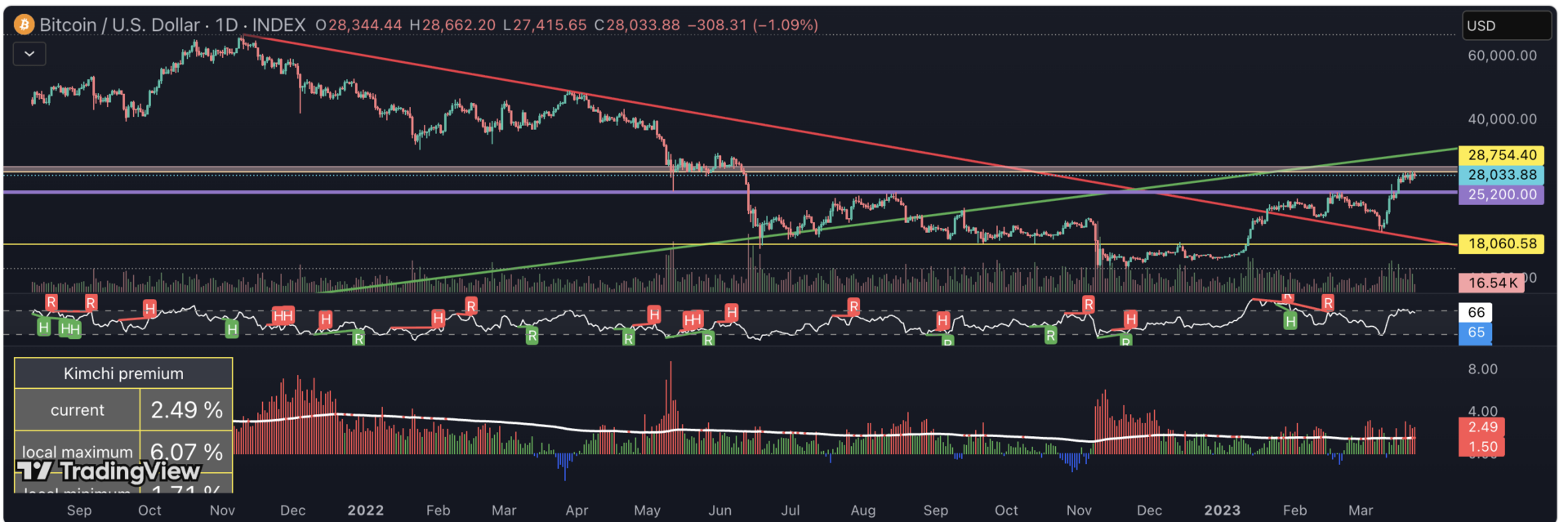
Observe the chart above and pay attention to all lines when the premium passes 1.5%, because it tells us that the premium steadily matches perfectly with Bitcoin’s green trendline breakout even it times when Bitcoin wasn’t exactly rallying.
Still though, that breakout level is right around $25,200, and guess what? That’s also where the highest buy volume spike showed up, right when Korea’s premium rallied.
Resistance is sitting around $28,754.40, while strong support is at $25,200, followed by zones down at $18,060.58 and $16,540.00. Bitcoin has been stuck under that red descending trendline from 2021, and current prices are just under that key resistance.
Right now, the premium isn’t too hot or too cold. At 2.49%, it’s in the middle of its historical range. Not enough to call it overheated, but still strong enough to keep this bullish setup alive. If it goes back above 4% or 6%, expect another price push. But if it crashes under 1%, that’s your sign Korean demand is falling off, and price might revisit the $18,000s.