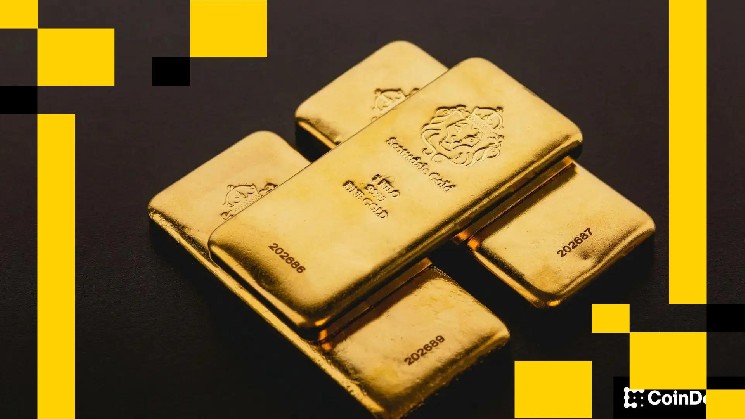
There is a buying frenzy in the gold market that has propelled the price of the precious metal by more than 80% over the last 12 months, making it one of the best-performing assets.
However, investors aren’t paying attention to a hidden threat that is forming beneath the surface, according to Björn Schmidtke, CEO of the Tether gold-treasury firm Aurelion (AURE).
The easiest way for someone to buy gold is to purchase what Schmidtke calls ‘paper gold’ or stocks of a gold exchange-traded fund. When buying such stocks, what investors think is that they have bought the physical gold bar, when the reality is that they have bought “a small piece of paper that says, ‘I owe you gold.’ And people collectively agree that this piece of paper has value,” he said in an interview with CoinDesk.
While this avoids the hassle of owning and storing a physical gold bar, it is where the real problem starts, according to Schmidtke.
‘Seismic event’
Think about it this way: an investor buys the “paper gold” thinking that they now own a bar of gold. While it’s redeemable, the investor doesn’t know which gold bar they own. There is simply no proof of owning a gold bar, other than the fact that an investor bought a share of the ETF.
Schmidtke estimates that 98% of gold exposure is effectively unallocated in IOUs, in which investors hold billions of dollars’ worth of pieces of paper that are meant to be backed by the gold they represent, but they don’t know which gold bars they own.
This is fine for now because the current system has worked for decades, as few investors ever demand delivery.
But let’s say a catastrophic event occurs in which fiat currency is exponentially devalued, and people rush to get their physical gold they thought they bought when they purchased their “paper gold.”
When such a “seismic event” occurs and the investor wants their gold bar, where is the proof that the gold bar is owned by that investor, and how do those gold bars get delivered to the investors?
“You simply cannot move a few billion dollars’ worth of physical gold in a single day,” he said. And if those gold bars lack proof of ownership, that creates an even bigger logistical bottleneck, which could lead to a market rupture if panic drives investors toward redeemable assets. In such a crisis, the price of actual gold could soar while paper gold prices lag, leaving holders of derivatives unable to settle.
“The risk is real. We’ve already seen it in the silver market,” he said, pointing to past events where physical premiums rose while spot prices stayed flat. “We believe we will see it in the gold market as well,” if such an event happens.
This is where onchain gold comes into play, according to Schmidtke.
Proof of ownership
Think about a theoretical real estate ownership scenario.
Let’s say a real-estate developer offered a unique way for investors to buy housing units. If they buy 10 shares in the project, they receive an instant IOU promising delivery of 10 housing units. This developer has also promised the same to other investors. The whole process is completed by simply buying shares in the project, without signing an ownership deed.
Sounds easy, right?
Now, when it comes to taking possession of the housing units, because the investors didn’t sign any ownership but bought shares, there is no searchable proof of which units they bought, and developers might try to deliver them at random, creating a nightmare bottleneck, where the units will get probably get delivered to the investors but it will take substantial amount of time and without guarantee who gets which units and when.
Schmidtke says that onchain gold ownership solves this by eliminating the bottleneck in the delivery of physical gold.
To redeem physical gold, investors would have to physically move it, whereas tokenized gold, like XAUT, decouples ownership from the physical movement of the metal.
Because every XAUT token is inextricably linked to a specific, allocated bar of gold sitting in a Swiss vault, the “title deed” to that gold can be transferred globally in seconds on the blockchain.
It’s similar to the theoretical real estate problem. If, instead of buying just shares, an investor signed a title deed from the get-go, they would know exactly which units they are getting, and it would be easier for developers to quickly sort through those deeds and deliver those units to their rightful owners on time.
With the onchain gold token, these allocations will be searchable and redeemable. While the actual physical delivery may still take time, at least the investors can trust that their gold, with their ownership deed, remains safe and traceable.
A ‘durable’ ownership
That view is shaping Aurelion’s strategy.
The company has overhauled its treasury to hold XAUT$5,059.67, a blockchain-based token backed by physical gold stored in Swiss vaults.
Schmidtke argued that XAUT provides the speed of digital transactions without sacrificing physical settlement. Unlike paper gold, the tokens represent allocated bars and are fully redeemable. “How you own gold matters as much as whether you own gold,” he said.
Schmidtke sees XAUT as early in its adoption cycle, with room to scale.
Asked whether Aurelion would consider selling its gold, Schmidtke said only if market conditions present a “significant and sustained discount” to the firm’s underlying holdings. For now, the company is focused on long-term compounding.
“This is not a short-term arbitrage strategy,” he said. “It’s about building a durable Tether Gold equity that investors can participate in over time.”
Aurelion also plans to raise more capital over the next year to expand its gold treasury.
The company, according to CoinGecko data, currently holds 33,318 XAUT tokens worth around $153 million.