
Stablecoins pose a real risk to bank deposits both globally and in the United States, according to a new report by Standard Chartered analysts.
The delay of the US CLARITY Act — a bill proposing to prohibit interest on stablecoin holdings — is a “reminder that stablecoins pose a risk to banks,” Geoff Kendrick, global head of digital assets research at Standard Chartered, said in a report on Tuesday seen by Cointelegraph.
“We estimate that US bank deposits will decrease by one-third of stablecoin market cap,” the analyst said, referring to a $301.4 billion market of US dollar-pegged stablecoins, as measured by CoinGecko.
Standard Chartered’s findings add to the CLARITY Act debate amid companies like Coinbase withdrawing support, and Circle CEO Jeremy Allaire dismissing fears of stablecoin-driven bank runs as “totally absurd.”
Regional US banks most exposed, investment banks least
In the report, Kendrick highlighted net interest margin (NIM) income — a key profitability metric that measures the difference between interest earned and interest paid, divided by average interest-earning assets.
“NIM income as a percentage of total bank revenue is the most accurate measure of this risk because deposits drive NIM, and they risk leaving banks as a result of stablecoin adoption,” Kendrick said.
“We find that regional US banks are more exposed on this measure than diversified banks and investment banks, which are least exposed,” he added, naming Huntington Bancshares, M&T Bank, Truist Financial and CFG Bank as the most exposed.
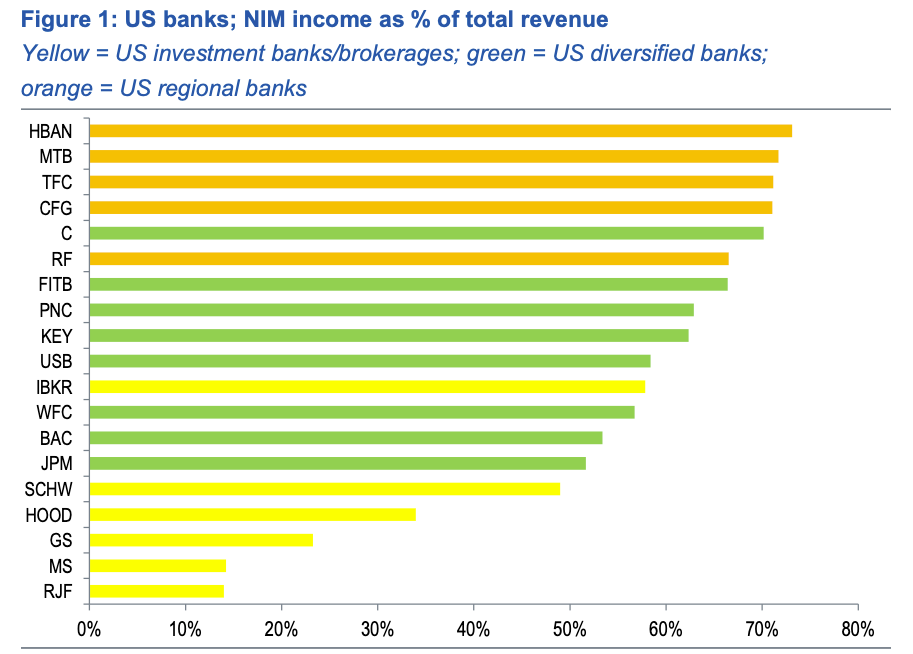
The amount of US bank deposits at risk from stablecoin adoption depends on a number of factors, including the location of issuer’s deposits, domestic versus foreign demand and wholesale versus retail demand, the analyst noted.
Tether and Circle hold just 0.02% and 14.5% of reserves in bank deposits
If stablecoin issuers hold a large share of their deposits in the banking system where the stablecoins are issued, the pressure for bank runs should be reduced, Kendrick wrote, adding:
“The idea is that if a deposit leaves a bank to go into a stablecoin, but the stablecoin issuer holds all of its reserves in bank deposits, there would be no net deposit reduction.”
However, Tether and Circle — the operators of the world’s two largest stablecoins, USDt (USDT) and USDC (USDC) — hold just 0.02% and 14.5% of their reserves in bank deposits, respectively, Kendrick reported, adding: “So very little re-depositing is happening.”
Regarding domestic versus foreign demand, Kendrick concluded that domestic demand drains local bank deposits, while foreign demand does not.
Related: BofA CEO flags $6T bank deposit risk from stablecoin yield
“We estimate that around two-thirds of stablecoin demand comes from emerging markets at present, so one-third comes from developed markets,” he wrote.
He added that, based on a projected $2 trillion market cap, about $500 billion of deposits could leave developed-market banks by end-2028, while roughly $1 trillion could exit emerging-market banks.
Kendrick also said Standard Chartered still expects the CLARITY Act to pass by the end of the first quarter of 2026. He noted that bank-run risks are not limited to stablecoins, but also stem from the “inevitable” expansion of real-world assets.
Magazine: How crypto laws changed in 2025 — and how they’ll change in 2026