For much of this month, bitcoin $BTC$67,852.73 has been trading around the mid-$60,000s. That much is humdrum.
The interesting bit is a developing split in coin ownership that could shape what happens next.
Data from Santiment shows the number of wallets holding less than 0.1 $BTC, a level typically associated with retail investors, has increased by 2.5% since the largest cryptocurrency hit a record high in October. The growth has pushed the so-called shrimps’ share of supply to its highest since mid-2024.
In practice, though, it’s the larger holders known as whales and sharks who tend to set the tone for price direction. Those investors, with wallets holding between 10 and 10,000 $BTC, went the other way, dropping about 0.8%.
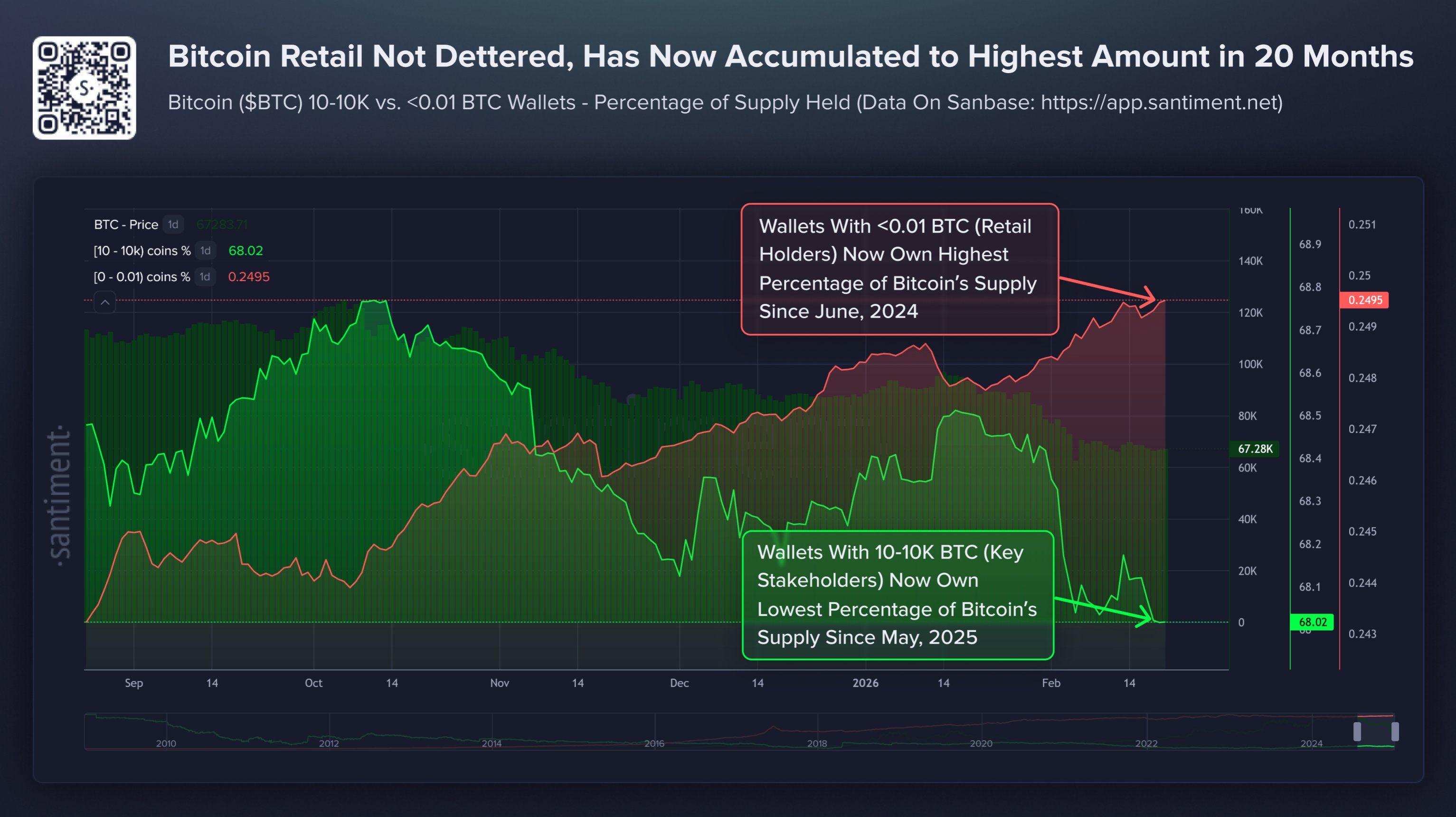
It’s the kind of split that tends to produce choppy, frustrating price action rather than clean trends.
Retail provides a floor and can spark short-term momentum. Rallies that stick require bigger players who are prepared to buy whatever’s on offer.
The divergence is especially notable because the picture looked different just a few weeks ago.
After bitcoin cratered toward $60,000 on Feb. 5 — a drawdown of more than 50% from its October peak — Glassnode’s Accumulation Trend Score climbed to 0.68, the strongest broad-based reading since late November, as CoinDesk reported earlier in the month.
Glassnode’s metric measures the relative strength of accumulation across different wallet sizes by factoring in both entity size and the amount of $BTC accumulated over the past 15 days. A score closer to 1 signals accumulation, while a score closer to 0 indicates distribution.
During the flash, the 10-to-100 $BTC cohort was the most aggressive dip buyer, and the data suggested the market was shifting from capitulation into something more synchronized.
Santiment’s wider lens complicates that reading. Its 10-to-10,000 $BTC band captures a much broader slice of large holders than Glassnode’s dip-buying cohort, and across that full range, net positioning since October is still negative.
One way to reconcile the two takes: mid-sized wallets may have genuinely bought the panic while the largest holders kept distributing into every recovery, dragging the aggregate number down.
It matters because bitcoin doesn’t need retail to show up. Retail is already here.
What it needs is for the distribution from large wallets to stop, or better yet, reverse. Without that, every rally risks being sold into by the very cohort that needs to provide structural demand if it is to succeed.
The shrimps are doing their part. They are waiting for the whales join in.