
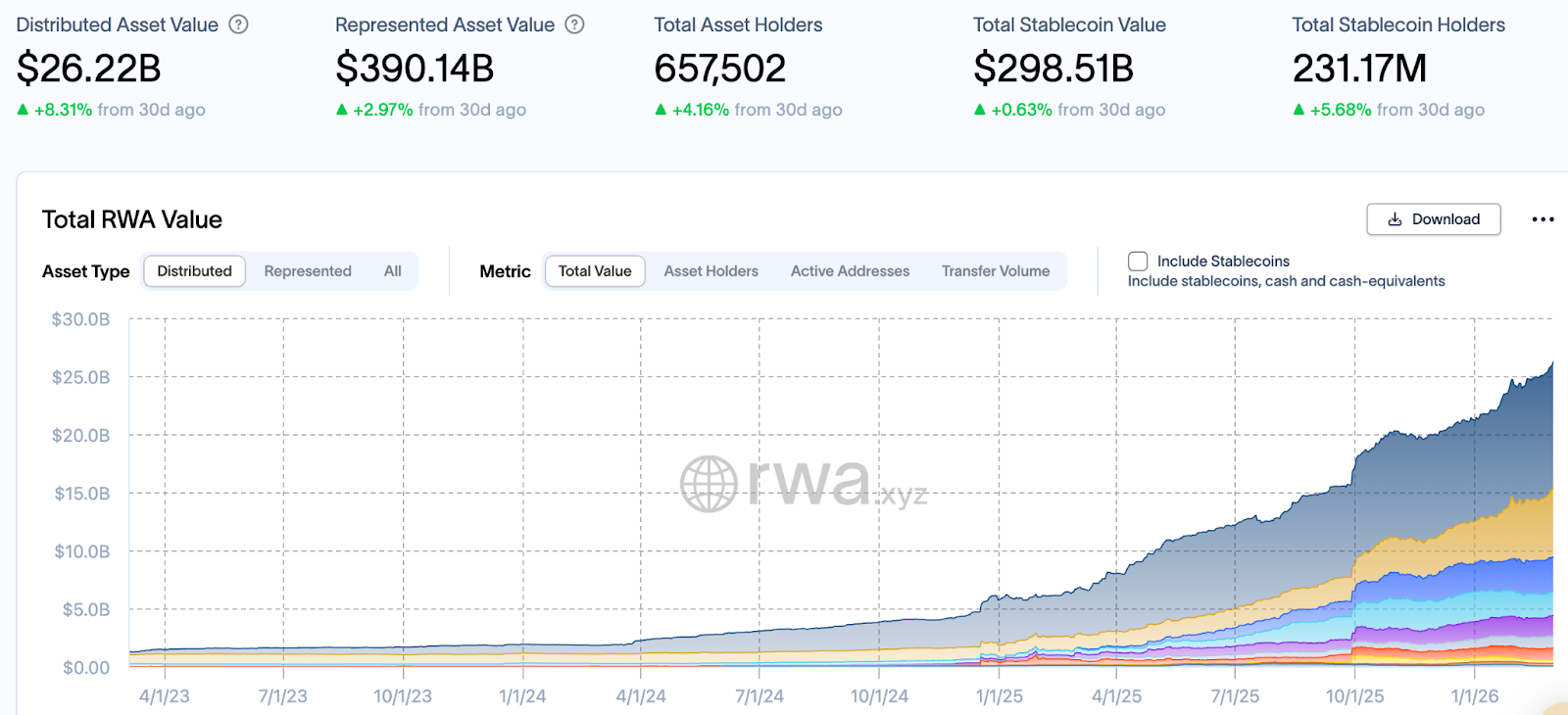
On RWA.xyz’s dashboard, the represented asset value now sits around the $390B range, close enough to the $400B headline to change how the market reads the category.
In two exclusive BeInCrypto interviews, we spoke with Gate Group’s Chief Business Officer and ChangeNOW’s CSO, Pauline Shangett, to understand where RWAs are heading.
Lee describes a move away from experimental, low-demand assets toward instruments with established buyers, transparent pricing, and existing market depth, while Shangett points to a structural change: issuers are increasingly building regulatory alignment and secondary-market considerations into products from the outset rather than treating them as post-launch fixes.
This maturation, highlighted by both interviewees, helps explain why offerings such as BlackRock’s tokenized money market-style fund could launch and immediately resonate with institutional allocators.
Let’s unpack this.
The Catalyst for Change
RWA tokenization is being taken very seriously. But neither Kevin Lee nor Pauline Shangett believes that this shift was triggered by a single technical breakthrough.
Lee rejects the idea of a defining unlock:
“This growth came from a strategic shift in focus toward asset classes with proven demand and deep liquidity. Earlier attempts often centered on niche or alternative assets such as timber plantations, carbon credits, or golf memberships, assuming tokenization alone would generate liquidity. That assumption proved to be premature.”
In his view, the past year marked a change in discipline. Instead of expecting liquidity to emerge from code, the industry refocused on applying on-chain advantages such as round-the-clock access, instant settlement, and asset portability to instruments that already had established markets.
Shangett frames the transition as structural:
“The $400 billion RWA scale-up did not occur because of a single ‘Eureka’ moment. It occurred because three separate, parallel efforts matured simultaneously: Beijing gave RWA a legal passport, QXMP gave hard assets a verifiable on-chain fingerprint, and BlackRock proved that institutional dollars will follow compliant, yield-bearing tokens.”
She continued that the industry largely moved past the “can we digitize this?” phase in 2022-2023. The pilot era proved that assets could be wrapped on-chain, but for a long stretch those tokens sat in a grey zone, constrained by thin liquidity and unresolved regulatory questions – effectively products in search of a market.
In her view, the turning point came when the market stopped funding projects that were technically elegant but structurally untradeable. That washout forced a more disciplined model where liquidity and regulatory approval began to be treated as default steps at issuance and origination, rather than features added after launch.
The Central Tension in RWA 2.0
Tokenizing a bond is straightforward. Making it reliably tradable at any moment is not.
On paper, cross-chain infrastructure is more advanced than ever. Protocols like Chainlink CCIP, Axelar, and LayerZero enable ownership proofs and messaging across networks. This is important for distribution, but movement is not the same thing as depth.
Lee makes the point:
“Liquidity fragmentation will diminish as tokenized assets become increasingly fungible and interoperable across exchanges and protocols.”
In his view, transparent reference pricing naturally attracts market makers and arbitrage capital, which helps compress spreads and unify markets over time.
Shangett underlines the liquidity issue:
“Issuing a token is easy, selling it anytime is the hard part. The main challenge is liquidity.”
Interoperability can prove ownership across chains, she notes, but it does not create buyers. For a token to be reliably sellable, capital has to sit in the order book. Without liquidity rooted in the soil from the beginning, scaling across more chains risks spreading the same illiquidity.
Instant settlement moved risk upstream
One of the most seductive promises in tokenization is speed. Near-instant settlement sounds like the end of counterparty risk and failed trades. However, speed also deletes the informal buffer that traditional markets lean on when something goes wrong.
Lee pushed back on this argument:
“Settlement delays in traditional finance are not intentional safeguards but legacy constraints of outdated infrastructure. In practice, most execution errors are rarely reversible even within traditional settlement windows.”
“Therefore, risk management should always be front-loaded. Pre-trade validation, controls, and safeguards are far more critical than relying on post-trade correction mechanisms, regardless of whether the system is traditional or blockchain-based. Moving at the speed of code simply reinforces the need for stronger pre-execution discipline.”
Shangett reaches the same conclusion from another angle:
“Instant finality is both a benefit and a risk. In traditional finance, there was always a ‘window’ between transaction and settlement to correct mistakes. Blockchain closed that window. But instead of denying the issue, the industry built a new protection architecture. In 2025-2026, we moved from the logic of ‘code is law’ to a model of code with embedded safeguards.”
She describes the industry’s new protection architecture, where:
“Disputed funds are moved into escrow, and an arbiter makes the decision. The original transaction isn’t reversed, a return transaction is created. Immutability remains intact, but a controlled ‘cooling-off’ period is introduced.”
If settlement becomes closer to instantaneous, the system has to become stricter before execution and more explicit about how exceptions are handled after it.
CEXs as Digital Investment Banks
Once tokenized Treasuries and equities sit next to memecoins inside a centralized exchange, the exchange becomes a portfolio layer.
Kevin Lee describes CEXs moving toward integrated financial platforms, where the value proposition is less about listing breadth and more about portfolio construction, capital efficiency, and cross-asset financing. For a user who used to trade memes, the appeal is diversification, steadier yield, and risk tools that simply didn’t exist inside a crypto-only menu.
Shangett’s framing is that the exchange “was a casino,” and now it’s closer to a digital investment bank. The implications are obvious. Tokenized Treasuries make sovereign yield accessible in smaller sizes, and tokenized equities pull crypto users toward the rhythms of traditional markets, only without the old closing bell.
The direction of travel is also showing up in legacy market infrastructure. In January 2026, ICE/NYSE announced it is developing a tokenized securities platform designed to support 24/7 trading of U.S.-listed equities and ETFs (subject to regulatory approval). The SEC, meanwhile, has been explicit that “tokenized securities” are still securities, and that market participants should expect federal securities-law obligations to apply regardless of the kind.
Indeed, the closer tokenized RWAs get to mass distribution, the harder it becomes to treat them as an innovation sandbox. Accessibility invites scrutiny, and RWA 2.0, in practice, is the industry learning to scale under that pressure.
The post RWA 2.0: Coming to a CEX Near You appeared first on BeInCrypto.