Bitcoin is entering a period of uncertainty, as analysts present sharply divergent views on its next move.
While on-chain data points to potential downside risks, institutional research suggests the market may already be stabilizing.
Key Points
- Bitcoin faces conflicting outlooks between bearish on-chain data and bullish institutional research.
- Willy Woo warns of a possible drop to $46,000–$54,000 based on historical on-chain models.
- Weak capital inflows and recent price rejection above $70,000 indicate fading momentum.
- Bearish sentiment is rising, with short positions jumping by more than 52% in two days.
- Some analysts, including Ali Martinez, see further downside toward ~$42,100
- Goldman Sachs suggests Bitcoin may have already bottomed and is entering a consolidation phase.
On-Chain Data Signals Downside Risk
To begin with, leading on-chain analyst Willy Woo recently outlined a cautious outlook based on blockchain data.
In a recent post on X, he suggested Bitcoin could fall into a range between $46,000 and $54,000. This implies a potential decline of roughly 33% from its current level near $67,000.
Woo’s analysis is grounded in historical on-chain behavior, which tracks how investors interact with the network over time. A key component of his framework is the CVDD Floor model, a metric that evaluates long-term holder activity to estimate market bottoms.
According to Woo, this model currently places Bitcoin’s floor around $45,500 and indicates a gradual upward trend.
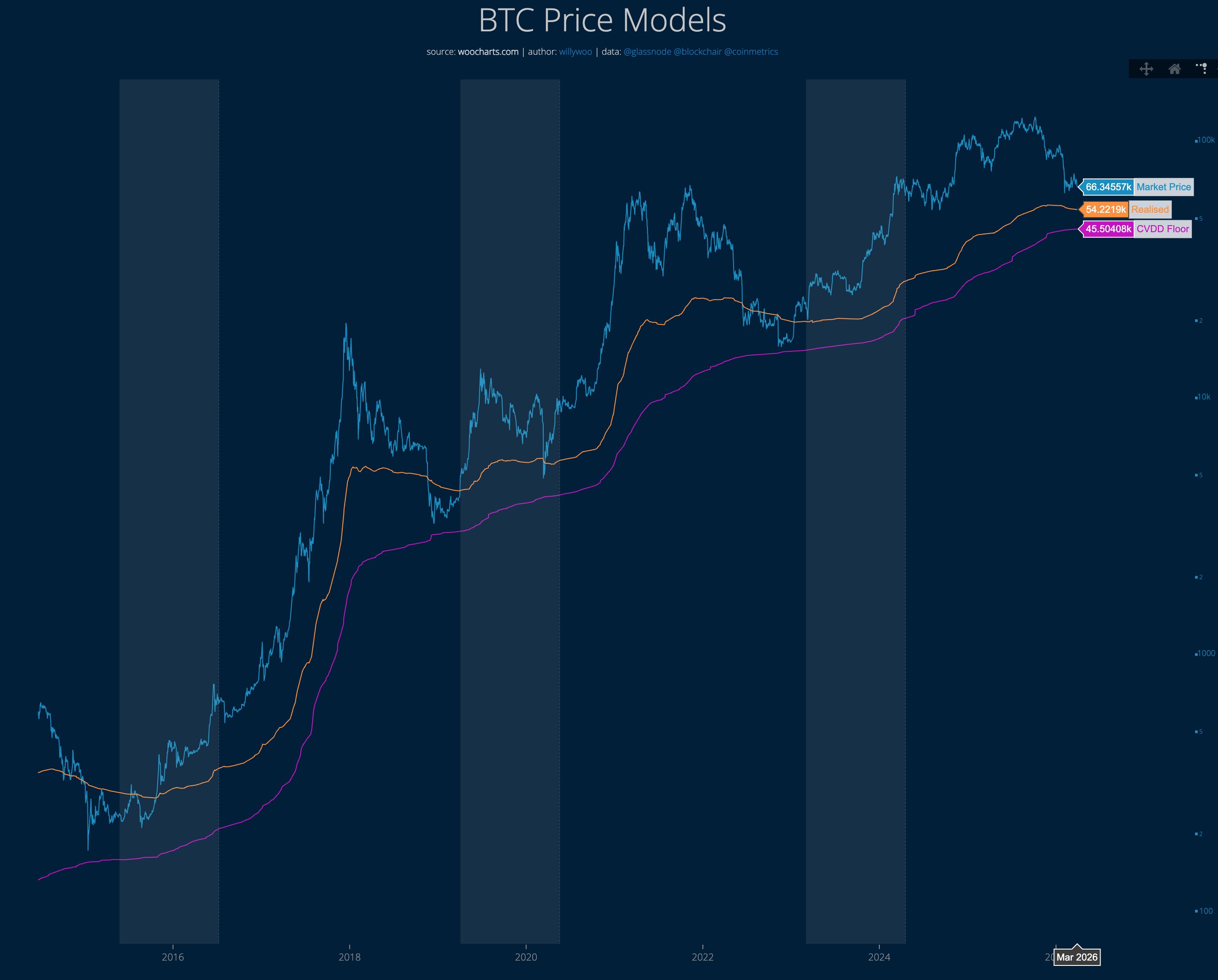
Even so, he emphasized that these models are not foolproof. Bitcoin has gone through only four major downturns, all within broader bullish conditions. As a result, Woo warned that if these patterns fail, the market could enter a deeper and less predictable decline.
Weak Momentum Reflected in Market Data
Building on this cautious outlook, other indicators also suggest weakening momentum. Woo noted that the total capital held in Bitcoin has been declining since November, signaling reduced inflows.
At the same time, recent price action reinforces this trend. Bitcoin struggled to hold above the $70,000 level and quickly lost ground. Last Friday, the price dropped from $71,343 to $65,604 within a few hours.
Since then, the market has remained under pressure. Bitcoin is currently trading around $67,374, marking a weekly decline of about 2%, according to CoinGecko.
Other Analysts and Institutions Offer Mixed Views
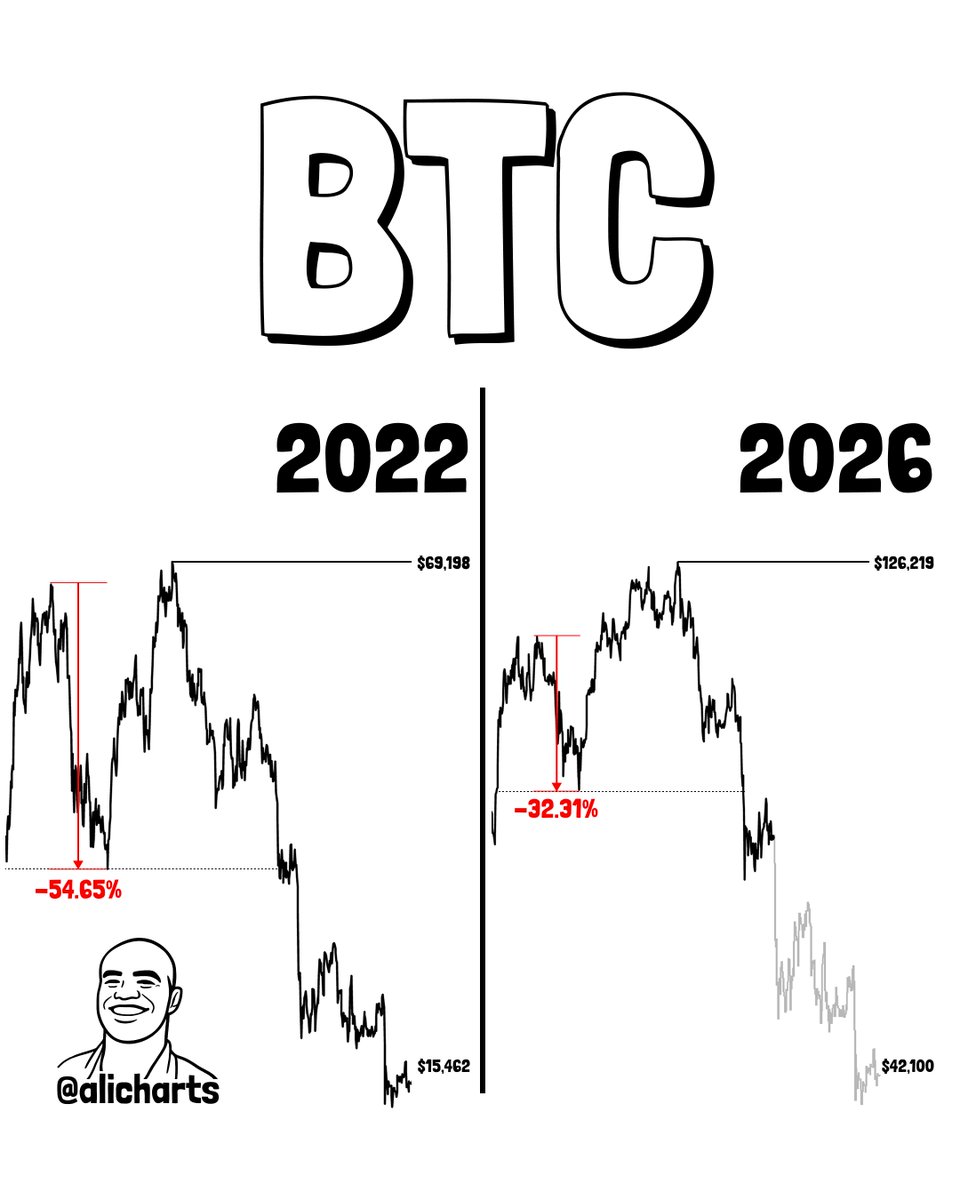
While Woo’s analysis points to downside risk, other experts offer different interpretations. For instance, Ali Martinez believes Bitcoin could fall even further, potentially reaching $42,100.
His projection is based on historical four-year cycles, which often guide long-term market behavior. He also observed that current price patterns resemble those seen in 2022, suggesting the correction may not be over yet.
Meanwhile, market sentiment appears increasingly bearish. Data from Coinglass shows that short positions have surged by more than 52% in just two days.
However, such extreme positioning can sometimes lead to the opposite outcome. If Bitcoin begins to rise, traders betting against it may be forced to buy back in quickly. This could trigger a short squeeze, accelerating upward movement.
Institutional Research Points to Stabilization Phase
In contrast to these bearish signals, institutional research presents a more optimistic scenario. Goldman Sachs recently suggested that Bitcoin may have already reached its cycle bottom at $70,000.
According to the bank, the market could now be entering a consolidation phase rather than continuing its decline. This shift is attributed to easing selling pressure from leveraged traders and improving liquidity across exchanges.
Additionally, early indications of renewed institutional participation point to cautious but growing confidence among larger investors.
Market at a Crossroads
Taken together, these perspectives highlight a market at a critical juncture. Woo’s on-chain analysis signals potential downside, while institutional insights suggest stabilization may already be underway.
With sentiment divided and volatility still elevated, Bitcoin’s near-term direction will likely depend on how these opposing forces evolve in the weeks ahead.