
Following multiple requests from the US Senate Banking Committee for research on stablecoins, the White House Council of Economic Advisers (CEA) has published a study concluding that stablecoins and their yields pose no threat to bank deposits.
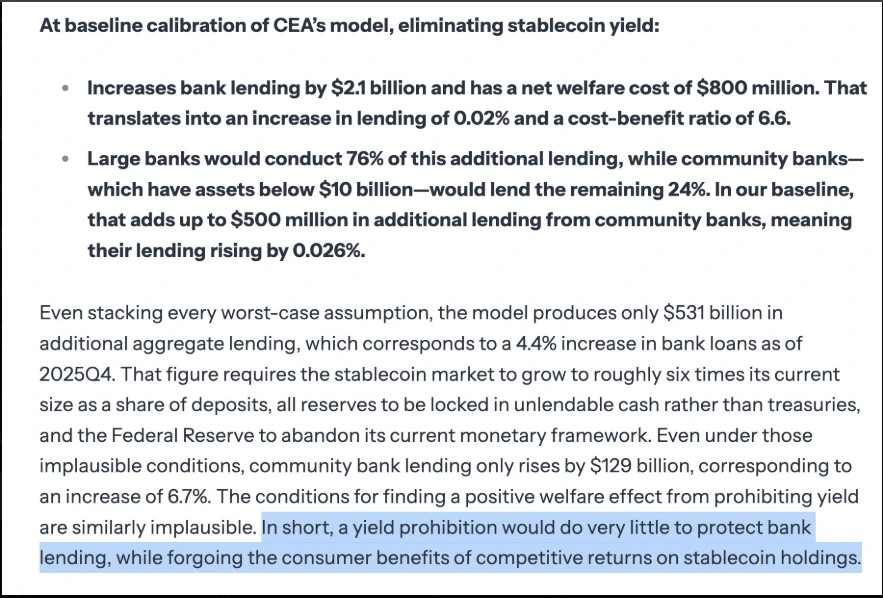
According to the report, eliminating interest on stablecoins would increase banks’ lending capacity by a mere 0.02% (roughly $2.1B), while increasing consumer welfare costs to $800 million.
Stablecoin yields pose negligible threat to bank deposits
The report simulated a worst-case scenario in which the stablecoin market grew to roughly six times its current size, its reserves were non-lendable, and the Federal Reserve renounced its current financial policies.
In such an “implausible” case, bank lending would only grow by 6.7% ($129B). The study also found no case in which welfare was positive with a stablecoin yield ban.
The economists added that fear of “capital flight” from banks was “quantitatively small,” noting that most stablecoin reserves remain within the traditional banking system.
“In short, a yield prohibition would do very little to protect nak lending, while forgoing the consumer benefits of competitive returns on stablecoin holdings.”
Source: whitehouse.gov
Coinbase, banks, and community reaction
Coinbase, a key player in shaping crypto policy, saw its executives strongly support the White House findings. Chief Policy Officer Faryar Shirzad said the report concurred with other previous analyses that also concluded:
“Stablecoins are an opportunity and not a threat.”
The headline says it all:
“White House Economists Say Stablecoin Rewards Won’t Harm Banks” https://t.co/x36Y1lDKrv pic.twitter.com/rZ5iVlNvQi
— Brian Armstrong (@brian_armstrong) April 8, 2026
That said, banks remain unconvinced, according to one insider. The source noted that even when stablecoin reserves return to the bank, they “don’t always come back in the same form.” Additionally, the source noted that stablecoin yields would prompt large outflows from banks, forcing institutions to restructure their entire lending systems to maintain stability.
Community reaction is largely supportive of the White House study, as it legitimizes the global adoption of stablecoins. The research is now a substantial point of reference for the CLARITY Act, which is expected to receive a markup in April and move to Senate voting in May.