Bitcoin flows into exchanges have dropped to levels not seen in over six years, signaling a market that has not allowed uncertainty to shape sentiment.
Rather than panic as prices consolidate, Bitcoin ($BTC) holders are choosing to hold onto their stash. This sentiment is not borne of hype but of a conviction among market investors that the current phase is only temporary and that the premier asset would rebound from the setback.
Key Points
- Inflows to Binance, the largest trading platform globally in terms of trading liquidity, have declined sharply.
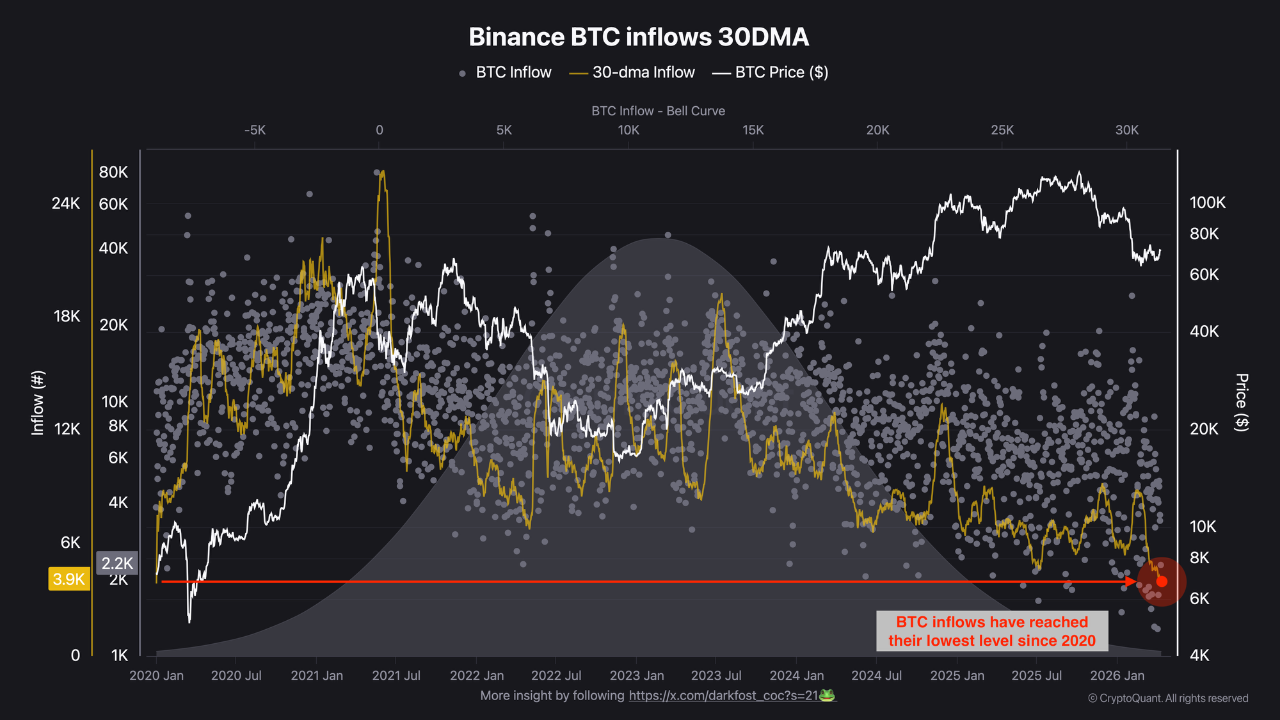
- The 30-day moving average has fallen to around 3,998 $BTC, marking a low last observed over six years ago in 2020.
- What this means is that most holders are not willing to sell their stash, preferring to keep them in self-custody wallets.
- This situation stands in stark contrast to previous periods marked with stress or euphoria.
- Daily inflows on Binance exceeded 19,000 $BTC in July 2023 and surpassed 25,000 $BTC in May 2021, with the historical average sitting near 11,000 $BTC.
- Some capital that flowed through exchanges may now be moving through alternative channels.
Bitcoin Inflow to Exchange Drops
Recent data from CryptoQuant’s verified author, Darkfost, highlighted this disposition. According to the Monday analysis, inflows to Binance, the largest trading platform globally in terms of trading liquidity, have declined sharply.
The 30-day moving average has fallen to around 3,998 $BTC, marking a low comparable to conditions last observed over six years ago in 2020. What this means is that most holders are not willing to sell their stash, keeping them in self-custody wallets for long-term holding rather than on platforms where they can easily sell.
Bitcoin Inflow to Binance Lower Than Historically Normal
Interestingly, this situation stands in stark contrast to previous periods marked with stress or euphoria. Typically, after the market peaks or when macro uncertainties kick in, Bitcoin holders have historically sold more than they do now.
For context, daily inflows on Binance exceeded 19,000 $BTC in July 2023 and surpassed 25,000 $BTC in May 2021. With the historical average sitting near 11,000 $BTC, current deposit levels of 3,988 $BTC are roughly three times lower than typical market conditions.
Notably, this decision to keep assets off platforms is admirable, given the backdrop of global market uncertainties. Geopolitical tension in the Middle East and the United States’ failure to strike a deal with Iran continue to influence oil prices, pressuring the global economy.
Choosing to HODL Bitcoin rather than dump highlights a behavioral shift among market participants, who believe that Bitcoin will make a comeback. Again, this behavior reflects a shift in how participants respond to uncertainty. Rather than selling off quickly amid price swings, many appear to be waiting for a clearer direction before making significant moves, reducing immediate selling pressure.
Structural Changes May Be Influencing Market Flows
Beyond sentiment, structural factors may also be contributing to the trend. Some capital that previously moved directly onto exchanges could now be flowing through alternative channels, including institutional products such as Bitcoin spot exchange-traded funds. This shift reduces the need for exchanges while still allowing users to easily gain exposure or sell their assets.
In essence, these signals suggest that the market is in a phase of waiting rather than a breakdown. While uncertainty remains elevated, the absence of heavy inflows into exchanges suggests that holders are holding relatively steady, with no clear signs of capitulation at this stage.