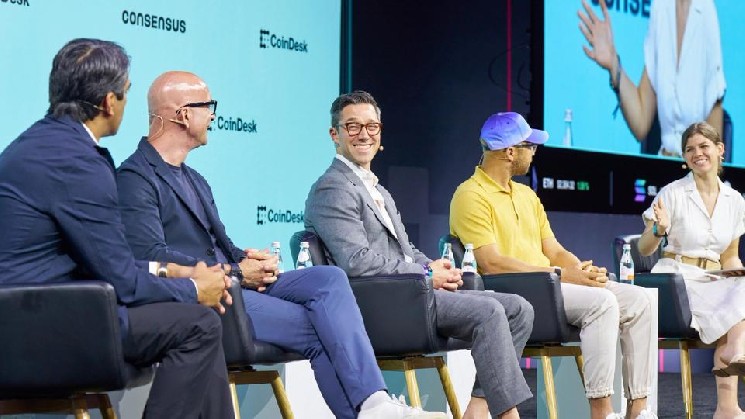
Executives from Intercontinental Exchange (ICE), OKX and Securitize warned that synthetic tokenized stocks are creating market and retail risks, as ICE moves ahead with a regulated platform for tokenized U.S. equities.
Michael Blaugrund, who works on strategic initiatives at ICE, the owner of the New York Stock Exchange (NYSE), said during a panel at Consensus Miami that NYSE’s first version will start with pre-funded tokenized equities trading against stablecoins.
That model is “not the sexiest way” to build a market, Blaugrund said, but gives issuers, investors and regulators a structure they can evaluate before more complex features such as leverage or self-custody.
Carlos Domingo, founder and CEO of Securitize, said offshore tokenized stock products are taking the opposite approach. Some use public-company names without issuer approval and do not represent the underlying equity, he said.
“For some stocks there’s like five different tokenized versions,” Domingo said, citing Coinbase as an example. “None of them actually represent equity on Coinbase.”
The risk is clearest during corporate actions, Domingo said, as he saw one tokenized stock wrapper trade at prices that differed by five times across markets after a stock split.
Haider Rafique, OKX’s global managing partner officer, noted the exchange has not launched synthetic tokenized securities and does not plan to move before regulated supply is in place.
“We’re not selling a promissory note,” Rafique said. “We’re actually selling the underlying asset.”
The warning follows broader scrutiny of stock tokens and private-market exposure. OpenAI said last year that Robinhood’s OpenAI stock tokens did not represent OpenAI equity and were not approved by the company, while Robinhood later said the tokens were backed by a special purpose vehicle.
Domingo said the issue is regulatory arbitrage. Offshore issuers can create wrappers in permissive jurisdictions and claim they are not targeting the U.S. or Europe, he said. Permissionless tokens can still flow back into those markets.
The SEC has also sharpened its focus on the distinction between true tokenized ownership and synthetic exposure, saying issuer approval is required for true tokenized stock ownership.
Blaugrund compared the shift to tokenized securities with the move from floor trading to electronic markets.
“It’s now ‘when,’ not ‘if,’” Blaugrund said.
NYSE said in January it was developing a platform for 24/7 trading and onchain settlement of tokenized U.S.-listed stocks and ETFs, pending regulatory approval. The platform is expected to support fractional trading, immediate settlement and dollar-denominated orders.
ICE later struck a strategic partnership with OKX, giving the crypto exchange’s customers access to ICE futures and NYSE tokenized equities, also subject to approvals.
NYSE also tapped Securitize to help build the tokenized stock platform, with the firm acting as a digital transfer agent for issuer-backed tokenized securities.