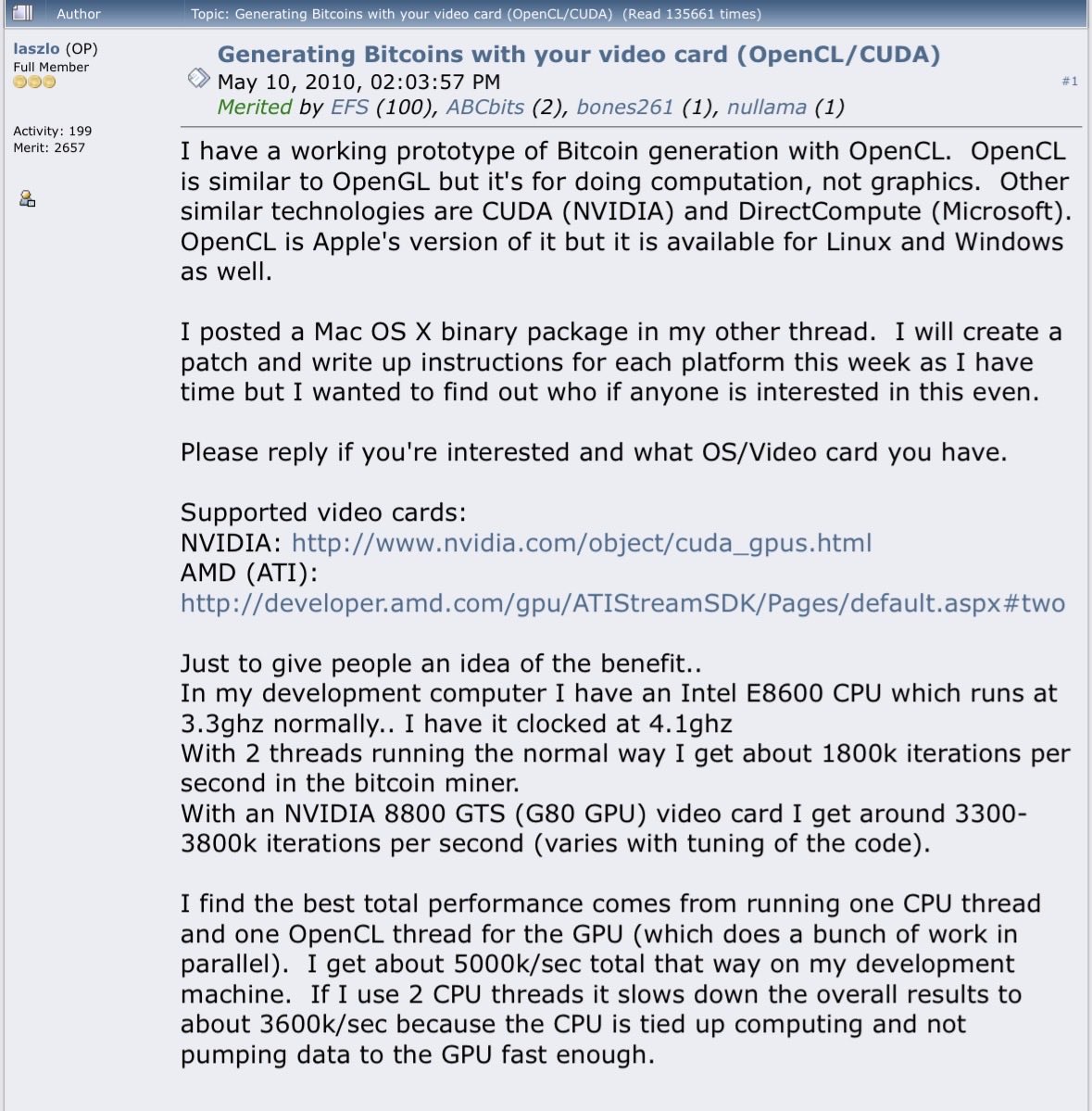
On May 10, 2010, developer Laszlo Hanyecz published a post on the Bitcointalk forum explaining how to mine Bitcoin using an NVIDIA 8800 GTS graphics card instead of a CPU. Today marks exactly 16 years since that publication that helped drive the network’s hash rate up by 130,000% by the end of the same year.
However, this historical moment is interesting from a very different angle too, as it became the first point of conceptual division in Bitcoin’s philosophy and stripped the project of its original “democratic” nature.
In mainstream culture, Laszlo Hanyecz is known as the man who invented GPU mining and later bought two pizzas for 10,000 $BTC. What often remains behind the scenes, however, is the reaction of Satoshi Nakamoto.
After learning about Laszlo’s success, Satoshi personally asked him to slow down the popularization of the method because he viewed Bitcoin as a system of “one CPU, one vote,” where anyone with a home computer could support the network and receive rewards.
Why Bitcoin’s biggest upgrade worried its creator
The transition to graphics cards instantly destroyed that balance because ordinary PC users lost virtually any chance of mining a block, and mining turned from ideological support for the network into a hardware arms race. That was the moment $BTC began concentrating in the hands of those who could afford expensive graphics chips.
From a technical perspective, Laszlo simply optimized the code for OpenCL and CUDA architecture. His own post showed the exact scale of the jump using a single home machine as an example:
- An Intel E8600 processor, even overclocked to 4.1 GHz, produced only 1.8 million hashes per second.
- A single NVIDIA 8800 GTS graphics card produced up to 3.8 million hashes per second.
The combination of CPU and GPU allowed Hanyecz to capture a substantial share of the network’s blocks, mining thousands of coins per day on a single computer.
16 years since, common sense dictates that Hanyecz’s invention did not “break” Bitcoin, but it accelerated its maturation as without the transition to GPU mining, the network likely would not have survived the later influx of users or defended itself against potential attacks.