TLDR:
- Market vision: A Stripe report cited in the ecosystem projects that the Artificial Intelligence agent economy will require 1 billion transactions per second globally.
- Current infrastructure: No operational blockchain network in today’s market processes a volume anywhere near the demand estimated by the tech industry.
- Technical launch: Mysten Labs projects the release of a software development kit (SDK) designed to enable on-chain payments with no transaction costs.
The co-founder and Chief Product Officer of Mysten Labs, Eman Abio, stated that the foundational economic design assumptions in the crypto industry have structural flaws and explained how the Sui network aims to replace such models.
AI agents will automate everything in crypto. Payments. Wallets. On-chain activity.@EmanAbio breaks down why @SuiNetwork is making payments free:
“The idea of wallets is nonsensical. The idea of gas is nonsensical. Moving money should be free.”
How AI changes crypto adoption… pic.twitter.com/OzHtSPRVke
— New Era Finance Podcast (@new_era_finance) May 25, 2026
During a recent interview with analyst Michaël van de Poppe, the executive assured that transaction fees currently limit growth on a global scale.
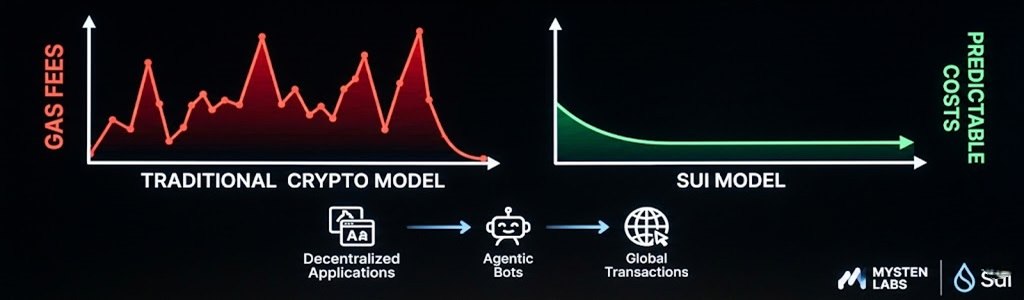
The Structural Problem of Gas Fees
In his statements, Abio compares current gas fee markets to the dynamic pricing model of private ride-hailing platforms. He argued that when a user transfers funds to an acquaintance and must compete in the same fee rate against high-frequency traders, the pricing mechanism does not discriminate by the type of activity. Data from Mysten Labs reveals that this drives up the cost of network usage based on external saturation rather than the actual value of the executed service.
The firm’s analysis indicates that traditional internet platforms, such as search engines, scale their infrastructure based on physical resources and do not increase direct costs for individual searches during global demand peaks.
The traditional concept of wallets and gas charging is presented as a temporary engineering workaround due to the lack of structural scalability in first- and second-generation protocols.
The Mysten Labs team, composed at its core of engineers with prior experience developing large-scale search and connectivity infrastructure at corporations like Google and Meta, bases its approach on the abundant provisioning of hardware. Historical data from these tech firms reflects an initial design oriented toward supporting billions of active users rather than mitigating scarcity through economic barriers.
Fee-Free Payments and AI Automation
A recent report from the network details the integration of solutions for deploying Artificial Intelligence agents. The company’s technical projection estimates that the majority of internet traffic will migrate toward automated systems that will require massive processing speeds.
To address this milestone, the release of a free payment SDK on the Sui network is projected for the year 2026. This technical tool could allow developers to integrate on-chain transactions without cost restrictions for automated operations.
The operational viability of this free model will depend directly on the nodes’ capacity to dynamically add hardware as demand increases on the network. Monitoring adoption metrics and processing speed on the testnet will validate the performance of this data architecture against the real workload of autonomous agents.