
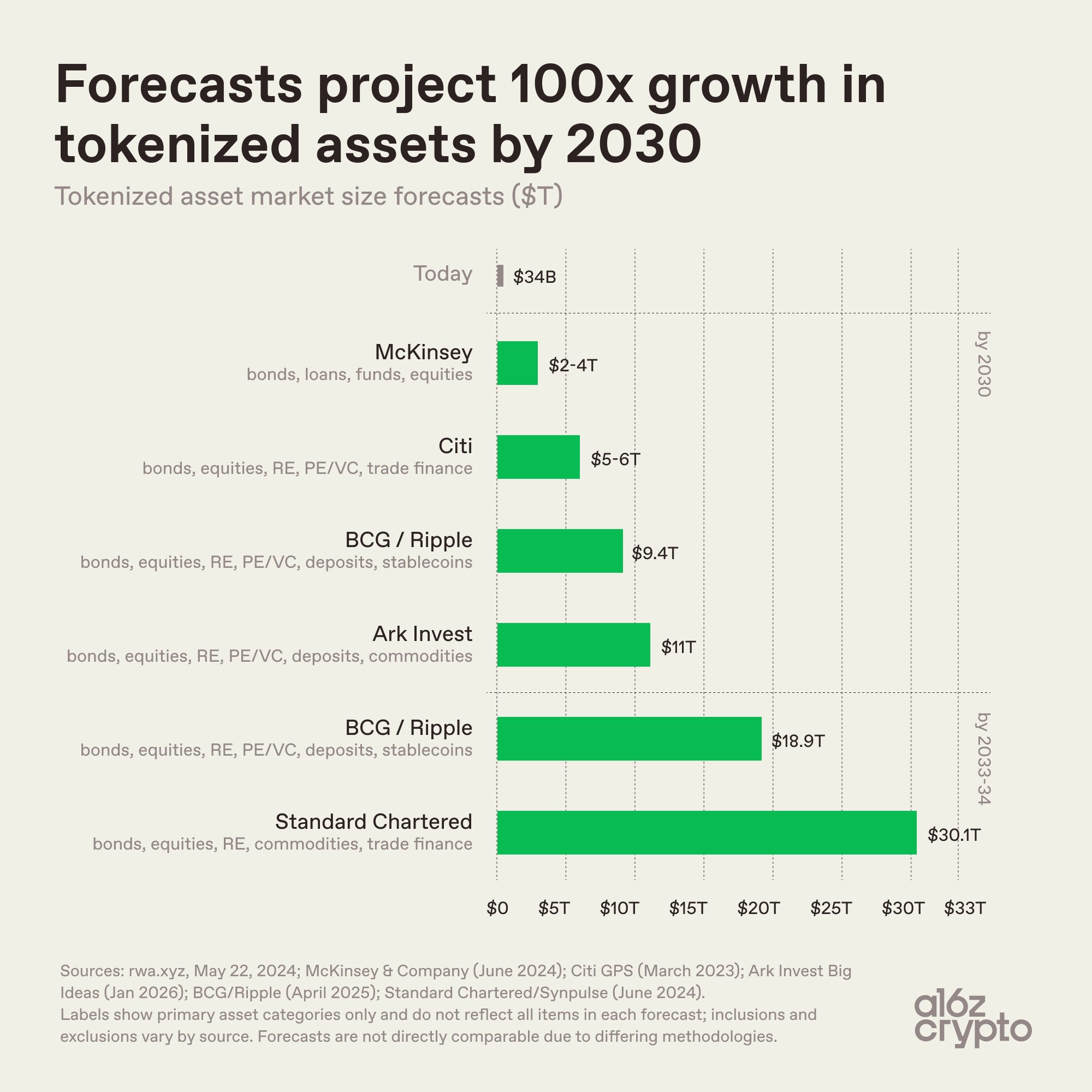
Leading RWA platform Securitize has officially stated that a fundamental transformation of global finance is inevitable, forecasting a 100x growth of the tokenization industry from its current $34 billion level. As the main benchmark for this move, Securitize highlighted a joint study by Ripple and Boston Consulting Group (BCG), according to which the total volume of digitized assets will reach $18.9 trillion by 2033.
This expansion looks logical, since Ripple originally built the tokenization of the money layer into its model – stablecoins, settlement tokens, and interbank deposits – moving away from McKinsey’s more conservative estimates of $2 trillion to $4 trillion.
Ripple builds money layer on $XRP Ledger
This is exactly the settlement sector that the company is taking under its technological control, having deployed institutional stablecoin Ripple USD ($RLUSD), whose capitalization has already reached $1.74 billion, with monthly transfer volume at $14.31 billion.
Moreover, Ripple owns the underlying rails, as XRPL handles the backend for Ripple, already processing billions of dollars across 302 active RWA projects, while the total volume of assets represented on the chain has grown to $3.69 billion.
All this institutional capital is distributed on the Ripple-linked blockchain across two key directions:
- U.S. Treasury bonds: Conservative Wall Street funds have chosen $XRP Ledger as a base fiat anchor, with Ondo Short-Term U.S. Government Bond Fund leading the segment at $293.9 million.
- Premium real estate: The blockchain has become a key technological rail for digitizing commercial space in the UAE, allowing major properties in Dubai — Executive Residences, PRIVE BY DAMAC, and Park Ridge — to be successfully traded on-chain in fractions.
Securitize’s forecast simply highlights the pragmatic division of labor in RWA: some issuers create the tokens themselves, while others provide them with liquidity. Ripple does not issue bonds or funds, but its $RLUSD stablecoin and XRPL network solve the main technical pain point for issuers – they are positioned for instant settlement and clearing for these trillion-dollar TradFi flows.