Corporate blockchains are multiplying, but Coinbase CEO Brian Armstrong expects the boom to end in consolidation rather than coexistence.
Over the past year, several corporate institutions and Wall Street giants, including Stripe, Circle, and Robinhood, have developed rails for stablecoins and institutional markets.
Their expansion has revived concern that regulated companies with established distribution could draw financial activity away from the permissionless networks that powered crypto’s growth.
However, Armstrong views the proliferation differently, as he expects the new launches to fragment liquidity and users before network effects force weaker platforms to combine or retreat.
Corporate chains are already finding users
The threat to public networks is gaining credibility because companies are building chains around businesses and customers they already control.
VanEck Research said banks, exchanges and payment firms can use proprietary networks to control validators and participation, protect sensitive information, guarantee costs and retain fees that would otherwise accrue to public blockchains.
For context, Stripe’s Tempo is focused on payments, Circle’s Arc on stablecoin settlement, and Robinhood Chain on tokenized securities.
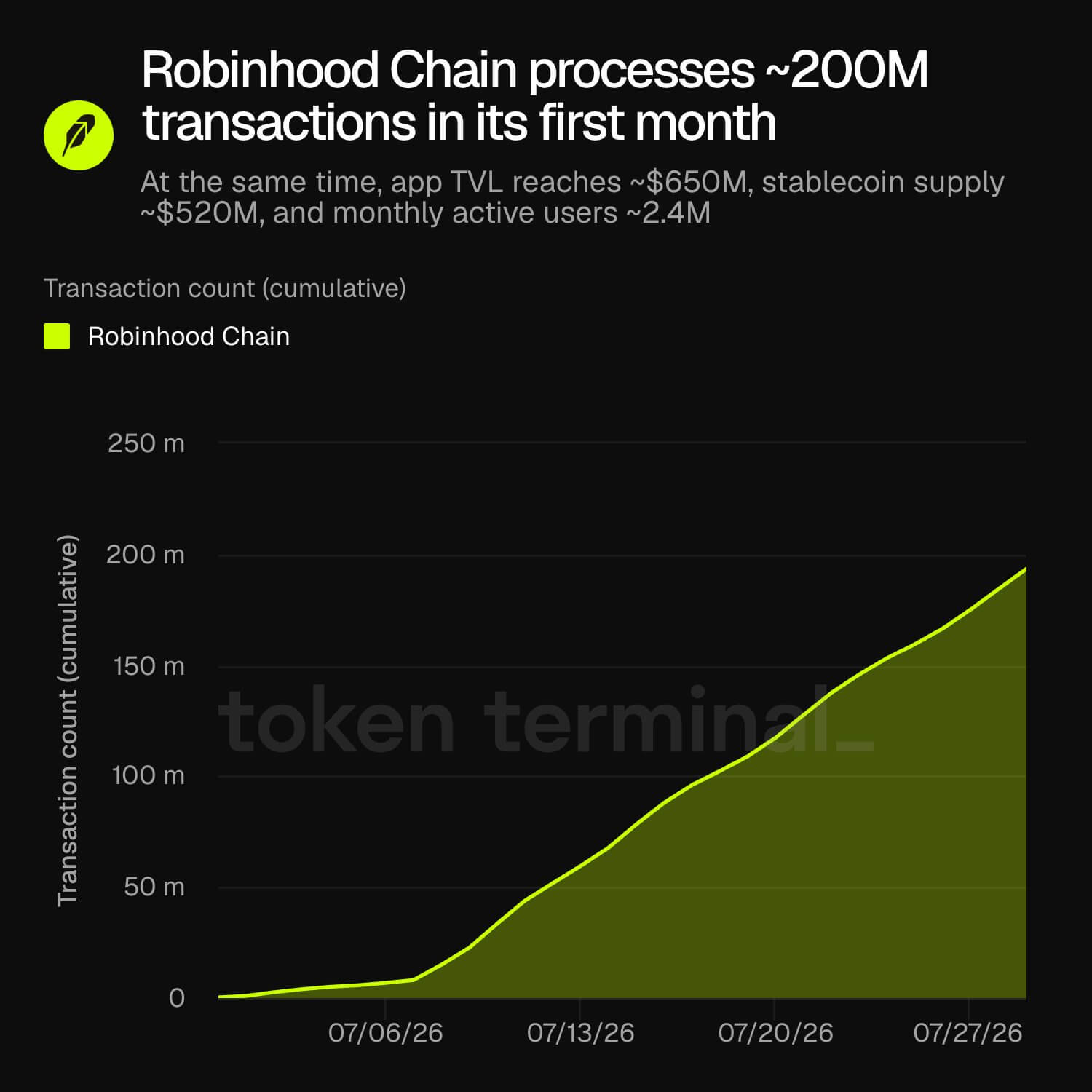
Robinhood Chain’s early performance shows the advantage of launching with an established distribution network.
Token Terminal data shows the network processed roughly 200 million transactions in its first month, while applications built on it attracted about $650 million in total value locked. Its stablecoin supply reached approximately $520 million, alongside 2.4 million monthly active users.
However, that traction does not guarantee the expanding field can sustain more than 100 networks.
L2Beat tracks 110 Ethereum scaling projects, including 22 rollups, seven validiums and optimiums, and 81 other systems.
Data from the platform shows that only 24 of these networks were processing more than two user operations per second as of July 31. Activity fell below one operation per second by the 32nd-ranked network, leaving most of the landscape far behind a relatively small group of chains.
Some of those networks serve narrow applications or remain early in development. The divide nevertheless demonstrates that deploying a chain is easier than attracting lasting liquidity, developers and users.
During the exchange’s earnings call, Armstrong said he expects corporate networks to encounter the same pressure. He compared their proliferation with the stablecoin market, where numerous companies introduced dollar-linked tokens but activity concentrated around Tether and $USDC.
According to him, some specialized chains may remain independent. However, others could eventually decide that the cost of maintaining separate infrastructure exceeds the value of controlling it.
Armstrong said that transition could require an “M&A-type process” for blockchains and suggested Coinbase may need to become a specialist in the area. He did not identify targets or disclose an acquisition program.
His comments instead showed that Coinbase is looking beyond the launch cycle to the contest over which networks retain enough activity to survive it.
Control creates the next fault line
Meanwhile, scale will not be the only factor separating the survivors because the control corporate chains offer can also limit their neutrality.
Omid Malekan, an adjunct professor at Columbia Business School, argues that Bitcoin’s defining innovation was replacing an identifiable payment operator with rules enforced by an open protocol. Miners voluntarily process transactions under those rules and cannot individually rewrite the ledger or permanently block a valid payment.
Permissioned networks create a different relationship. Validators are known, selected by an operator and potentially removable, giving the sponsoring company or consortium practical influence over how the system behaves.
He noted that Tempo illustrates that trade-off. Its documentation says the network is intended to become permissionless and decentralized, but management of its active validator set remains permissioned by the Tempo team.
Malekan argues that an identifiable gatekeeper could be pressured to censor transactions, reverse activity, or halt the network because it can coordinate those decisions. A validator on a sufficiently decentralized network can more credibly argue that the protocol, rather than any participant, controls settlement.
Regulated companies may deliberately accept that exposure. Permissioning gives them the privacy, compliance controls and accountable counterparties needed to move securities and institutional assets onchain. VanEck regards those features as central advantages of corporate blockchains.
The same structure can make a network harder for competitors to trust. A company considering whether to abandon its own chain will care about liquidity and distribution, but it may also resist placing critical activity under rules a rival can change.
Malekan stated:
“All of that wrangling is why every other attempt at building a permissioned chain, despite the honest attempts of really smart people and the investment of countless millions, has ended in total disaster.”
A Base token could widen Coinbase’s lead
But Coinbase is trying to resolve that conflict before the consolidation phase begins.
Armstrong said Base, its layer-2 Ethereum blockchain network, has accumulated a roughly two-year head start and processed about $32 trillion in stablecoin transfers during the previous 12 months. Coinbase wants other companies to treat the network as neutral infrastructure rather than an extension of its exchange.
Chief Financial Officer Alesia Haas said the company is working toward deeper decentralization and continues to explore a Base token. Coinbase has not disclosed a launch date, distribution model or the rights the asset would give holders.
Haas said the company has one opportunity to design the token correctly. Base has meanwhile advanced its technical roadmap through the Azul and Beryl upgrades, which improved its security, scaling and path toward decentralization.
The token could therefore serve a more strategic purpose than rewarding early users.
A design that distributes governance or validation power could reduce Coinbase’s control and make Base more credible to companies reconsidering their own networks.
While migrating onto infrastructure controlled by a direct competitor would create commercial risk, joining a network governed by a broader group could present a different calculation.
Coinbase has not confirmed that the token will carry governance rights or materially reduce its influence. Linking the exploration to Base’s decentralization work nevertheless suggests neutrality is part of the design problem.
That decision could become as important as Base’s existing scale. Coinbase can supply exchange users, institutional relationships, $USDC liquidity and product integrations that newer chains must build independently. Greater decentralization could add the credibility needed to convert those advantages into shared infrastructure.
Armstrong’s consolidation scenario would not require Coinbase to buy every struggling network. Companies could migrate applications, share settlement infrastructure, or preserve their customer-facing products while abandoning separate execution layers.