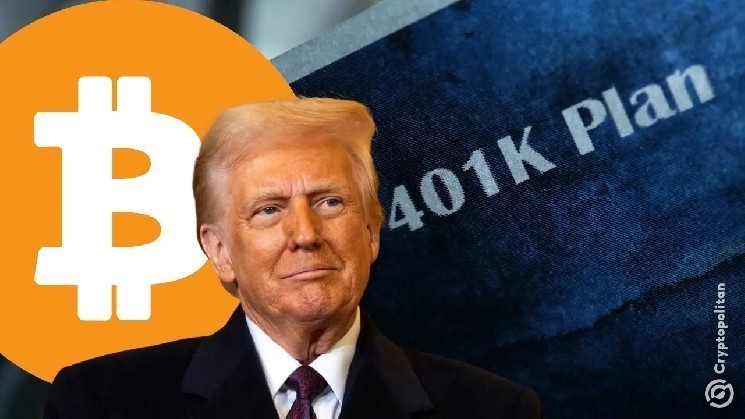
The White House moved this week to push crypto into retirement investing after President Donald Trump signed an executive order allowing 401(k) plans to include alternative assets.
The directive will expand how Americans invest for retirement and potentially give bitcoin and other cryptocurrencies a stronger role in long-term portfolios. But this change will not roll out quickly, and analysts say it faces major hurdles before most savers ever see it in their accounts.
Under the order, retirement plans could one day allow holdings in assets like bitcoin, which has seen growing institutional demand since U.S. bitcoin ETFs launched last year. The potential is there for crypto to become part of mainstream retirement investing.
But even with Trump’s approval, that doesn’t mean employers will suddenly add BONK, Pudgy Penguins, or other meme coins to employee investment menus. Doug Boneparth, certified financial planner and founder of Bone Fide Wealth, said it was notable to see “digital assets getting presidential-level attention,” but stressed “the reality is a lot more nuanced.”
Employers face legal and risk hurdles before adding crypto
The Employee Retirement Income Security Act of 1974 (ERISA) governs how retirement plans are managed, and any major change in investment options requires careful review and agreement from plan sponsors. These sponsors carry fiduciary responsibilities, meaning they must run the plan in the best interest of participants and comply with ERISA. That makes it harder to add volatile, still-developing assets like crypto.
Fidelity broke new ground in 2022 as the first major provider to give savers the option to put bitcoin in their 401(k)s, but Doug said whether employees could use it “came down to employers’ risk tolerance and fiduciary responsibility.” That’s not going to shift immediately because of an executive order.
Preston Cherry, certified financial planner and founder of Concurrent Financial Planning, warned that too many investment choices can backfire. “People become overwhelmed with the investment menu options,” he said, adding that this often leads to lower participation.
Even when employers offer education on these investments, workers have to opt in to receive it, and Preston said participation rates “are typically low.”
He also questioned how employers will decide which coins are allowed. Separating bitcoin, ether, and Solana from the rest of the crypto market requires oversight from an investment committee or plan sponsor.
Without it, employees could end up exposed to coins with extreme price swings. Preston pointed out that many people “can’t understand 30%, 40%, 50% drawdowns – and it could be destructive.” While he’s not against crypto in retirement accounts, he urged investors to “be crypto cautious.”
Plan providers and recordkeepers will control final decisions
Even if employers are willing to add crypto, the choice may ultimately rest with plan providers and recordkeepers. U.S. retirement accounts held $43 trillion in assets in the first quarter, with about $9 trillion in 401(k)s.
By comparison, the entire crypto market is worth nearly $4 trillion. Integrating the two is a huge step, and companies controlling plan infrastructure will decide whether it’s worth the operational and regulatory challenges.
Trump’s order follows other administration moves to promote U.S. dominance in crypto. In July, he signed the GENIUS Act, the first U.S. law for stablecoins. The Securities and Exchange Commission has also launched Project Crypto, aimed at updating securities rules for crypto-based trading.
Tyrone Ross, CEO of registered investment advisor 401 Financial, said, “The plan providers, the third-party providers, the recordkeepers, are going to decide the end result here, if they want to put crypto in or not.”
He added that while the administration is committed to making the U.S. the global crypto hub, major firms like Fidelity, Schwab, MassMutual, and Vanguard may not rush to implement the change.
Doug agreed that the executive order is “more symbolic than structural right now.” But he also said it opens a door for education in the retirement space. While he believes bitcoin has a long-term place in a diversified portfolio, he emphasized that fiduciaries must weigh opportunity and risk before offering it.
“If we do this right, the door opens a little wider to the future of retirement investing,” Doug said. “If we don’t? Well then, who knows what meme coin we’re going to see on a retirement plan statement.”