Raphael Zagury, the newly appointed CEO of Bitcoin-focused public company Twenty One Capital, says the premium-funded model behind Bitcoin treasury firms cannot provide easy returns forever. His answer is to build cash-generating businesses around the company’s $BTC balance sheet.
In a July 22 fireside chat furnished to the SEC, Zagury described issuing shares above the net asset value of a company’s Bitcoin holdings and using the proceeds to buy more $BTC as a temporary market dislocation. As more companies copy the strategy, he said, their market-value premiums should converge toward 1x.
“There’s no free money forever,” Zagury said. The premium could return, he added, but it should not remain the only source of shareholder returns.

Twenty One had already outlined an operating-company model in May. Its refreshed priorities now include buying or building operating businesses, expanding capital-markets capabilities, developing Bitcoin-backed financial products and creating a Bitcoin-native lending platform. Prospective acquisitions must be accretive when measured against Bitcoin.
The shift coincides with a leadership reset. Zagury became CEO effective July 20 after Jack Mallers resigned as chief executive and director. The company said Mallers’ exit was unrelated to any disagreement and that he would focus on Strike. Twenty One is no longer pursuing a combination with Strike.
Zagury used mining to illustrate the proposed return engine. He compared its potential cash generation with the role insurance played in Berkshire Hathaway’s capital-allocation model, supplying funds that could be reinvested across a portfolio. He also said Twenty One had not yet built such a model and that execution would be difficult.
Asked whether Twenty One was trying to outperform Bitcoin, Zagury initially agreed, then qualified that answer. Matching Bitcoin’s value with lower volatility could still be a good result, he said, while beating $BTC over the long term would require exceptional opportunities or irresponsible leverage. He framed mining and other operating businesses as a route to better risk-adjusted returns and said shareholder value should be measured in Bitcoin terms.
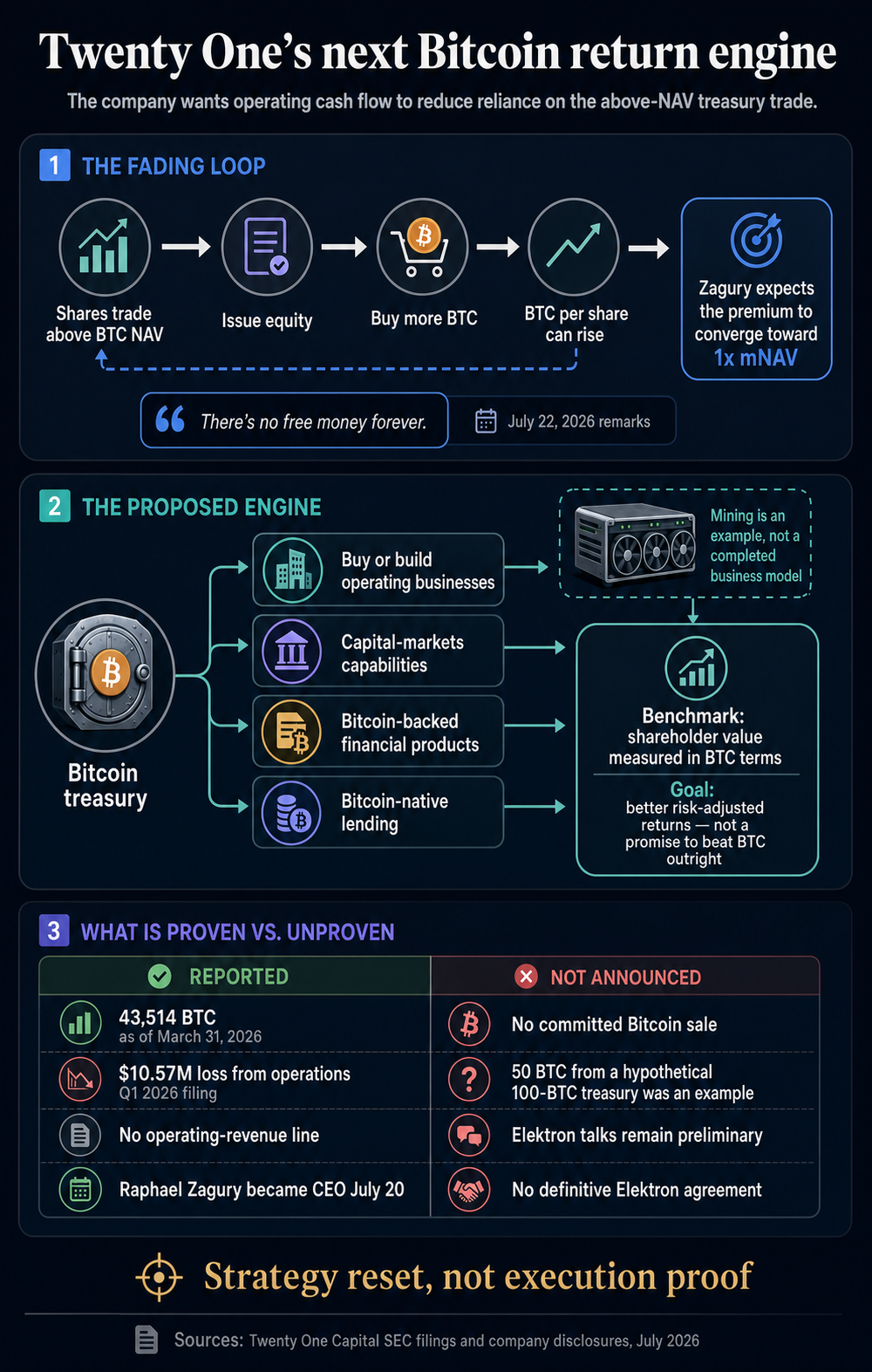
Twenty One’s first-quarter filing reported 43,514 $BTC as of March 31. The same filing presented no operating-revenue line and reported a $10.57 million loss from operations, meaning the planned cash-flow engine had not yet appeared in reported results.

Zagury’s discussion of using treasury assets did not announce a sale. His example of exchanging 50 $BTC from a hypothetical 100-$BTC treasury for a cash-generating company was explicitly hypothetical. A possible combination with Elektron Energy, the mining business whose management team he leads, remains preliminary, with no definitive agreement or assurance that a deal will be approved.
Twenty One has therefore set a harder benchmark than accumulating Bitcoin through share issuance: building businesses that can improve returns on a Bitcoin basis. Whether those businesses can deliver better risk-adjusted returns remains an unproven strategy rather than a reported result.