Saylor Pushes Back on Viral Bitcoin Sale Claim
Strategy Executive Chairman Michael Saylor pushed back Aug. 1 on reports that Strategy Inc. (Nasdaq: MSTR) had newly authorized up to $5 billion in bitcoin sales. His response followed a widely circulated social media post that presented the company’s existing capital-management framework as a fresh decision, prompting concern about potential selling pressure.
Saylor characterized the claim as recycled information and explained that the authorization was announced June 29 as part of the company’s Digital Credit Capital Framework. He reiterated that the program permits bitcoin sales for defined corporate purposes and that Strategy had announced no additional bitcoin sale authorization.
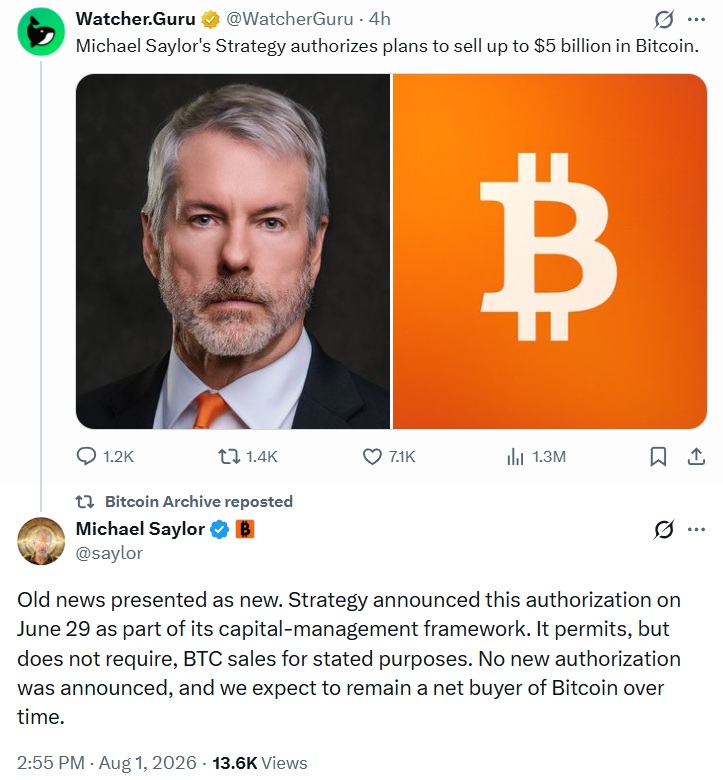
Filing Shows How the Program Operates
A July 6 filing with the U.S. Securities and Exchange Commission (SEC) recorded 3,588 bitcoin sold for $216 million between June 29 and July 5, following Strategy’s first bitcoin sale since 2022 of 32 $BTC to help fund preferred-stock dividend payments. It later issued $263.5 million in common stock without purchasing additional bitcoin, opting instead to increase cash reserves and liquidity. Those actions reflected the company’s broader effort to balance bitcoin holdings with funding requirements tied to its growing portfolio of preferred securities.
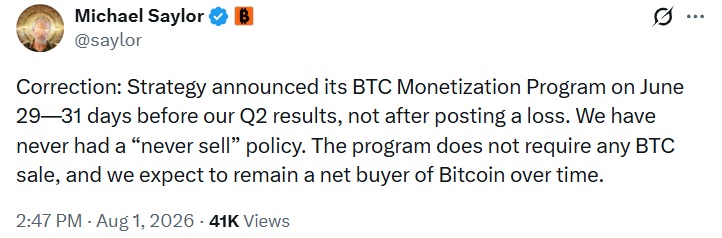
In another X post on Aug. 1, Saylor clarified that Strategy announced the $BTC Monetization Program on June 29, 31 days before reporting its second-quarter results, rather than after posting a quarterly loss. He added that Strategy has never maintained a “never sell” policy, the program requires no bitcoin sales, and the company expects to remain a net buyer over time.
Under the framework, management retains $1.25 billion in unused reserve-building capacity and may direct bitcoin sale proceeds toward dividends, interest, repurchases, taxes, fees, and transaction expenses. Analysts have argued that this flexibility could lower the risk of forced sales during periods of financial or market pressure.
Investors Debate the Framework’s Shareholder Impact
Market observers remain divided over the structure. Supporters view it as a way to preserve liquidity and meet obligations without relying on hurried bitcoin disposals, while critics warn that supporting STRC near its $100 target could place added costs on common shareholders through higher dividends or further asset sales.
The June framework remains unchanged and authorizes sales only for specified corporate purposes. It has no fixed expiration date, and management may modify, suspend, or terminate it as market conditions, liquidity requirements, and corporate priorities change.
Any sale outside the framework’s approved purposes or established limits would require additional authorization from the company’s board.