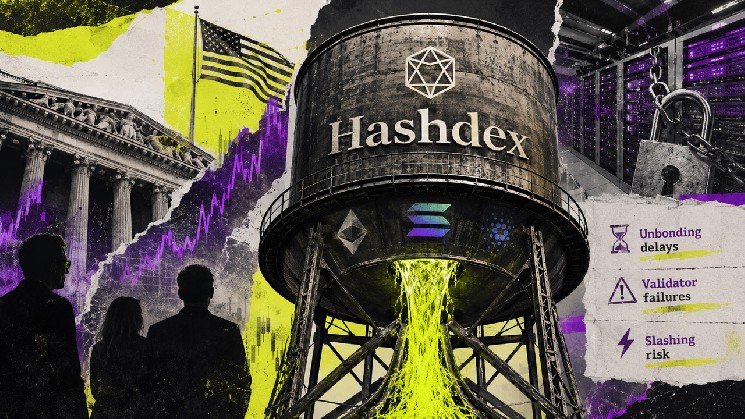
Hashdex plans to put some of the crypto held by its Nasdaq CME Crypto Index ETF (NCIQ) to work through staking. The sponsor takes the first slice of net income, while common shareholders begin sharing in the rewards after an annual threshold is cleared.
The framework is prospective. A July 23 Form 8-K named Coinbase Cloud as the initial provider and said staking was expected to begin promptly, subject to operational readiness.
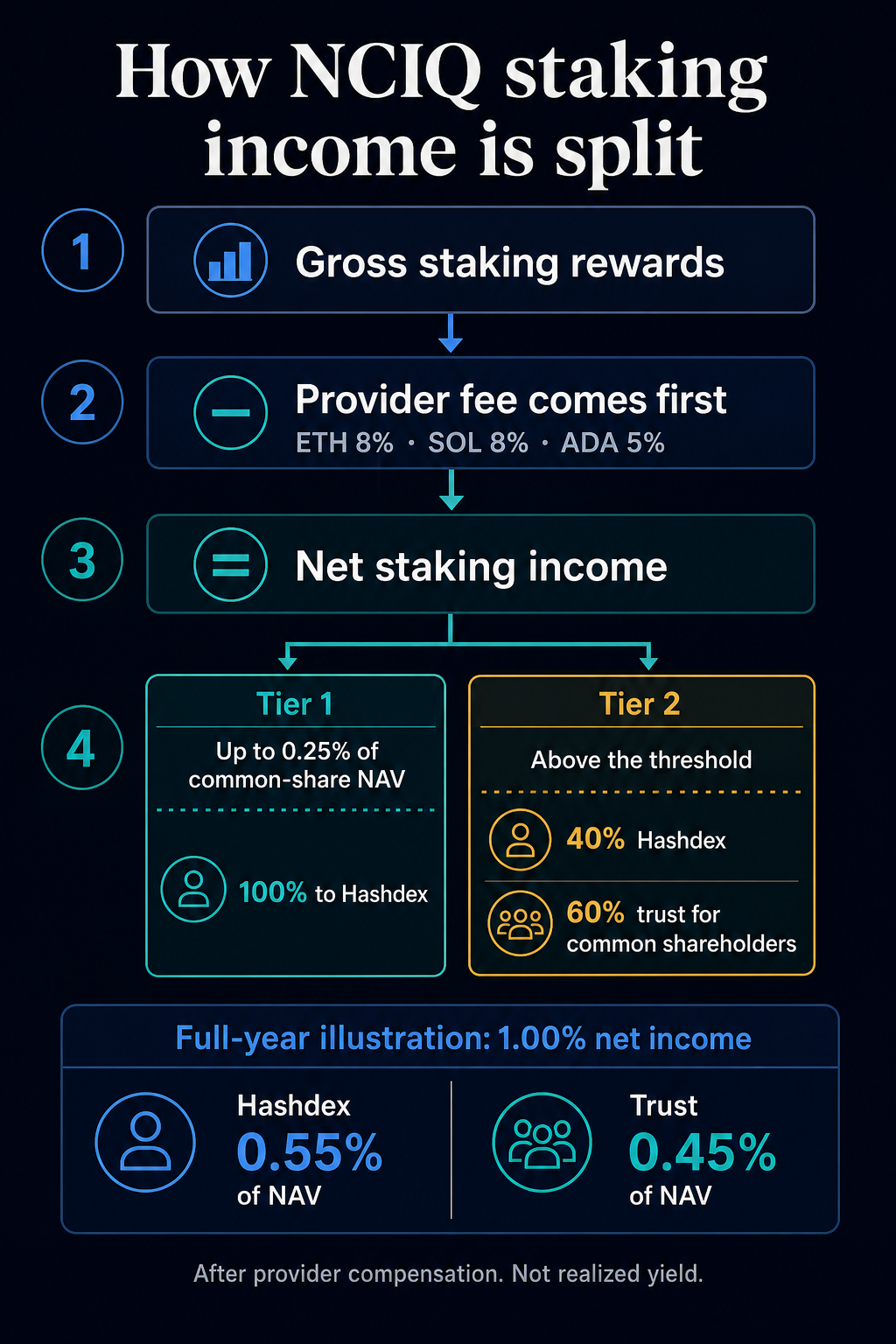
Under the July 23 prospectus supplement, a staking provider first retains its portion of gross rewards. Hashdex then receives all remaining net staking income up to a dollar threshold equal to 0.25% of common-share net asset value through one Sponsor Share, a separate unlisted class held exclusively by Hashdex. Income above that threshold is split 40% to Hashdex and 60% to the trust for holders of publicly traded NCIQ common shares.
The threshold is measured over each fiscal year and prorated for a partial year. If net staking income stays at or below it, none is allocated to the trust for common shareholders’ benefit.
For illustration, if net staking income reached 1% of common-share NAV after provider fees over a full year, the trust would receive 0.45% for common shareholders. Hashdex would collect the remaining 0.55%, comprising the first 0.25% and 40% of the next 0.75 percentage point. The figures are illustrative rather than a forecast or realized return.
The Sponsor Share return is separate from NCIQ’s 0.25% annual management fee and is not netted against it.
Provider deductions vary by asset. Hashdex’s NCIQ product page lists an 8% fee on gross ether staking rewards, an 8% validator commission for Solana, and a 5% validator commission for Cardano.
As of July 26, Ethereum represented 11.75% of NCIQ’s holdings, Solana 3.17%, and Cardano 0.49%, a combined 15.41%. That is not the amount staked. Hashdex lists a target staking range of 10% to 20% of total fund NAV.
The eventual benefit will depend on the assets Hashdex stakes, the portion committed, network reward rates, and provider deductions. Unbonding can temporarily lock assets, while validator failures or slashing can reduce rewards.
Those constraints can also complicate redemptions and rebalancing, potentially widening the difference between NCIQ’s NAV performance and its underlying price index. The filing does not quantify how large any tracking difference could become.