
Stablecoin Issuers Lose $7.7 Billion in June as Transaction Volume Jumps 63%
Stablecoin supply is shrinking for the first time in years, but the decline may say less about demand than it appears.
The market’s total capitalization has fallen about 4.3% from its May peak of $322.41 billion to $308.5 billion. June alone brought a $7.7 billion drop, the largest monthly decline since the collapse of Terra in May 2022.
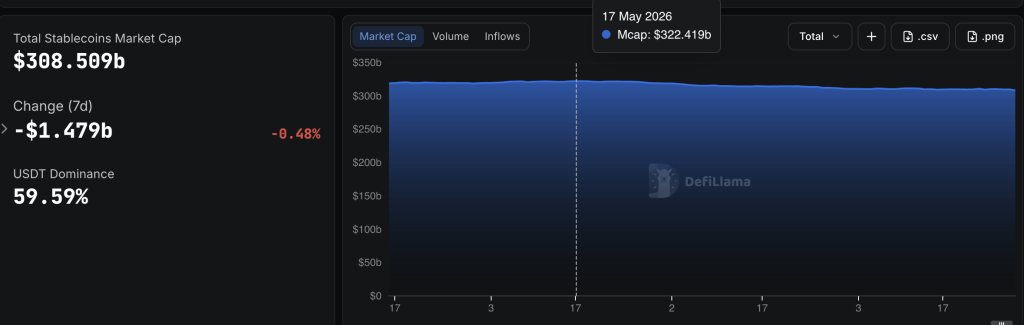
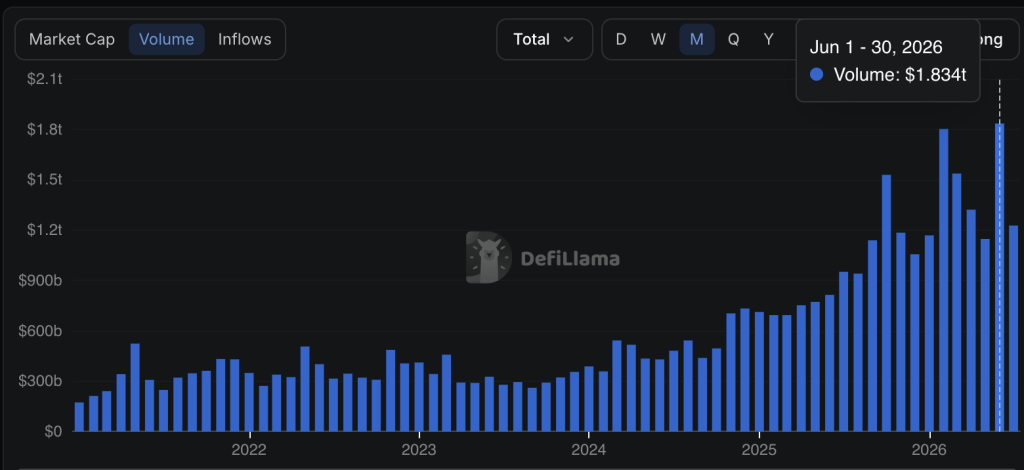
At the same time, adjusted stablecoin transaction volume reached a record $1.83 trillion in June. That was 60% higher than in May and more than double the level recorded a year earlier.
The divergence points to a shift in how stablecoins are used. Fewer dollars are sitting idle, while the remaining supply is moving faster through payments, trading and settlement systems.
Idle Balances Move Into Yield-Bearing Assets
Tether’s $USDT supply declined from $189.54 billion as at May 1 to roughly $184 billion as at July 29. Within the same period, Circle’s $USDC fell from $77.27 billion to $72.41 billion. The contraction remains modest compared with the 26% market collapse of 2022.
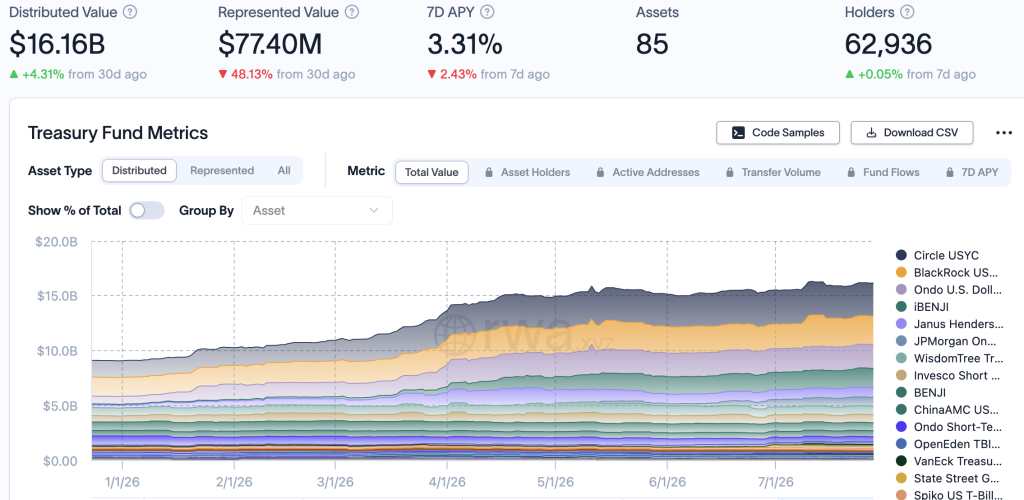
Some capital appears to have moved into tokenized Treasury products, which offer returns unavailable on payment stablecoins. The sector has expanded to over $16 billion, up from about $11 billion in March, according to data from rwa.xyz.
The GENIUS Act, signed in July 2025, prevents issuers from paying interest directly on payment stablecoins. That structure encourages treasurers to keep savings in tokenized funds while holding stablecoins only when they need to make payments.
Transaction Velocity Replaces Market Cap as Key Metric
Stablecoin turnover now runs at about six times per month, according to a March 2026 note by Standard Chartered. That is roughly twice the rate seen two years ago. Visa data also indicates that each stablecoin dollar moves far more frequently than a dollar held in a conventional US bank account.
$USDC has emerged as the leading settlement asset despite having a smaller supply than $USDT. It processed about $1.21 trillion of adjusted volume in June, compared with $576 billion for $USDT.
However, not all blockchain transfers represent economic payments. Automated activity, exchange transfers and wash trading can inflate raw figures.
According to a Forbes report, McKinsey and Artemis estimated that identifiable real-world payments accounted for about $390 billion in 2025. Business-to-business transactions made up $226 billion, while payroll and remittances contributed roughly $90 billion.
The payments share remains small, but it has expanded sharply over two years.
Stablecoin market capitalization still matters because issuers earn interest on reserves. Yet for networks, processors and financial platforms, transaction frequency may become the more valuable measure. June’s data suggests stablecoins are evolving from parked collateral into active financial infrastructure.