
Culper Research shorted Nvidia after predicting the $5 trillion AI giant might be re-routing Chinese demand for AI chips through sketchy deals with neighboring countries.
Almost no one believed it at the time, but as it turns out, it called the top.
Despite Nvidia CEO Jensen Huang’s guidance of “assuming zero for China” to comply with US export controls to the country, the company actually benefitted from work-arounds and created big problems for itself in neighboring nations.
“I’m forecasting China’s sales to be zero,” Huang said in November 2025 after US export restrictions halted Nvidia’s chip sales to China. “It’s zero for the next quarter, zero for the quarter after that. We’re assuming it’s going to be zero.”
By May 13, however, Culper Research sniffed a problem with that claim and sold-short Nvidia shares. It sensed that Nvidia might be re-routing its Chinese demand for AI chips via Taiwan and places like Malaysia and Singapore.
It also foresaw legal problems as regulators discovered its diversions.
With the exception of one day immediately following that report, Nvidia’s stock has never closed any day higher than its May 13 close.
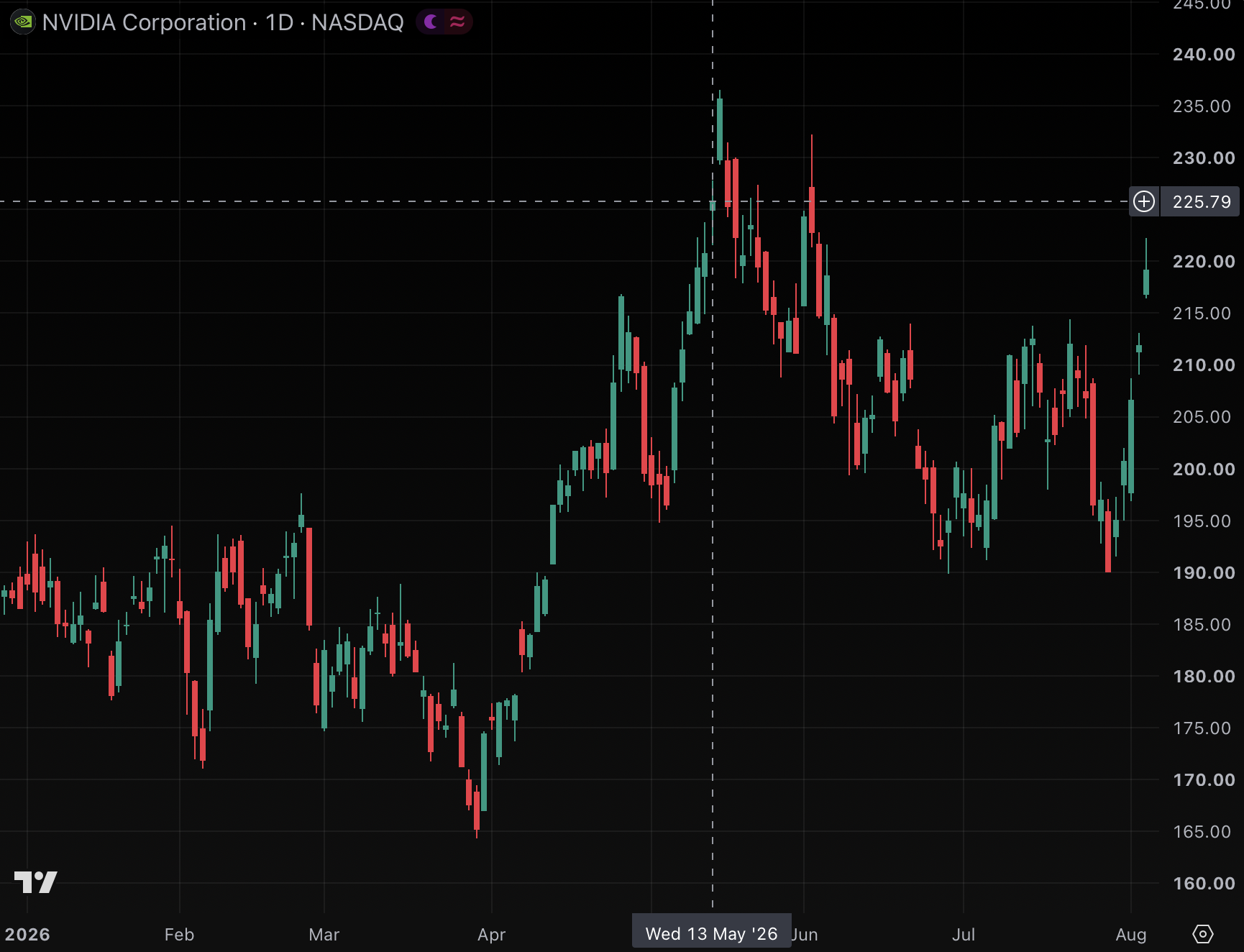
Calling the top on Nvidia
It was an unexpected and remarkably accurate call in the middle of a bullish mania. The week prior to the report, Nvidia had rallied 13%, and shares were up an impressive 20% year-to-date.
Skeptical, Culper Research wrote, “We are short Nvidia for one reason: The company has a significant China problem.”
As it turns out, Nvidia did have massive, unpublished problems in China and neighboring Taiwan. In the three months since that report, those problems became mainstream news.
On July 24, Taiwanese prosecutors searched the home and workplace of an Nvidia employee suspected of smuggling prohibited chips to China. Investigators also went through his desk at the company’s Taipei office.
It’s the first known legal action against an alleged Nvidia employee in Taiwan’s widening AI chip-smuggling investigation. Prosecutors said the man was “strongly suspected of having committed the offences,” and cited a risk of flight and destruction of evidence.
That story surfaced on July 28. The same day, Jensen Huang quietly sat down with US Commerce Secretary Howard Lutnick in Washington, DC.
Credit default swaps forecast AI bankruptcies
Saw these problems coming three months ago
Both events landed 11 weeks after an activist short seller told investors exactly where to look.
On May 13, Culper Research estimated that more than 20% of Nvidia’s fiscal 2026 compute revenue would still run on Chinese demand, even though that demand would, according to its analysis, probably run through Southeast Asian intermediaries and Taiwanese diversions.
The report named those intermediaries: Singapore’s Megaspeed, Malaysia’s Speedmatrix, and a subsidiary of Taiwan’s Gigabyte, Giga Computing.
Crucially, Culper warned that the exposed corridor of Chinese demand routing through Taiwan was “just one of many in what is a complex and far-flung operation.”
It predicted multiple additional Nvidia OEMs, partners, and intermediaries would sustain their Chinese demand through intermediaries in nearby countries.
A former high-level Nvidia employee told the firm that “Megaspeed is just the tip of the iceberg.”
Huang insisted the company wasn’t skirting export restrictions and that it “repeatedly tested and sampled data centers around the world and found no diversion.”