A recent working paper from the Central Bank of Malaysia has identified XRP and bitcoin as potential alternatives to traditional monetary and payment systems.
Digital Assets Could Replace Bank Deposits
A recent working paper from the Central Bank of Malaysia (CBM) has identified XRP alongside bitcoin ( BTC) as potential “alternatives to the current monetary and payment instruments.” The paper, which examines the fundamentals of what the CBM calls modern money and its application to a central bank digital currency (CBDC), posits that these digital assets could eventually replace currency in circulation (CIC) or bank deposits if they become widely used.
“Private tokens such as Bitcoin or XRP may be widely used as means of payment outside the banking system in the future, replacing CIC or bank deposits,” the working paper asserts.
Nevertheless, the paper ultimately downplays the two cryptocurrencies’ prospects, citing their lack of a “stable nominal anchor” and “tendency towards fragmentation” as factors that work against them complementing or even replacing the current payment system.
Furthermore, the paper argues that without centralized institutions or intermediaries, “crypto platforms require large liquid balances to effect payments across different cryptocurrencies.” This is because decentralization, the paper asserts, “does not allow any party’s balance sheet to expand and contract.”
Despite this dim conclusion on the prospects of “private tokens,” the identification of XRP alongside BTC in the CBM working paper reignited a social media debate about the former’s utility. As expected, supporters of XRP lauded this as evidence that the digital asset is gaining ground, but this was rejected by opponents.
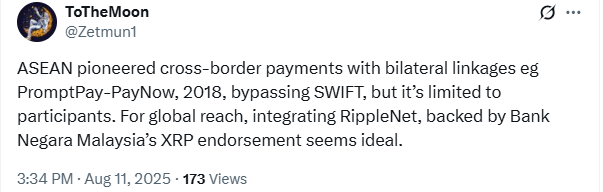
On the social media platform X, one user, Casey Delaney, noted the significance of XRP’s recognition by central banks, while another referenced it as “the future of finance.” Meanwhile, one user’s reference to a paper by Alexander Bechtel, Agata Ferreira, Jonas Gross, and Philipp Sandner that dismisses BTC and Ethereum ( ETH)’s credentials as payment instruments did not go over well with supporters of the two cryptocurrencies.
However, one user speculated that the Malaysian central bank paper’s conclusions are not based on independent research but are viewpoints influenced by the World Bank and the International Monetary Fund.
“Having worked with the Malaysian gov directly I’d say this is most likely to reflect IMF/world bank influence, incompetence, corruption, or a mix of all of these. It’s less likely to be the result of an in depth assessment of L2 scalability for BTC & its inherent strengths,” the user argued.