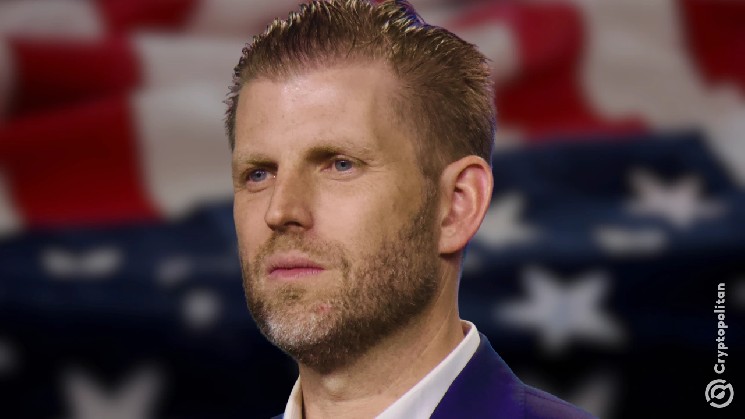
Eric Trump has agreed to pull back from decision-making at World Liberty Financial’s proposed national trust bank while the crypto business works through the federal approval process.
Eric, World Liberty co-founder Zak Folkman, and Emirati investor Hamad Khalfan Ali Matar Alshamsi each signed separate commitments through companies connected to them. The agreements keep all three investors away from bank management decisions.
The commitments became public when World Liberty won preliminary approval late last week. They deal with the company’s ties to Trump’s family and overseas money as its affiliate pursues a federal bank charter.
Such deals have been termed passivity commitments. According to World Liberty, the reason behind making such arrangements is to ensure that particular investors do not control the trust bank.
The lawyers said the reason why the case would be considered different is that, apart from a foreign investor, who has some connections with the royal family of Abu Dhabi, it is the son of the country’s president, which makes the situation different from others. This is also true for other aspects of financial business.
World Liberty keeps major investors away from management while regulators review the bank
World Liberty spokesman David Wachsman said the company expects to remain under federal oversight for years.
“World Liberty is intentionally running towards regulation and permanent supervision, not away from it. Before full approval and for many years afterward, the World Liberty Trust Company will fully cooperate with the OCC, a federal regulator, and will adhere to all other applicable laws and regulations,” Wachsman said.
More scrutiny has been directed at the proposed crypto bank compared to other such proposals in view of the ownership associations of World Liberty. World Liberty had just made an agreement prior to Donald Trump taking the helm as president of the country to sell 49% ownership to a business that is associated with Sheikh Tahnoon bin Zayed, brother to the UAE president.
Trump and his family also hold financial interests in World Liberty. The company says none of them work there as officers, directors, or employees. The White House rejects claims that Trump’s business interests amount to a conflict or that he uses presidential power to make himself richer.
Federal reviews for bank charters involve detailed checks on the finances of organizers and directors. World Liberty’s filing lists Zach Witkoff, son of presidential envoy Steve Witkoff. It also names Scott Alper, an executive at the Witkoff Group, along with Robert Witkoff, Steve’s brother.
A federal charter would move $USD1 issuance and nearly $4 billion of reserves inside World Liberty
The charter would let World Liberty directly hold the assets supporting $USD1, its dollar-backed stablecoin.
That setup would allow the company to keep issuance and reserve management within the same organization rather than depend on outside arrangements. $USD1 is worth nearly $4 billion by market value, according to CoinGecko, making it one of the world’s largest stablecoins.
The filing also lands during a wider shift in federal policy toward crypto banking. Jonathan Gould, the U.S. Comptroller of the Currency, said after taking office that approving new bank charters would be one of his priorities.
That differed from the Biden administration, which had been far less welcoming toward charter requests from digital-asset firms.
World Liberty is part of that group. Ripple, Paxos, and Fidelity Digital Assets all won conditional trust bank approvals in 2025. Coinbase (NASDAQ: COIN) received comparable conditional approval earlier this year. Those decisions give the companies a route toward running regulated trust banks, but each still has federal requirements to meet before getting full authorization.
Trump’s administration has also moved deeper into digital-asset policy. On Wednesday, Trump met top executives from crypto companies at the White House. The meeting happened as the Securities and Exchange Commission works on finishing a broader regulatory structure for the industry.
World Liberty now faces the remaining steps in that process. Regulators still have to decide whether the company can bring $USD1’s reserve setup inside a federally supervised banking business.