The crypto-focused investment arm of venture capital firm Andreessen Horowitz argues that modern cryptographic techniques, such as zero-knowledge proofs, can protect user privacy but still allow law enforcement to crack down on bad actors.
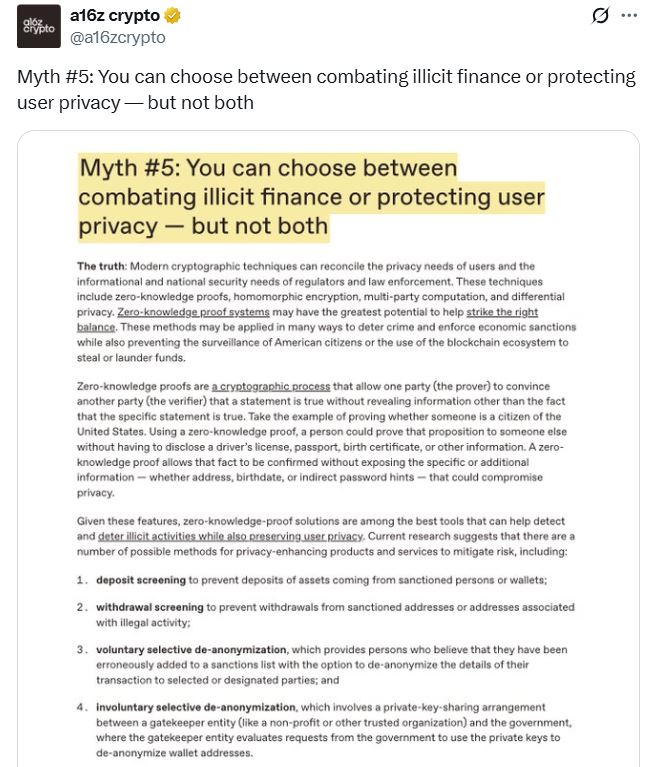
In a report on Tuesday, a16z Crypto policy partner Aiden Slaven and regulatory counsel David Sverdlov said that ZK-proofs, which verify the authenticity of data without disclosing any detailed private information, have the “greatest potential” by showing the origin of funds, but without publicly revealing private information.
Their report comes only two weeks after Roman Storm, the co-founder of the crypto mixing service Tornado Cash, which allows users to mask the origin and destination of cryptocurrency, was found guilty of charges related to conspiracy to run an unlicensed money business.
Law enforcement and prosecutors in the Tornado Cash case argued that mixing services that obscure the origin of funds helps facilitate criminal activity by providing a means of hiding ill-gotten gains.
“If users are able to furnish such proofs upon exchanging crypto for fiat currency, the cash-out points will have reasonable assurances that the crypto did not derive from proceeds of crime, while the users are able to retain privacy over their onchain transactions,” Slaven and Sverdlov said.
ZK-proofs have wide variety of privacy-related uses
Slaven and Sverdlov also suggest ZK-proofs have a use beyond just finance; they can help with other everyday tasks, such as proving the citizenship of a country or equivalent.
“Using a zero-knowledge proof, a person could prove that proposition to someone else without having to disclose a driver’s license, passport, birth certificate, or other information,” they said.
“A zero-knowledge proof allows that fact to be confirmed without exposing the specific or additional information — whether address, birthdate, or indirect password hints — that could compromise privacy.”
US Securities and Exchange Commission Commissioner Hester Peirce echoed a similar sentiment on Aug. 4 at the Science of Blockchain Conference, arguing that privacy-protecting technologies should be safeguarded.
Privacy tech ready for mainstream adoption
Critics often raise scalability concerns about cryptographic privacy technology, but advancements such as reducing computational overhead are making it more practical for larger-scale implementation, according to Slaven and Sverdlov.
“Cryptographers, engineers, and entrepreneurs continue to improve the scalability and usability of zero-knowledge proofs, making them an effective tool for fulfilling the needs of law enforcement, while preserving individual privacy,” they said.
The US government’s July crypto report flagged ZK-proofs as a method to protect user privacy while enabling compliance checks. JPMorgan’s private blockchain, Nexus, also uses the technology for tokenized cash settlements and interbank messaging.
Related: SEC’s Peirce defends transaction privacy as Tornado Cash verdict looms
Other cryptographic privacy technology worth exploring
Besides ZK-proofs, Slaven and Sverdlov said there are other options worth exploring, such as homomorphic encryption, a type of cryptographic technique that allows part of data, such as numbers, to be used without decrypting other private info, such as names.
Other possibilities include multiparty computation, which allows multiple people to work together to calculate without anyone revealing their private data to anyone, and differential privacy, which ensures aggregated data collected through methods like surveys can’t be used to identify individuals.
“New technologies — from the telegraph and telephone to the internet — have always sparked fresh anxieties about privacy’s impending demise,” Slaven and Sverdlov said.
“Blockchains have proven no different, and privacy on blockchains is often misunderstood as either creating a dangerous level of transparency or a haven for crime.”
Magazine: Solana Seeker review: Is the $500 crypto phone worth it?