The ongoing advancement in quantum computing is raising urgent questions about the long-term security of Bitcoin (BTC).
Unlike classical machines, quantum computers can solve certain problems exponentially faster, posing a direct threat to Bitcoin.
Notably, using Shor’s algorithm, a sufficiently powerful quantum computer could break elliptic curve cryptography (ECC) and recover private keys from public keys in hours, putting exposed funds at risk.
It’s worth noting, as reported by Finbold, that analysts have offered varying timelines for when this technology might crack Bitcoin, with many settling on the next decade as the critical period.
Probability of quantum computers cracking Bitcoin
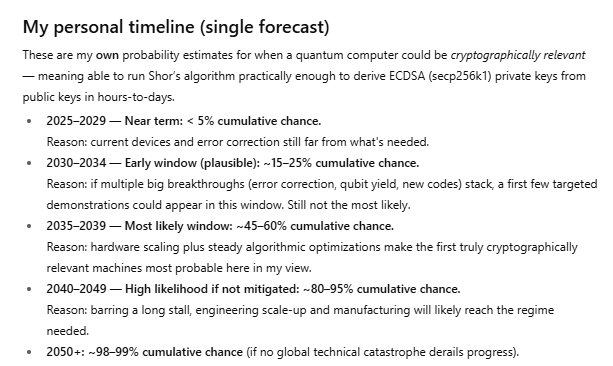
Meanwhile, Finbold gathered insights from OpenAI’s latest artificial intelligence (AI) model, ChatGPT-5, which issued its own estimates on when this scenario could become reality, projecting a gradual increase in risk over the coming decades.
The model highlighted the mid-to-late 2030s as the most likely window for “cryptographically relevant” quantum computers, machines capable of breaking Bitcoin’s ECDSA (secp256k1).
To this end, ChatGPT-5 provided cumulative probability estimates, assigning less than a 5% chance for the 2025 to 2029 period, citing current device limitations and immature error correction.
It placed the probability between 15% and 25% for 2030 to 2034 if breakthroughs in error correction, qubit yield, and coding align. The greatest likelihood was assigned to the 2035 and 2039 window at 45% to 60%, with hardware scaling and algorithmic improvements expected to enable the first practical key-recovery demonstrations.
If development continues at the current pace, the 2040s carry an 80% to 95% likelihood, and by 2050, the probability rises to nearly 99%, barring a global technical catastrophe.
Bitcoin code cracking timeline acceleration
The model cautioned that certain milestones could immediately accelerate the timeline, such as large-scale fault-tolerant qubits, machines with millions of low-error qubits, full demonstrations of Shor’s algorithm, or government advisories shifting from planning to urgent migration.
To mitigate these risks, ChatGPT recommended proactive measures, including auditing addresses, avoiding key reuse, and moving funds away from exposed keys.
It also advised piloting post-quantum or hybrid signatures between 2026 and 2029, completing critical custody migration by 2032–2035, and ensuring full network readiness by 2035.
Featured image via Shutterstock