Mike McGlone, Senior Commodity Strategist at Bloomberg Intelligence, is drawing a hard line underneath Bitcoin’s 2026 outlook, arguing that January’s surge toward the $90,000 area may already represent this year’s ceiling if broader market stress returns.
In a Feb. 23 post on X, Senior Bloomberg Strategist Mike McGlone concluded a series of public notes published over the last five days. Of special importance is McGlone’s framing for Bitcoin as the “tip of the risk-asset iceberg,” not an isolated digital asset story, and the assumption that elevated levels of Bitcoin could become “potentially prudent shorts,” particularly around the $90,000 $BTC open in 2026.
Bitcoin braces for “mean reversion” to $10,000
McGlone has reiterated his controversial thesis, which earned him the “McGloom” nickname in crypto circles, that the flagship cryptocurrency could revisit $10,000 in a “normal reversion” scenario.
Still, he points to prepandemic trading concentrations as a statistical anchor. Furthermore, McGlone has identified the $28,000 to $66,000 range as a mean or modal zone derived from post-2023 price behavior.
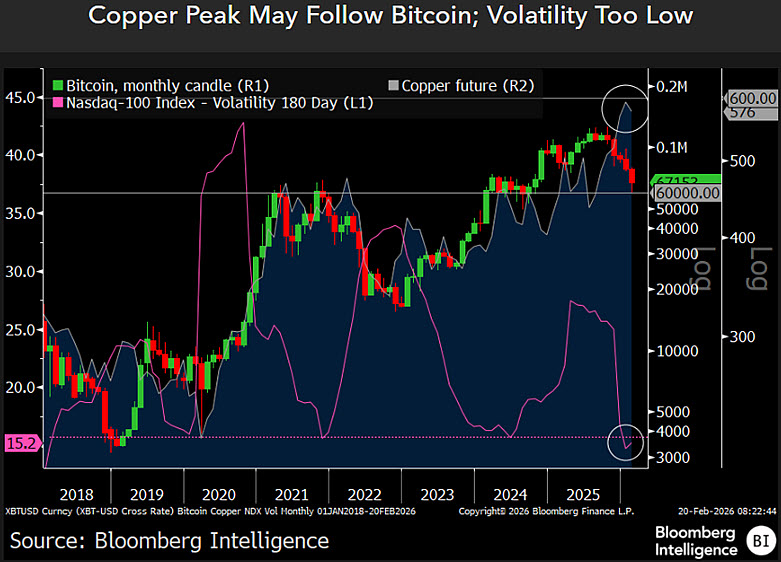
It is Bitcoin’s inability to hold the mid-$70,000 region or break decisively below $64,000, for the expert, that would strengthen the case that crypto is leading risk assets lower. This, McGlone says, could lead to a reverse wealth effect, where falling digital asset valuations pressure equities, industrial metals and even treasury yields.
In his view, January highs across Bitcoin, gold, silver and bond yields may mark synchronized 2026 peaks if economic data deteriorates.
While critics push back on the $10,000 $BTC projection, McGlone has not withdrawn it. Instead, he positions it as an outer-bound scenario within a broader mean-reversion thesis.
His message for 2026 remains consistent: Bitcoin’s trajectory will likely mirror, and potentially magnify, broader macroeconomic trends, rather than defy them.