Bitcoin’s network has been running nonstop since 2009. The question nobody had rigorously answered until now is what it would actually take to break it.
Researchers at the Cambridge Centre for Alternative Finance last week published the first longitudinal study of Bitcoin blockchain’s resilience to physical infrastructure disruption, analyzing 11 years of peer-to-peer network data against 68 verified submarine cable fault events.
The headline finding is that between 72% and 92% of the world’s inter-country submarine cables would need to fail simultaneously before Bitcoin experiences significant node disconnection.
In a world where the Strait of Hormuz is currently disrupted and infrastructure vulnerability is front of mind, the study provides the first empirical benchmark for how hard Bitcoin actually is to knock offline.
The numbers tell a story of a network that degrades gracefully rather than collapsing catastrophically. The researchers ran 1,000 Monte Carlo simulations per scenario across the full dataset and found that random cable failures barely register.
Over 87% of the 68 real-world cable fault events they studied caused less than 5% node impact. The largest single event, when seabed disturbances off Côte d’Ivoire damaged 7-8 cables simultaneously in March 2024, knocked out 43% of regional nodes but affected only 5-7 bitcoin nodes globally, roughly 0.03% of the network.
The correlation between cable failures and bitcoin’s price was essentially zero, at -0.02. Infrastructure disruptions are invisible against daily price volatility.
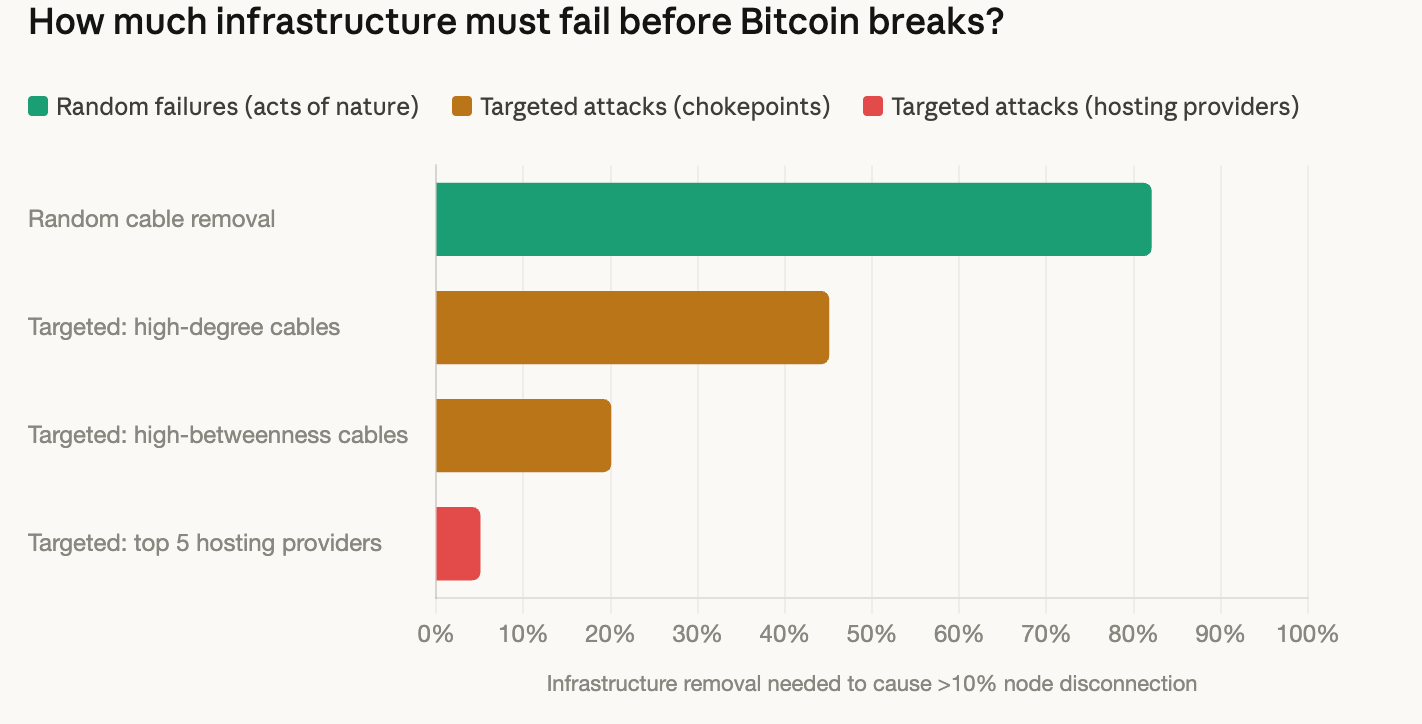
But the paper’s most important finding is the asymmetry between random and targeted attacks.
While random cable failures require 72-92% removal to cause damage, a targeted attack on the cables with the highest betweenness centrality, the ones that serve as chokepoints between continents, drops that threshold to 20%.
And targeting the top five hosting providers by node count, Hetzner, OVH, Comcast, Amazon, and Google Cloud, requires removing just 5% of routing capacity to achieve the same impact.
That’s a fundamentally different threat model. Random failures are acts of nature. Targeted attacks are acts of state, coordinated regulatory shutdowns of hosting providers or deliberate severing of critical cable routes. The study essentially maps two very different adversaries: one Bitcoin can easily survive, and one that remains a credible risk.
How threats to bitcoin change over time
The paper tracks how resilience evolved over time, and the trajectory isn’t a straight line. Bitcoin was most resilient in its early years from 2014-2017, when the network was geographically diverse and the critical failure threshold sat around 0.90-0.92.
Resilience declined sharply during 2018-2021 as the network grew rapidly but concentrated geographically, hitting its lowest point of 0.72 in 2021 during peak mining concentration in East Asia. The China mining ban in 2021 forced redistribution, and resilience partially recovered to 0.88 in 2022 before settling at 0.78 in 2025.
The TOR finding is the one that challenges conventional thinking. As of 2025, 64% of Bitcoin nodes use TOR, making their physical location unobservable.
The assumption has been that this inability to observe might hide fragility, that if TOR nodes turned out to be geographically concentrated, the network could be more vulnerable than it appears.
The Cambridge researchers built a four-layer model to test this and found the opposite. TOR relay infrastructure is heavily concentrated in Germany, France, and the Netherlands, countries with extensive submarine cable and land border connectivity.
An attacker trying to disrupt TOR relay capacity by cutting cables faces a compound problem because those countries are among the hardest to disconnect. The four-layer model consistently showed higher resilience than the clearnet-only baseline, with TOR adding between 0.02 and 0.10 to the critical failure threshold.
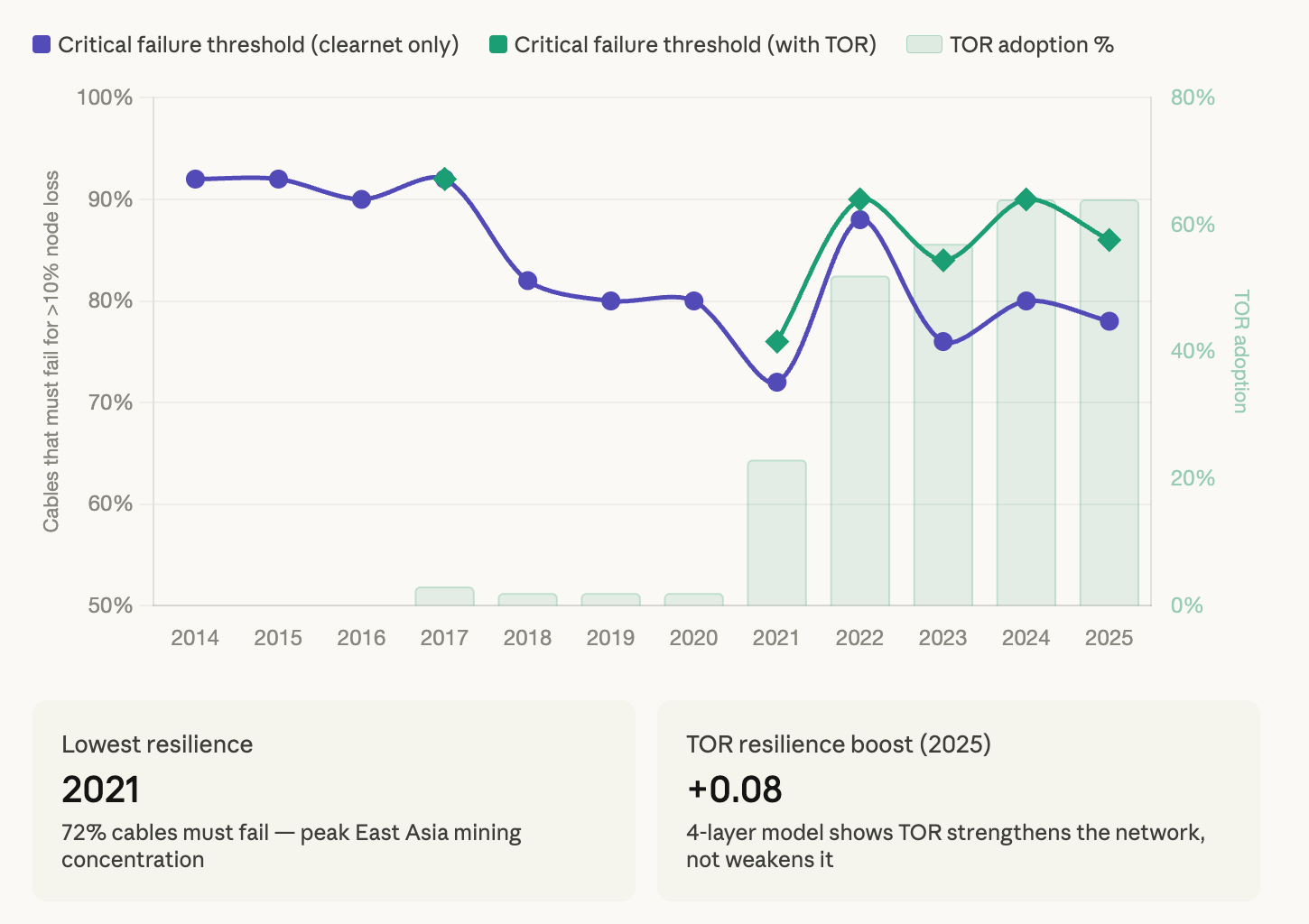
The paper frames this as “adaptive self-organization.” TOR adoption surged after censorship events like Iran’s internet shutdown in 2019, the Myanmar coup in 2021, and the China mining ban.
The Bitcoin community shifted toward censorship-resistant infrastructure without any central coordination, and that shift happened to also make the network physically harder to disrupt.
With the Strait of Hormuz effectively closed and a regional war disrupting infrastructure across the Middle East, the question of what happens to Bitcoin if submarine cables get damaged isn’t theoretical.
The study suggests the answer is probably nothing, unless someone is deliberately targeting the specific cables and hosting providers that matter most.