
Stablecoin transaction volume surpassed the US Automated Clearing House network for the first time in February, a significant milestone for an asset class that has existed for less than 12 years.
According to data from blockchain analytics platform Artemis, the total 30-day adjusted rolling stablecoin volume hit $7.2 trillion in February, beating the Automated Clearing House network at $6.8 trillion.
“Stablecoins are quietly becoming the foundational infrastructure for global payments: no banks, no weekends, no borders,” said analyst Alex Obchakevich in an X post on Friday.
Surpassing the $ACH is significant, given that the network functions as the backbone of the US payments system. Data from Nacha, one of the primary forces governing the $ACH alongside the Federal Reserve, indicates that the $ACH network processes about 93% of salary payments in the US.
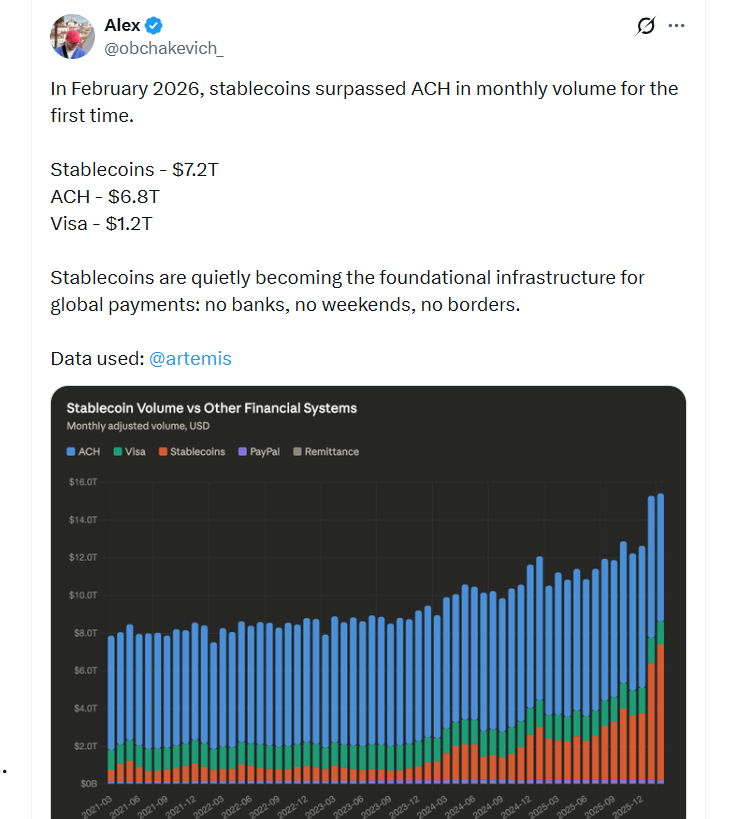
The data also shows that stablecoin market volumes have consistently grown over the past few years relative to the other major financial systems, such as Visa and PayPal.
Artemis data for March show that stablecoin volume continued to hit new highs, notching $7.5 trillion for the month and matching the $ACH over that 30-day period.
Stablecoin supply continues to surge
Meanwhile, in the first quarter of 2026, total stablecoin supply hit $315 billion, increasing by $8 billion from the first quarter of 2025, according to data from CEX.IO.
Stablecoins also accounted for 75% of total crypto trading volume in the quarter, marking the highest levels on record, Cointelegraph previously reported.
An important catalyst for stablecoins has been the growing adoption by institutions amid a warming regulatory climate in the US.
Analysts from major traditional finance institutions such as Standard Chartered have tipped the total stablecoin market cap to hit $2 trillion by 2028, which would mark an increase of over 530% from current levels.
In a post on Tuesday, Frank Chapparo, the content head at trading firm GSR, argued that banks or fintech firms are “toast” if they ignore the explosive growth of the sector.
“The signals are everywhere,” he said, pointing to the total supply growing from less than $30 billion in 2020 to over $300 billion since then. Chapparo highlighted the GENIUS Act as a key piece of regulation that has unlocked institutional adoption.