Bitcoin has extended its decline into a sixth consecutive month after peaking at an all-time high of $126,000. While the correction is already substantial, on-chain and market data suggest it may not be over.
Price is approaching a critical support zone where a large share of long-term holders previously accumulated. A breakdown at this level could open the door to a move toward $50,000.
Institutional selling adds to downside risk
The recent 1% reduction in corporate Bitcoin [$BTC] treasuries comes amid mounting pressures, including debt obligations and persistent market weakness. While modest in size, the shift is notable given the typically long-term orientation of institutional holders.
Recent disclosures tracked by AMBCrypto showed that at least four corporate entities reduced their Bitcoin exposure between March and early April.
Mara Holdings led the sell-off, liquidating 15,133 $BTC valued at over $1 billion in March. Riot Platforms and Empery Digital followed, offloading a combined 2,295 $BTC worth approximately $156 million as of the 2nd of April.
Despite these sales, corporate entities still control roughly 1.16 million $BTC, valued at around $77 billion. However, this sizable position is increasingly vulnerable as Bitcoin trades near the aggregate cost basis of a key long-term holder cohort—one that overlaps with institutional accumulation levels.
Long-term holder cost basis comes into focus
On-chain data from the UTXO Realized Price Age Distribution highlights a critical development. The metric tracks the average acquisition price of Bitcoin across different holding periods, offering insight into investor positioning.
Current data shows Bitcoin nearing the $63,049 cost basis for holders who accumulated between 18 months and two years ago. This level now acts as a potential inflection point.
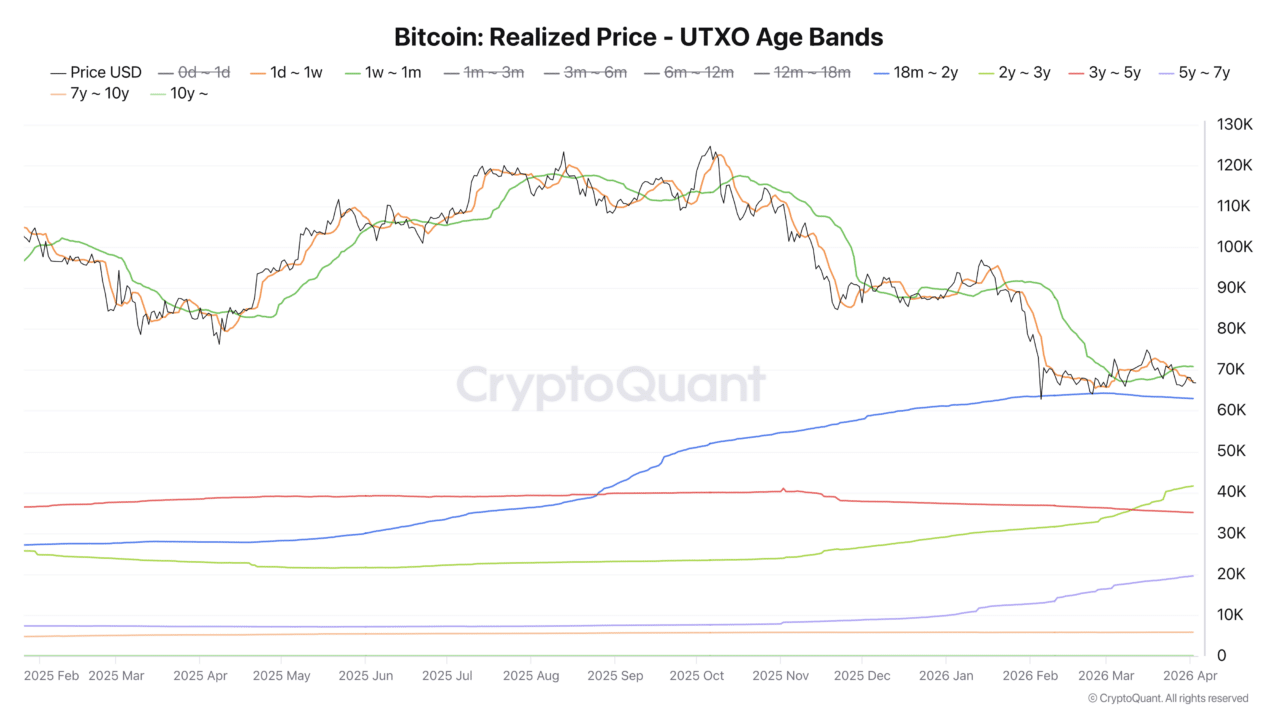
With Bitcoin trading at $66,794, the margin above this cohort’s cost basis has narrowed significantly. A sustained move lower could push these holders into loss, increasing the likelihood of defensive selling.
Short-term holders present an additional risk layer. Investors who entered the market within the past month remain particularly sensitive to volatility and are more likely to exit positions under pressure, amplifying downward momentum.
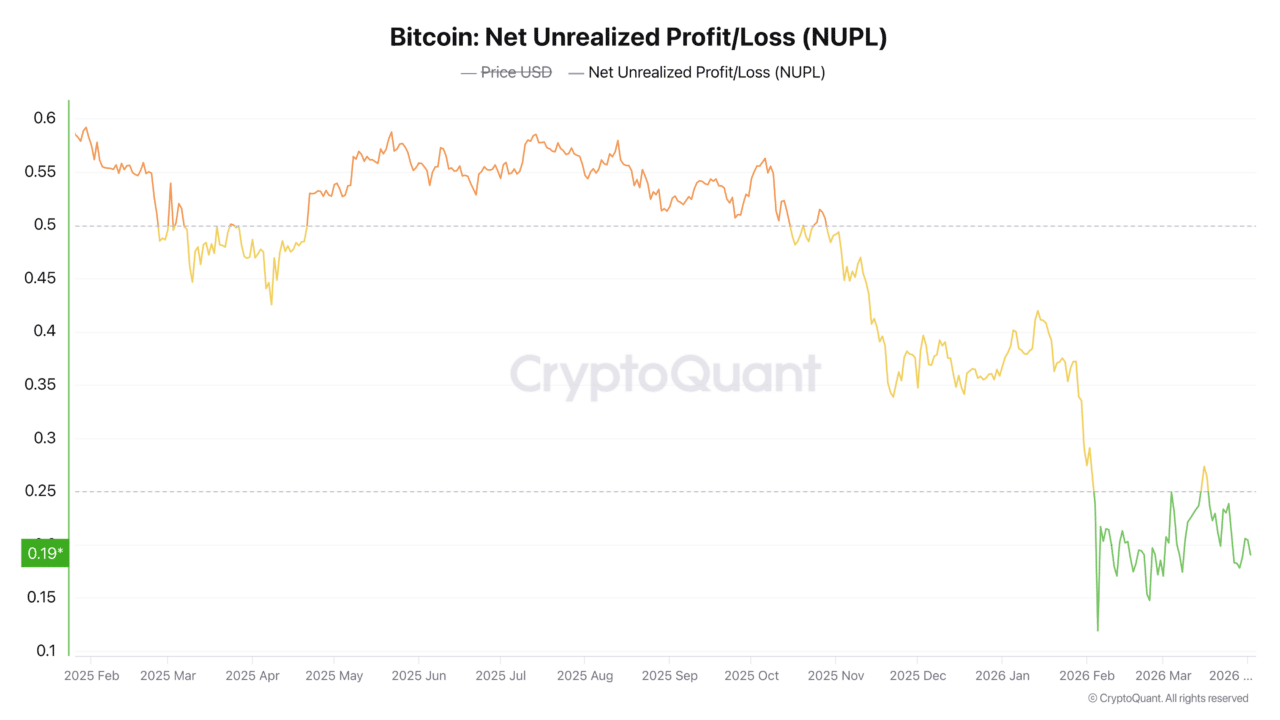
The Net Unrealized Profit/Loss (NUPL) metric reinforces this trend. At 0.6, it indicates a sharp compression in unrealized gains across the network.
As profitability declines, the probability of capitulation rises, especially if prices continue to weaken.
Weak capital inflows limit recovery potential
Market structure data points to another constraint: limited capital inflows.
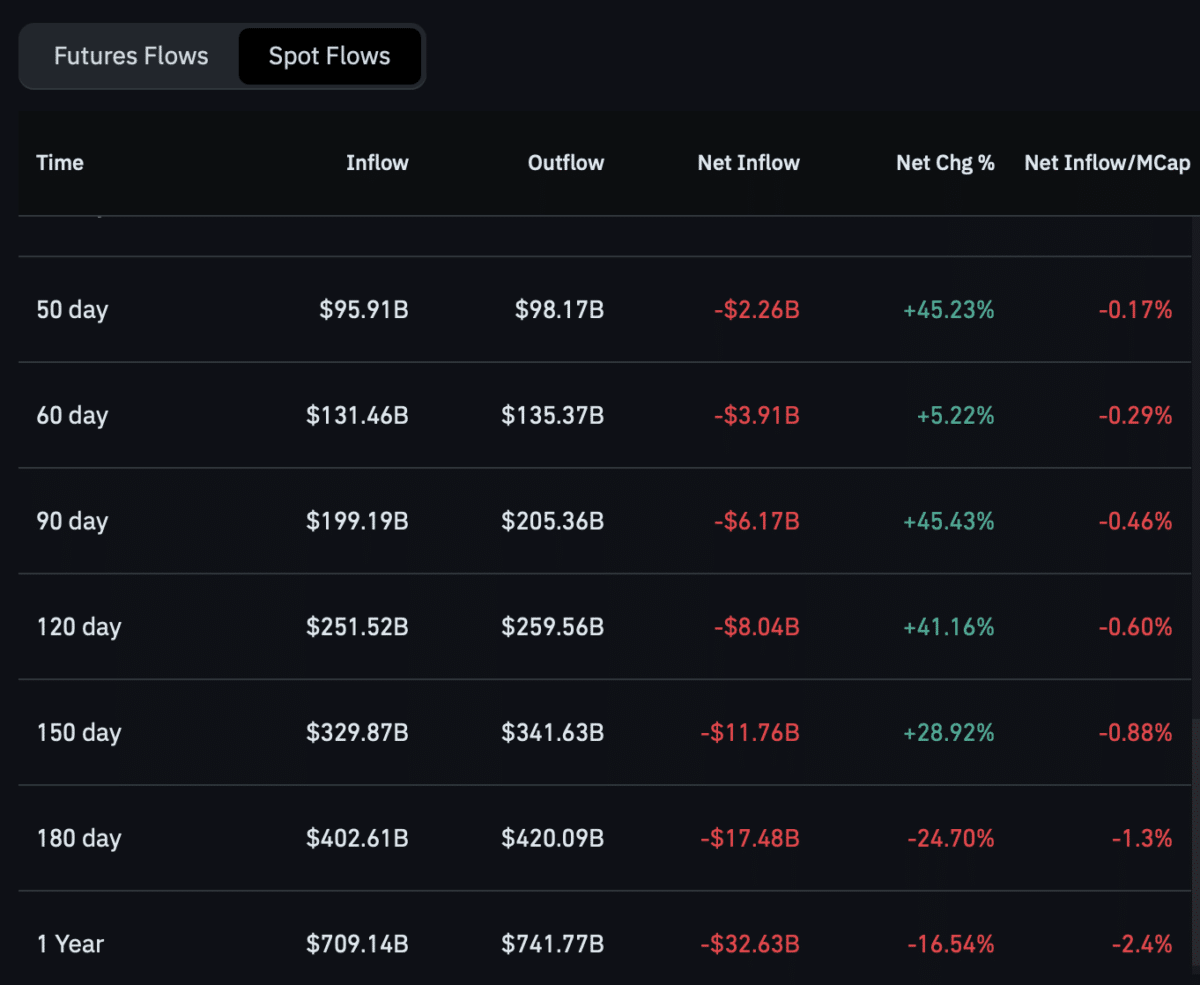
Spot market activity shows subdued demand over recent months. Bitcoin recorded approximately $8.04 billion in Spot purchases over the past 120 days, with only $6.17 billion flowing in over the last 90 days.
This level of demand remains insufficient to absorb sustained selling pressure or support a strong recovery.
At the same time, macro uncertainty continues to weigh on risk sentiment. Ongoing geopolitical tensions and global economic instability have led investors to adopt a more cautious stance, reducing capital allocation to risk assets like Bitcoin.
Unless inflows strengthen meaningfully, the market may struggle to stabilize, leaving Bitcoin exposed to further downside in the near term.
Final Summary
- Public and private entities have trimmed roughly 1% of their Bitcoin holdings as selling pressure builds.
- Bitcoin is now trading close to the cost basis of investors who accumulated between 18 months and two years ago, increasing downside risk.