The Bitcoin holder spectrum is seeing a significant shift in investor behavior.
New data from CryptoQuant analyst Darkfost shows a major decline in “wholecoiner” activity across exchanges.
Key Points
- Wholecoiner activity is declining as Bitcoin’s rising price makes owning 1 $BTC harder for many investors.
- Transfers of 1 $BTC or more to exchanges have dropped sharply, returning to levels last seen in 2018.
- ETFs and new access routes are reducing the need for direct $BTC ownership and on-chain exchange activity.
- Fewer large holders moving $BTC suggests lower selling pressure and a tightening available supply.
Bitcoin Wholecoiners Becoming Increasingly Rare
Wholecoiners, investors holding at least 1 $BTC, are gradually becoming less common, largely due to Bitcoin’s long-term price appreciation. As $BTC becomes more expensive, accumulating a full coin is increasingly out of reach for many participants.
This trend is now clearly reflected in exchange flows.
Exchange Flows Fall to Multi-Year Lows
On the Binance platform, monthly average transfers of 1 $BTC or more to exchanges have fallen to about 6,000 $BTC. This marks a steep decline from the 15,400 $BTC recorded during the 2021 market cycle, bringing activity back to levels last seen in 2018.
Across all exchanges, the drop is even more pronounced. Large transfers have fallen to roughly 27,500 $BTC globally, compared to the 80,000 $BTC peak in 2018, a nearly threefold decrease.
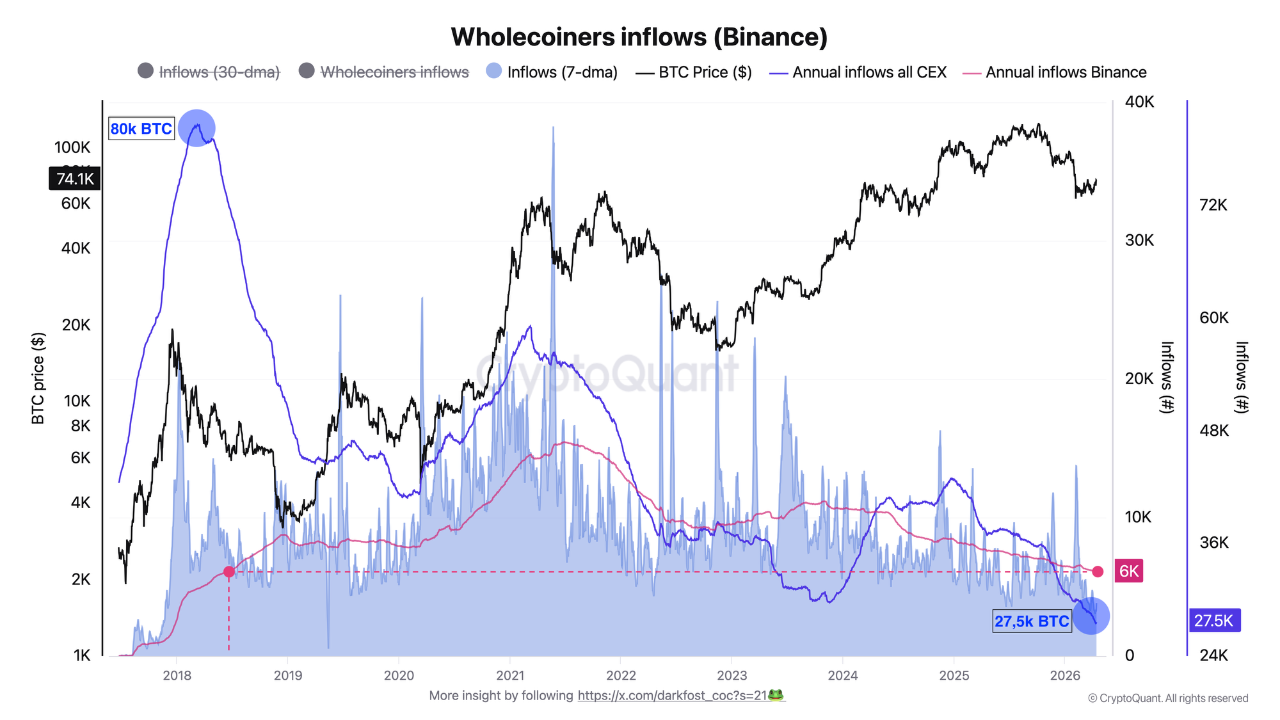
Bitcoin’s price helps explain why. The premier cryptocurrency trades at $74,100 today, and at its all-time high, it reached $126,200. Meanwhile, in 2018, Bitcoin traded below $20,000, while in 2021 it peaked near $69,000.
In other words, it now costs nearly four times more to own one full $BTC than it did in 2018.
ETFs and New Access Routes Reshape the Market
Beyond price appreciation, structural changes in the market are also driving this shift.
The introduction of spot Bitcoin ETFs in 2024, alongside the expansion of trading platforms, has created alternative ways for investors to gain exposure to $BTC without directly holding the asset. This reduces the need for on-chain transfers to exchanges.
Specifically, ETFs now hold over 1.61 million $BTC, accounting for nearly 8% of the total supply — something that didn’t exist just three years ago.
Long-Term Holding Reduces Selling Pressure
At the same time, a growing segment of investors appears to be adopting long-term holding strategies. This behavior further limits the movement of large $BTC amounts to exchanges, typically associated with selling activity.
In sum, the decline in wholecoiner flows points to a transformation in Bitcoin’s market structure. With fewer large holders moving coins to exchanges, selling pressure is easing while a larger portion of the supply becomes increasingly illiquid.
This combination could play a key role in shaping Bitcoin’s future price dynamics if demand continues to rise against a tightening available supply.