According to El Salvador’s Central Bank, the share of crypto-linked remittances sent to El Salvador rose by nearly 50% in Q1 2026 compared to the same period in 2025. Even so, crypto remittances have failed to reach even 1% of the country’s total remittances.
Key Takeaways:
- El Salvador’s Central Bank reported Q1 crypto remittances hit $17.38M, a $5.77M rise from 2025.
- Despite Bukele’s hopes to disrupt remittance giants, crypto comprises just 0.71% of the $2.43B total.
- Future growth may stall as El Salvador sunsets the Chivo wallet to honor a 2025 IMF credit pact.
El Salvador Registers Rise Of 49.7% In Crypto Remittances
El Salvador, the so-called Latam’s bitcoin country, registered an advance in the use of digital assets for remittances.
According to official data published by El Salvador’s Central Bank, the volume of cryptocurrency remittances rose to $17.38 million in Q1, up $5.77 million from the total registered during Q1 2025.
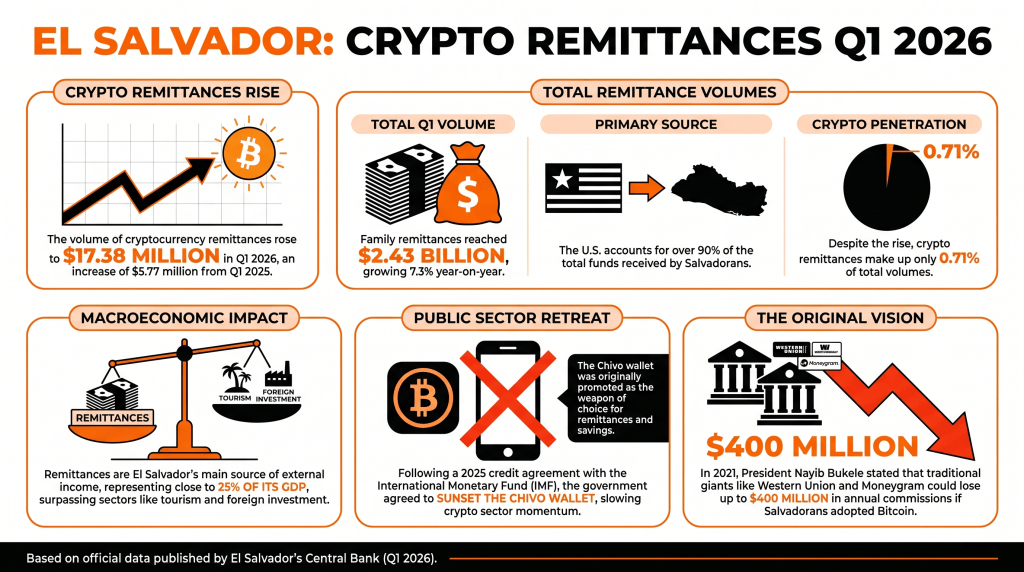
The rise comes as family remittance volumes reached $910.81 million in March, with Q1 total volumes sitting at $2.43 billion, growing 7.3% year-over-year, even as the world faces geopolitical challenges. The U.S. is the main source of these funds, accounting for over 90% of the total received by Salvadorans.
Nonetheless, even with this rise, cryptocurrency remittances reach only 0.71% of the total volumes, underscoring the low penetration of digital assets in a sector dominated by traditional giants that still charge significant fees for their services.
The sluggish performance of the crypto sector in the remittance industry might have been influenced by the public sector’s abandonment of bitcoin after the current administration inked a credit agreement with the International Monetary Fund in 2025.
As a result, the government also agreed to sunset the Chivo wallet, a national cryptocurrency wallet which had been promoted as the weapon of choice for remittances and savings.
President Nayib Bukele pushed remittances as one of the key use cases for bitcoin adoption in 2021, but Salvadorans have been slow to adopt them. At that time, Bukele stated that industry giants like Western Union and Moneygram could lose up to $400 million in annual commissions if Salvadorans adopted bitcoin for remittances on a large scale.
Remittances to El Salvador are the nation’s main source of external income, reaching nearly 25% of its gross domestic product (GDP), surpassing tourism and foreign investment.