An exchange-traded fund (ETF) in the artificial intelligence (AI) space is emerging among the best-performing assets ever as the sector continues to drive the technology market.
In this line, the Roundhill Investments Memory ETF (DRAM) has become the fastest-growing exchange-traded fund launch in history after surpassing the $10 billion mark in assets under management.
Insights shared by financial markets commentary platform The Kobeissi Letter on May 25 indicated that the actively managed fund, which debuted on April 2, 2026, hit the milestone in about 30 trading days, eclipsing previous ETF growth records.
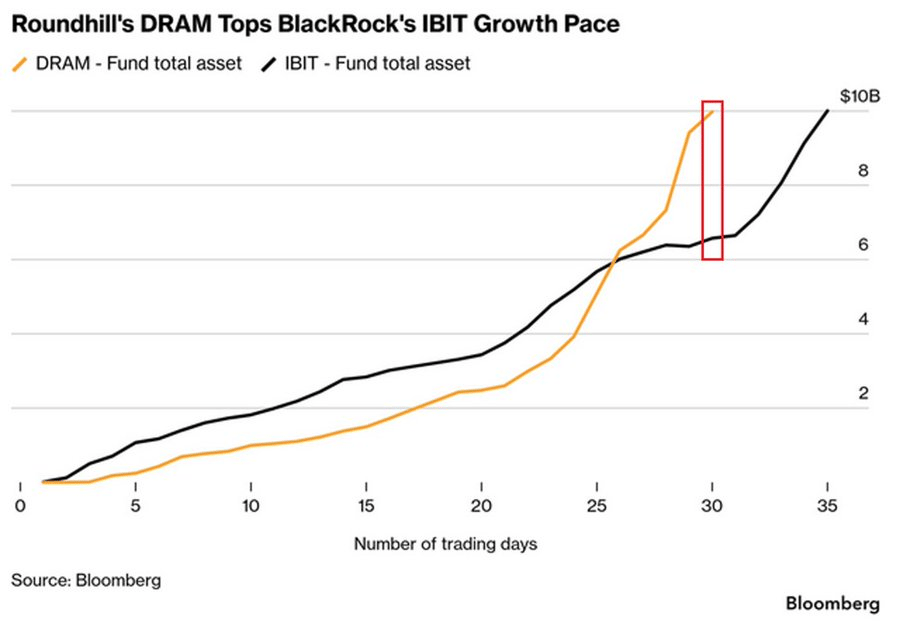
The milestone overtook the pace previously set by the BlackRock iShares Bitcoin Trust (IBIT), which had been regarded as the benchmark for rapid ETF expansion.
The fund reached $1 billion in assets within its first 10 trading days and maintained strong inflows throughout its launch period.
Alongside the surge in investor capital, DRAM’s share price has climbed about 84% since inception, reflecting strong market demand for exposure to AI-related semiconductor infrastructure.
DRAM ETF focus
DRAM focuses on memory semiconductor companies producing DRAM, NAND, and high-bandwidth memory chips used in AI training and inference systems. Its top holdings include Micron Technology (NASDAQ: MU), Samsung Electronics, and SK Hynix, which have benefited from soaring demand for AI-related memory products.
The ETF launched as major technology firms and hyperscalers accelerated AI infrastructure spending.
Growing demand for computing power has made memory chips a key constraint in the semiconductor supply chain, boosting prices and revenue expectations across the sector.
Unlike broader semiconductor ETFs, DRAM offers concentrated exposure to the memory segment, which analysts view as a major AI beneficiary.
The fund’s rapid growth also reflects shifting investor focus from GPU makers toward the broader hardware ecosystem supporting large-scale AI systems.
The fund, which trades on the Cboe BZX exchange, carries an expense ratio of 0.65%.
However, its concentrated exposure to the cyclical memory chip industry leaves investors vulnerable to volatility, particularly if AI infrastructure spending slows or chip supply increases.