
Welcome to our institutional newsletter, Crypto Long & Short. This week:
- Trusted indexes turn fragmented digital assets into a mature market that big institutions can confidently invest in, writes Kirsten Wegner, CEO of Index Industry Association.
- The division between traditional finance (TradFi) and crypto is disappearing, says Dave LaValle, President of CoinDesk Data & Indices.
- Top headlines institutions should pay attention to by Helene Braun.
- “GEODNET: Revenue at Record Highs as Price Plays Catch-Up” in Chart of the Week.
-Alexandra Levis
Expert Insights
The measure of a maturing market
By Kirsten Wegner, CEO, IIA
It is worth shining a light on an important tool in the evolution of digital asset markets: the index. At their core, indexes are a way of measuring markets. They turn fragmented, around-the-clock trading data of different types of securities — from equities to bonds to digital assets — into clear, comparable figures investors can actually use. The ability to capture the size and performance of different cryptocurrencies and tokens is becoming central to how digital assets are understood by institutional investors like asset managers, pension plans, foundations and endowments.
As digital assets move toward broader institutional adoption, investors bring familiar expectations with them. They want the same tools that support decisions across public markets, including transparent pricing, standardized benchmarks, independent governance and reliable ways to measure performance and risk. In other words: they want what indexes provide.
Throughout financial history, the arrival of trusted benchmarks has often marked the moment that a new market becomes an investable one. Equities, fixed income, commodities and currencies each developed their own benchmarks as they matured. None of these measures are the market itself, but they are the lens through which it can be seen clearly and compared consistently.
Digital assets are following that path. A decade ago, crypto pricing was scattered across venues with very different standards, leaving investors to guess at fair value. Today, rules-based methodologies of indexes aggregate data across exchanges, screen for quality and flag anomalies — producing reference points reliable enough to anchor derivatives pricing and support the spot bitcoin ETFs now drawing institutional capital. That trust came not because prices rose, but because measurement improved.
It is worth being precise about what an index is and is not. An index holds no assets and no money. It is a licensed statistical construct, a rules-based measurement that others can tie to research or to investment vehicles such as exchange-traded funds. An asset manager builds the product and holds the capital; the index provides the yardstick. That separation keeps the measurement independent of the money it measures.
Looking for more? Receive the latest crypto news from coindesk.com and market updates from coindesk.com/institutions.
Note: The views expressed in this column are those of the author and do not necessarily reflect those of CoinDesk, Inc., CoinDesk Indices or its owners and affiliates.

-
1
Crypto industry aghast at Illinois’ new tax on holding or transferring digital assets in state budget8 minutes ago
-
2
Moody’s rolls out credit ratings on Solana in tokenized asset push45 minutes ago
-
3
BitGo stock surges on $50 million share buyback as value languishes 65% below IPO price2 hours ago
-
4
Crypto’s security nightmare won’t be solved by ordinary audits2 hours ago
-
5
Mexican billionaire with 70% of his investment portfolio in bitcoin says it’s better than real estate2 hours ago
-
6
Kevin Warsh’s first Fed meeting could be more about communication than rates3 hours ago
-
7
CoinDesk 20 performance update: Bitcoin Cash ($BCH) drops 3.1%, leading index lower3 hours ago
-
8
A new Bittensor proposal would turn validators into something like fund managers4 hours ago
-
9
SpaceX’s $2.6 trillion market cap nearly double that of bitcoin4 hours ago
-
10
Bitcoin’s June downturn leaves $8.6 billion in options out of the money5 hours ago


In May, combined exchange volumes fell 3.45% to $4.41T; the lowest since September 2024. RWA perpetual futures volumes rose 10.4% against the trend, hitting a new all-time high.
In May, combined exchange volumes fell 3.45% to $4.41T; the lowest since September 2024. RWA perpetual futures volumes rose 10.4% against the trend, hitting a new all-time high.
Why it matters:
In May, combined exchange volumes fell 3.45% to $4.41T; the lowest since September 2024. RWA perpetual futures volumes rose 10.4% against the trend, hitting a new all-time high.
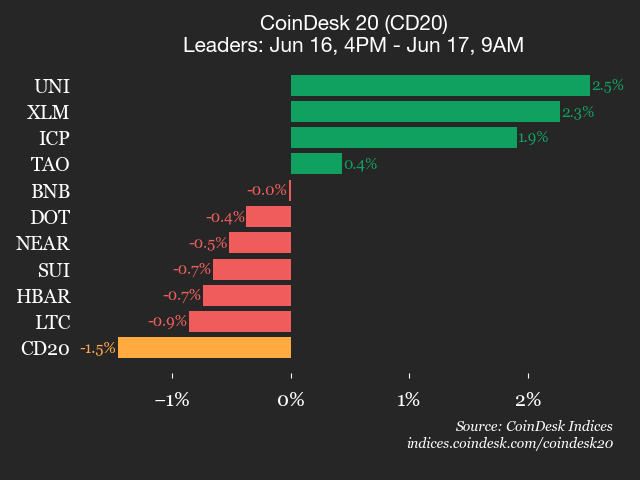 CoinDesk 20 performance update: Bitcoin Cash ($BCH) drops 3.1%, leading index lower
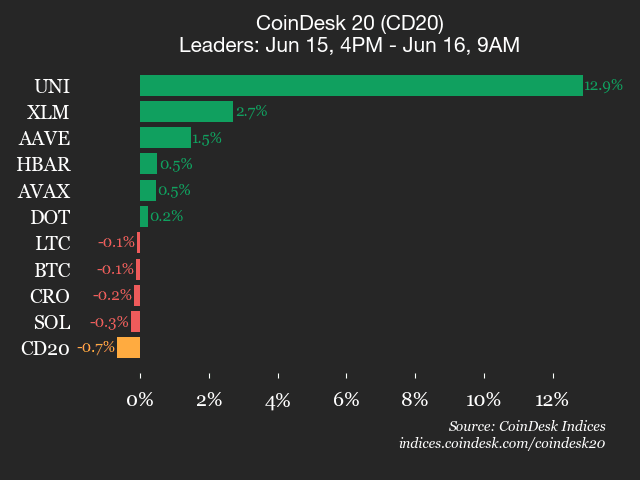 CoinDesk 20 performance update: Uniswap (UNI) gains 12.9% while index trades lower
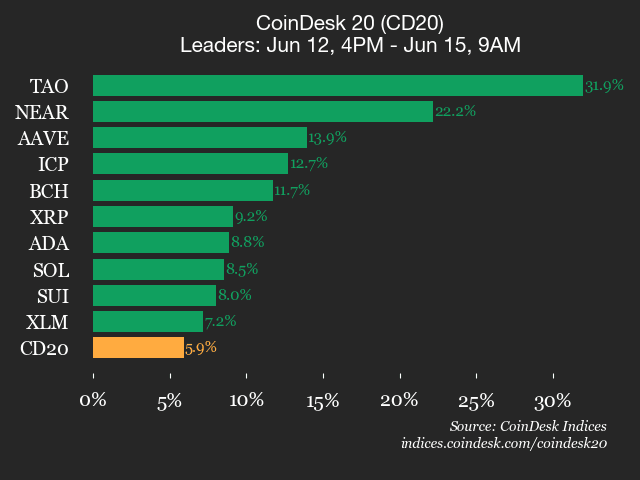 CoinDesk 20 performance update: Bittensor (TAO) surges 31.9%, leading index higher