The crypto market has increasingly followed U.S. macroeconomic conditions, often falling alongside equities during periods of tightening liquidity. That relationship now faces another test from the U.S. 30-year Treasury yield.
The yield reached 5.16%, raising concerns about borrowing costs and the returns investors demand from risk assets.
Why does the 30-year yield matter?
The U.S. 30-year Treasury yield crossed 5% on the 7th of July and remained above it for 16 days. According to The Kobeissi Letter, this marked its longest sustained stretch above 5% since 2007.
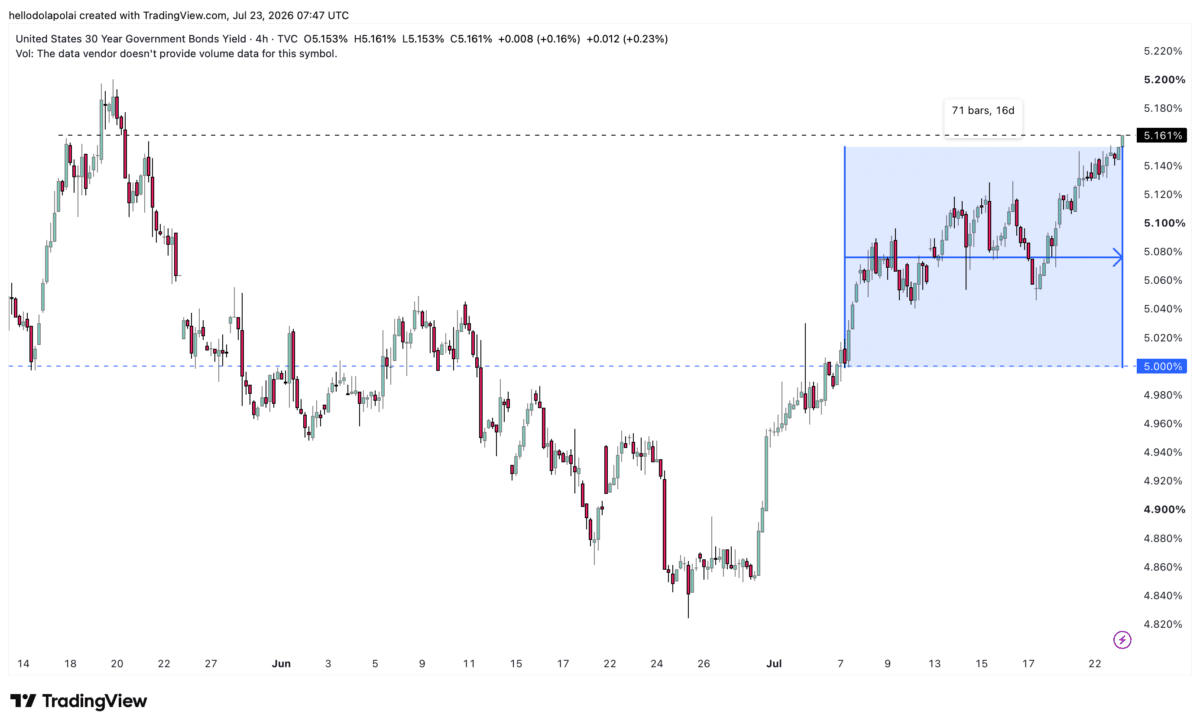
Long-term yields reflect several forces, including inflation expectations, Treasury supply, fiscal concerns, and demand for government debt. Their current rise suggests investors expect interest rates and borrowing costs to remain elevated.
Higher Treasury yields can pressure crypto by making lower-risk assets more attractive and increasing the return expected from speculative investments.
However, the yield does not prove that investors are directly rotating from crypto into government debt.
Bitcoin [BTC] previously responded positively after the Consumer Price Index [CPI] came below expectations. A sustained move above 5% could weaken that recovery by reviving concerns about inflation and tighter financial conditions.
Is the Hormuz crisis driving yields?
Oil disruption from the Middle East conflict has added to inflation concerns, particularly around the Strait of Hormuz. Iran said it had closed the waterway, while the U.S. continued efforts to protect commercial transit.
That disruption lifted energy prices, strengthening concerns that higher fuel costs could slow inflation’s decline.
Crypto analyst DarkFost said:
This is where Trump will need to ease tensions with Iran.
However, de-escalation remains the analyst’s expectation rather than a confirmed policy outcome.
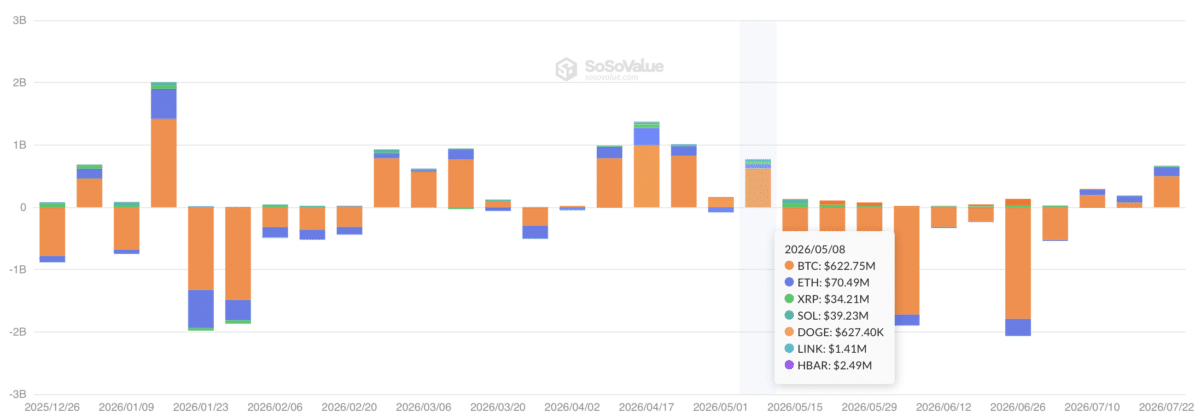
Despite the Treasury warning, U.S. crypto exchange-traded funds continued attracting capital. SoSoValue data showed $667.32 million in Net Inflows across tracked crypto ETFs during the current week.
This was the strongest total since the week beginning the 8th of May, when inflows reached approximately $771.2 million.
The divergence suggests institutional crypto demand has remained resilient despite pressure from long-term yields.
De-escalation around the Strait of Hormuz could reduce oil supply concerns and ease part of the inflation pressure.
Lower energy prices may support risk appetite, particularly if Treasury yields retreat alongside inflation expectations.
U.S. M2 reached $23.05 trillion in May, according to Federal Reserve data.
However, this money supply cannot be treated as capital waiting to enter crypto. For now, ETF inflows show resilience, while the 30-year yield remains a warning against assuming a full risk-on shift.
Final Summary