The recent halt in military exchanges between the United States and Iran shifted investors’ attention away from traditional safe-haven assets and back toward risk-driven markets.
Gold had rallied during the conflict as traders sought protection from geopolitical uncertainty. However, analysts later argued that easing tensions reduced the urgency for defensive positioning.
Several market commentators expected gold to struggle near the $4,100 region after the conflict cooled, while Bitcoin [$BTC] stood to benefit if investors rotated capital toward higher-risk assets. That shift arrived just as broader market sentiment improved across equities and digital assets.
Moreover, traders remained cautious because macroeconomic events still carried the power to reshape market direction. As a result, both gold and cryptocurrencies entered the week with competing narratives rather than a clear trend.
Will macro events decide the next winner?
Investors closely monitored a packed economic calendar that placed both crypto and gold at another decisive crossroads.
The U.S. stock market reopened after the U.S.-Iran ceasefire, while lawmakers prepared for another possible discussion around the Clarity Act on the 28th of July.
Markets also awaited the Federal Reserve’s interest rate decision on the 29th of July alongside earnings from Microsoft, Meta, and Kevin Warsh’s scheduled remarks.
The following day brought PCE inflation data, Bank of Japan and Bank of England rate decisions, plus earnings from Strategy and Apple. Each event carries the potential to reshape expectations around liquidity, interest rates, and risk appetite.
China fueled fresh debate over gold markets
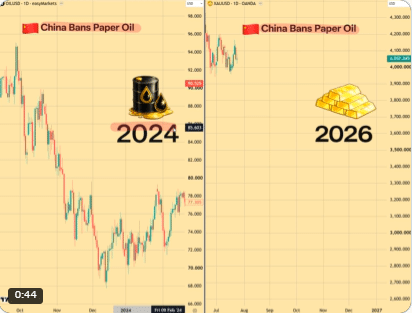
According to reports, China intended to impose restrictions on the trading of paper gold, adding even more uncertainty to the commodity markets.
The discussion centered on China’s reported holding of roughly 30,000 tonnes of physical gold while concerns grew over leveraged paper contracts determining market prices.
Analysts argued that one ounce of physical gold often supported multiple paper claims, leaving price discovery heavily influenced by derivatives instead of physical demand.
That narrative encouraged speculation that confidence could gradually shift toward physical metal ownership. However, the development also carried broader implications for cryptocurrencies.
Bitcoin supporters have long promoted the asset as a transparent alternative to traditional financial markets because its supply remains verifiable on-chain. Therefore, any decline in confidence surrounding paper gold markets could strengthen Bitcoin’s appeal among investors seeking assets with greater transparency and fixed issuance.
Bitcoin’s historical signals revived long-term conviction
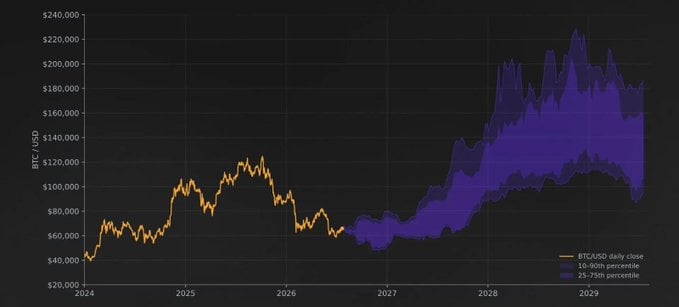
Bitcoin also attracted renewed attention after Blockworks Research highlighted several historical valuation signals. $BTC traded at its most oversold level relative to the Nasdaq in recent history.
The report also showed Bitcoin reaching an extreme oversold condition against gold while changing hands only 18% above its realized price of approximately $53,000.
Previous bear market cycles had formed bottoms roughly 60 weeks after each all-time high, while the current cycle approached 40 weeks since its peak. Those comparisons suggested Bitcoin had entered a valuation zone that historically rewarded patient investors.
Although history would not guarantee another identical outcome, the data indicated that downside pressure had already eased significantly compared with earlier stages of previous market cycles.
Final Summary
- Bitcoin’s historical valuation signals strengthened while gold’s geopolitical support started fading.
- Macro events this week could determine whether investors favor crypto or traditional safe havens.