For those who haven’t followed the BIP-110 fight, it is essentially a proposed change to Bitcoin’s rules that would restrict how much non-financial data, such as images or files, users can embed in the blockchain. Supporters argue the restriction would curb what they call “spam” that consumes block space and steer the protocol back toward its original job of moving money.
So far, support remains scarce, with less than 50 blocks left before mandatory signaling begins at block 961632, in less than eight hours from now at 9 a.m. EDT on Saturday. Signaling sits at just 2.6% at press time. The cleanest first-hand test is to run Bitcoin Core beside an RDTS-enforcing Knots build and watch whether their chain tips diverge once block 961632 arrives. However, not everyone has the hardware or technical setup to run full nodes, and nodes themselves do not reveal miner signaling percentages.
Where to Watch the Action
The following websites give onlookers a front-row seat as the event unfolds in real time, tracking miner signaling and distinct node chains so observers can spot a potential chain split as it happens. A fractured blockchain could emerge if miners produce blocks that BIP-110 rejects after block 961632, leaving Bitcoin Core nodes accepting blocks that RDTS-enforcing Knots nodes refuse to follow.
Fork.observer
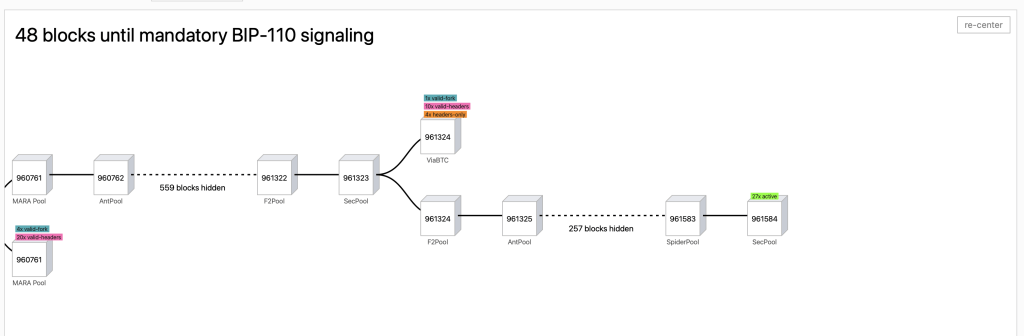
The web portal Fork.observer is one of the go-to sites for catching a Bitcoin bifurcation in the act. The site watches Bitcoin’s blockchain in real time for chain splits and competing blocks, plotting the main chain alongside any side branches or forks that suddenly break away. Fork.observer’s maintainer has the dashboard primed for today’s test, saying the site is:
“Connected to a mix of 50+ nodes: Bitcoin Core, Knots, BIP-11O, btcd, floresta, electrum, and mempool-space. Also showing which block 20+ mining pools are mining on.”
BIP110.org/monitor
BIP110.org/monitor is the official live dashboard attached to the BIP-110 proposal website. It tracks miner signaling for BIP-110’s version bit 4 in real time, showing the current difficulty period, signaling percentage, blocks remaining before mandatory signaling begins at block 961632 and a visual grid of recent blocks. For anyone watching the countdown, it offers a clean public window into whether miners are actually rallying behind the temporary>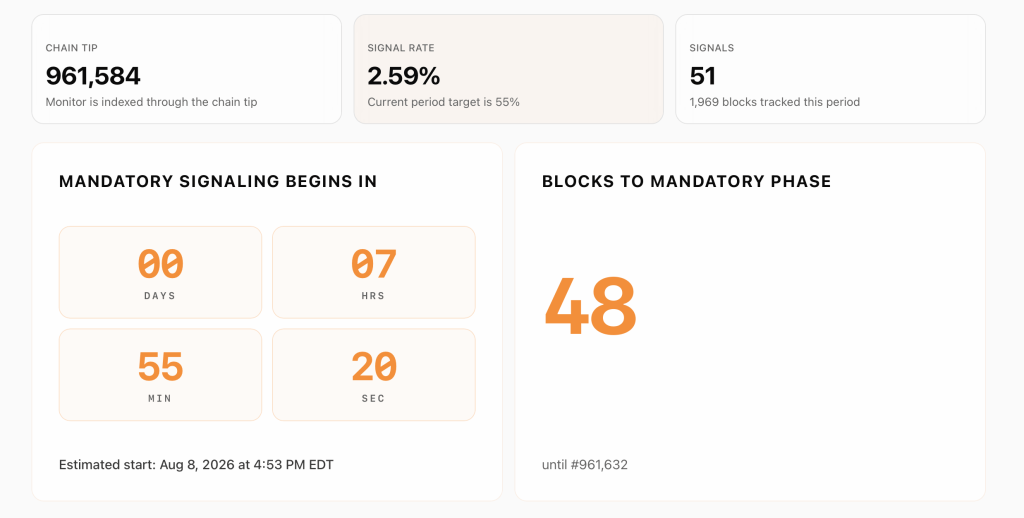
Image source: BIP110.org/monitor
Forkwatch.tv
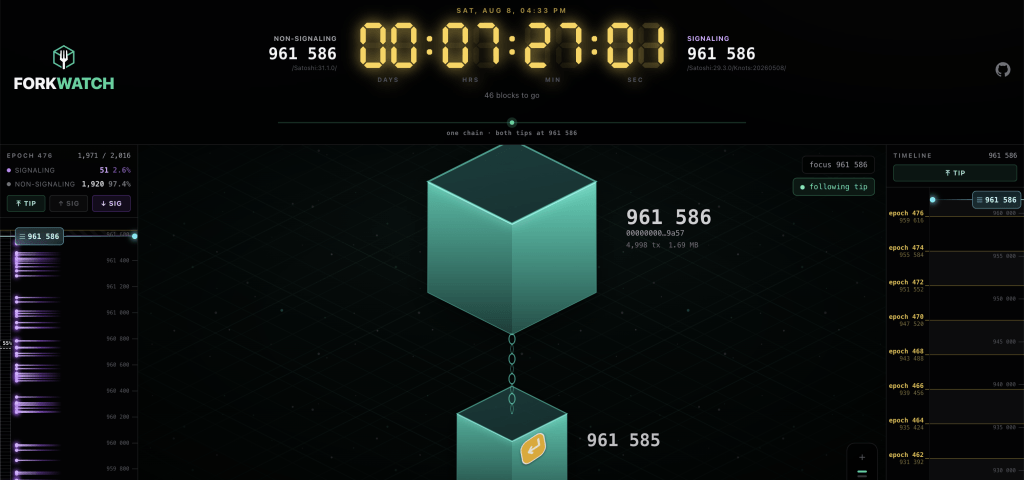
The next website, Forkwatch.tv, is built specifically to watch the BIP-110 showdown unfold in real time. It tracks Bitcoin’s current chain tip alongside emerging signaling and non-signaling branches, displaying block heights, BIP-110’s signaling percentage during the current difficulty period and the countdown to mandatory signaling. More importantly, the site flags blocks containing transfers that BIP-110 participants would reject, making it easier to see where competing rule sets could collide.
Mempool.kilombino.com
Mempool.kilombino.com is a customized clone of the familiar mempool.space interface, rebuilt to spotlight BIP-110 miner signaling through version bit 4 and flag transactions or blocks that would violate its proposed data limits, including oversized outputs, large data pushes and certain Taproot features.
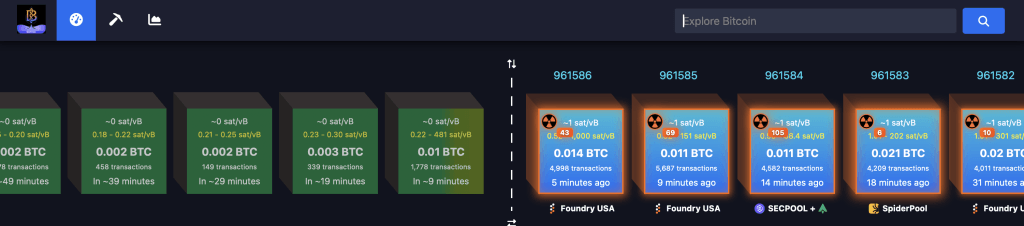
The dashboard lets observers watch the main Bitcoin chain alongside any potential BIP-110-enforcing chain, with visual warnings exposing rule violations and differences between node software as they appear.
Forkmonitor.info
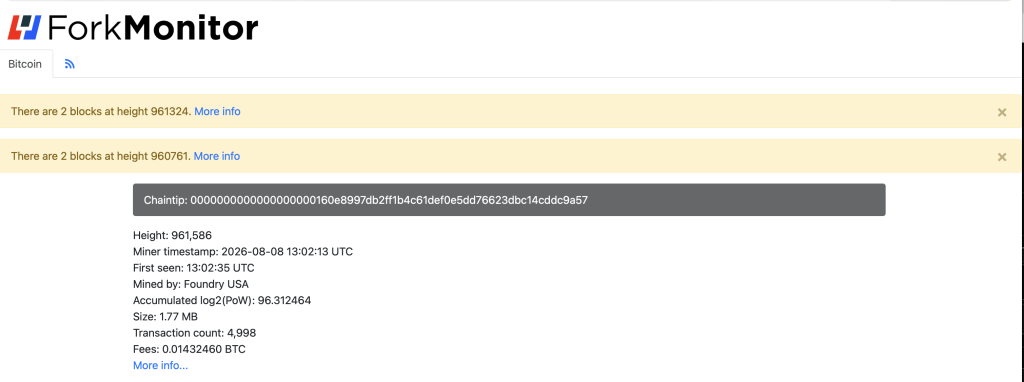
Forkmonitor.info is a long-running public Bitcoin network monitoring site that tracks chain tips and potential forks/splits in real time. It basically connects to many Bitcoin nodes running different software versions (including multiple Bitcoin Knots builds that enforce BIP-110) and displays their current chain height, sync status, and whether any nodes are following a different chain.
Miningpool.observer
Miningpool.observer puts Bitcoin mining pools under the microscope by comparing high-fee block templates generated by a Bitcoin Core node against the blocks miners actually produce. That side-by-side view exposes which transactions pools include, exclude or treat as conflicting.
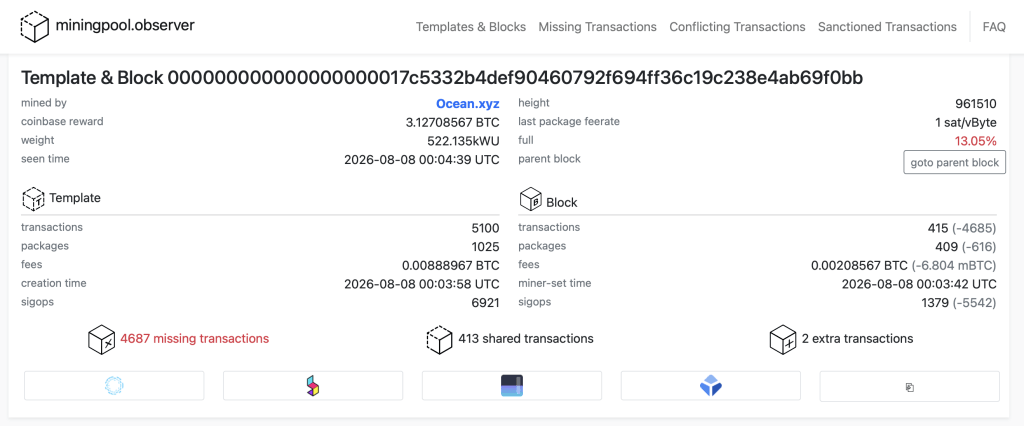
The site flags missing and extra transactions, conflicts and instances where pools appear to deliberately filter transactions. During an event like BIP-110, it becomes especially useful for seeing what miners are actually doing rather than what signaling alone claims, revealing transaction-selection policies block by block.
Wickedsmartbitcoin.com/bip110_signaling
Wickedsmartbitcoin.com/bip110_signaling (also reachable via the shortcut bip110.rip) is a detailed BIP-110 signaling dashboard. It basically tracks miner signaling for BIP-110 across each 2,016-block difficulty period with visual charts, shows the current signaling percentage and estimated hashrate, and displays a countdown to the mandatory signaling window.
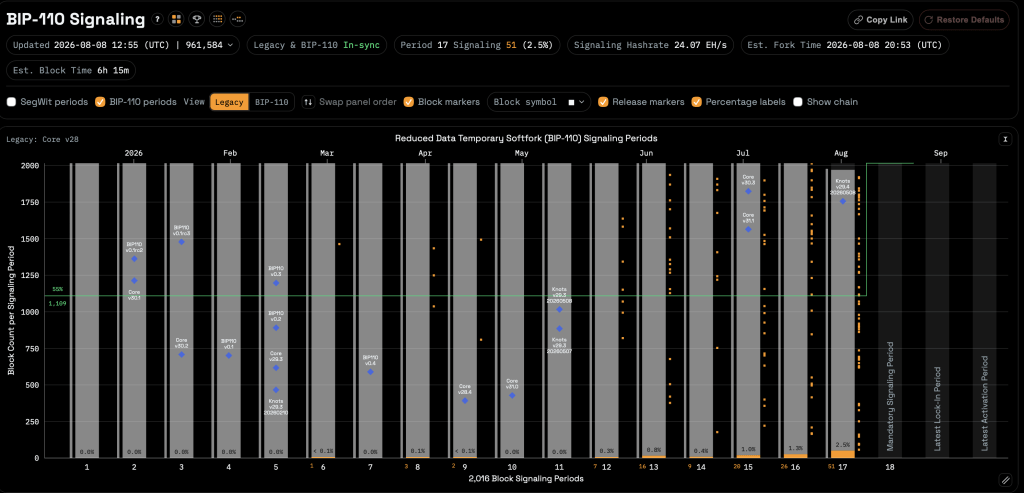
Key features include a live “Legacy vs BIP-110” chain comparison that indicates whether the two sides are still in sync or have started to diverge, a miner/pool signaling leaderboard, and historical comparisons with earlier soft forks like Segwit. It is one of the more feature-rich community tools for monitoring both signaling progress and potential chain-split risk.
Tik-Tok, Next Block
Whatever happens at block 961632, the value of these trackers goes beyond a single afternoon. Bitcoin’s governance has always run on rough consensus and running code rather than formal votes, and BIP-110 is turning that abstraction into something people can watch happen in real time. If the chain splits, these dashboards become the record of exactly when and where. If it doesn’t, they still show how close the network came to testing itself under pressure.
The bigger lesson sits with the tools themselves. A soft fork attempt used to mean parsing raw block headers or trusting secondhand reports from mining pools. Now anyone with a browser can watch chain tips diverge, compare miner behavior against expected templates, and see signaling data update block by block.
Right now, all eyes are on the clock. BIP-110 critic and Strategy founder Michael Saylor weighed in on the subject hours before mandatory signaling kicks in. Saylor stressed, “With only 2.6% miner signaling, BIP-110 has failed to earn broad miner support. At block 961,632, its nodes will reject non-signaling blocks. BIP-110 will then stall or fork into irrelevance while Bitcoin continues normally. Bitcoin is working as designed.”