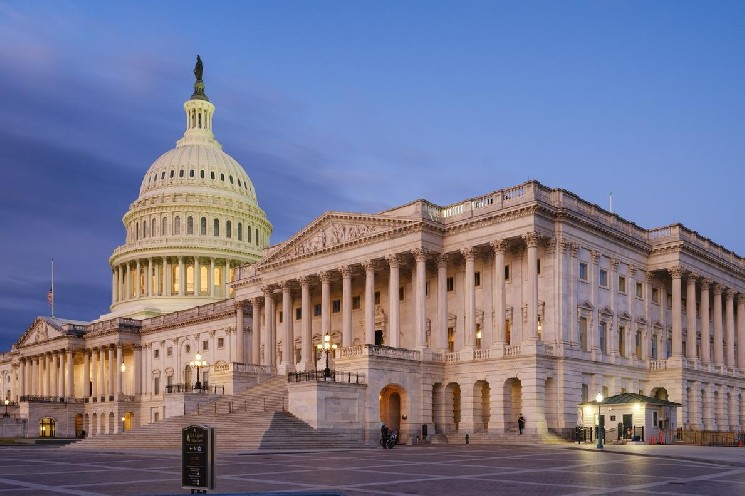
The Senate blocked the crypto industry’s market structure bill on Tuesday. On Thursday the Securities and Exchange Commission did a piece of the job itself. An order from the agency lets tokenized versions of U.S. stocks trade on blockchain liquidity pools for the next five years, provided the venue running the pool is American, checks who its users are and stays under a volume cap. It treats automated market makers, the software behind decentralized exchanges, as something to accommodate rather than police.
“Earlier this week, Congress was unsuccessful in advancing the CLARITY Act despite the tireless efforts of many,” chairman Paul Atkins said in a statement accompanying the order, two days after the cloture vote failed 49-50. The exemption, he said, “would allow TSVs to trade tokenized NMS stock in a permissioned environment today while the Commission considers the need for additional action.” TSV is the order’s term for a tokenized securities venue; NMS stock is an exchange-listed share.
“What a shift from four years ago,” Alex Cutler, co-founder of Aerodrome, said in an interview the morning the order was posted. Aerodrome is the largest decentralized exchange on Coinbase’s Base blockchain and the venue where Coinbase’s own tokenized stocks got their first liquidity in August. “This looks like they’re just dipping their toes in. But if you think back three, four years, I mean this is just incredible to see coming out of the US regulator. They know what AMMs are. That’s awesome.”
Coinbase put tokenized Apple, Nvidia, Meta and Alphabet shares on Base on August 24 and has since added six more, among them Tesla, Microsoft and a SpaceX token. Each token is a claim on a share held by Alpaca, a regulated broker, in a bankruptcy-remote structure supervised by Abu Dhabi Global Market’s financial regulator.
Dividends and splits are handled by an on-chain multiplier so balances never change. None of it is available to Americans. “Coinbase worked with the regulator in Abu Dhabi to issue the Coinbase tokenized stocks,” Xen Baynham-Herd, head of marketing and global at Base, said in an interview. “Even if the regulatory environment in the US is challenging, that’s changing, there’s still other options for companies to issue stocks.”
“We’re doing between 50 to 100 million of volume a day now, and fast approaching a billion in total volume, which is a great start,” Baynham-Herd said. Bitwise launched model portfolios of the tokens on August 25, rebalanced inside the holder’s own wallet by a platform called Glider. “Glider is another example where they have a Mag 7 portfolio. I think it recently hit a million in AUM,” he said.
The relief is narrower than the headlines. A venue must be a U.S. person, must set standards for who can trade, and may list at most 75 large-cap symbols, with volume in each capped at 0.25% of the stock’s average daily share volume in the prior month. For Nvidia that works out to roughly 300,000 shares a day, about $65 million at current prices, by my arithmetic on the past month’s trading. Smaller stocks get a 250-symbol, 2.5% tier. A company can object within 30 days and keep its shares off a venue entirely. The venue cannot offer leverage, must halt whenever the primary exchange halts, and must publish its smart contracts on a public, permissionless chain.
Synthetic products are out. The order excludes “a tokenized linked security or a tokenized security-based swap,” which is the structure behind Robinhood’s SpaceX and OpenAI tokens in Europe. A qualifying token must carry the same dividends, voting rights and liquidation claim as the share. Coinbase says its tokens carry shareholder rights under the ADGM prospectus; whether that structure satisfies a venue’s verification duty is a question the order leaves to the venues. Nothing changes for a U.S. investor until someone publishes a notice, waits 30 days and opens a pool.
Cutler’s argument is that the structure, not the regulator, separates this round from the last one. “If you go to most of these token issuers, right, issuing some version of a tokenized stock, they’re going to be really clear this is not a stock and you’ve got no claim on it,” he said. He pointed to earlier versions on other chains “where the stock in the aftermarket goes up like 500x and then it collapses right down.”
The friction the order does not address is time. Nasdaq’s 23-hour trading day starts on December 6, with the SEC’s blessing, and still closes on weekends. An on-chain pool does not. Cutler described Nvidia’s earnings on August 26, two days after the launch, which landed after the close. “You saw liquidity providers, which is almost like an order book on chain, positioning around Nvidia as it closed, on both the buy and sell side,” he said. “All they are doing, since this can be redeemed at market open for the real asset, is they are betting just like an aftermarket on what they think the price of Nvidia will be the next day at open.” “There’s no need for an oracle because you are the most liquid venue at that time and other markets will essentially take your price as the reference price,” Baynham-Herd said.
The oddest thing happening on Base is one the order quietly permits. “We’re seeing lots of people pair meme coins with tokenized stocks and that whole thing’s taken off in a big way,” Baynham-Herd said. The SEC’s text lets a venue pair a tokenized stock with any non-security crypto asset it chooses. Cutler’s answer to the manipulation question was GameStop. “There’s a groundswell of retail interest and it probably has some very little to do with the fundamentals of the company,” he said. “So we’ll see a version of that onchain, right? And people having fun and doing these types of things.”
Atkins called the order a bridge toward durable rulemaking and opened it to public comment. The five-year clock started on Thursday. “The train has fully left the station on tokenization,” Cutler said. “Absent something like Clarity, which I still deeply hope we get someday, although it was obviously a blow this week.”
Leave a Reply
You must be logged in to post a comment.