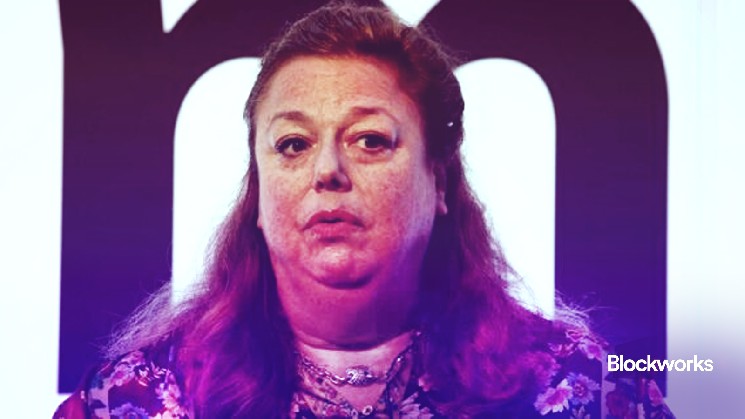
An overhaul of financial market infrastructure is set to occur, according to Franklin Templeton innovation head Sandy Kaul — and likely faster than many people expect.
“I think our entire product suite will be onchain at some point in the future,” she told me. “It is simply [about], ‘What is the migration path to getting there?’”
Financial institutions, central banks and corporations using account-based infrastructure are set to move to wallet-based systems on top of blockchains for efficiency and other benefits, Kaul argued.
Estimates that the roughly $240 billion stablecoin market could increase by 10 times over the next several years might be conservative, Kaul argued. But she made clear that it won’t be the crypto-native players driving this growth.
“I think banks are going to realize their future is going to be wallet-based, and they’ll begin to issue their own stablecoins and different versions of tokenized cash in an effort to remain competitive,” she said. “That is where trillions and trillions of dollars of deposits sit, so I think it will grow very, very quickly.”
As stablecoins (checking account equivalents, as Kaul labeled them) become “a foundational piece of financial infrastructure,” she explained, tokenized money market funds — acting like savings accounts — will take off in tandem.
Read more: Tokenized yield funds, stablecoins a “powerful” combo
Franklin Templeton launched its OnChain US Government Money Fund in 2021. Its assets under management were $740 million as of June 30.
Illiquid, difficult-to-process assets — like CLOs and private credit — are heading onchain to create operational efficiencies, Kaul said. More public equities and ETFs will be tokenized too — and in a less convoluted way than some of the “wrapped workarounds” currently available, she added.
“And if you move an ETF onchain, in essence you almost eliminate the need for the ETF wrapper over time,” Kaul noted. “Because the smart contract does all the work that the ETF wrapper does today.”
Keep reading for more excerpts from Blockworks’ interview with Kaul.
Blockworks: So you expect Franklin Templeton’s whole product suite will end up onchain. How far into the future could that be?
Kaul: I think within a decade. I don’t think this is decades away.
One of the really amazing attributes of technology innovation in the last 20 years has been how rapidly it is speeding up. If you think about the fact that Ethereum is just 10 years old, I think things will happen much more quickly than people anticipate.
Our CEO is on record saying [she thinks] we will see more transformation in the financial market infrastructure in the next five years than we’ve seen in the last 50. People are going to be surprised, because I think a lot of people are skeptical that it’s going to happen at all.
Blockworks: What is it like to be at a traditional financial company that is also leaning into a disruptive technology like blockchain?
Kaul: We’re very fortunate in that we have a CEO, an executive team and a board who are highly supportive and enthusiastic about the opportunities that we’ve uncovered, the infrastructure we’ve built and the opportunity they see ahead of them.
Now that we’ve reached the point of maturity in the infrastructure we’ve built — where we can issue and program our own tokens, where we have our own transfer agent on blockchain, where we can administer our shareholder records and offer brand new functionality like intra-day yield and peer-to-peer transfers — we’re identifying the spots where we’re integrating it into our own ecosystem.
We’re talking with our vendor management group and our treasury group about ways that we can start to experiment and show the use cases around tokenized money market funds. We’re looking at ways that we can work with our fund boards to see if we can’t introduce new innovations into the way they manage their cash in our traditional mutual funds.
It may take us 10 years to move onto these new rails, but we will do it one step at a time, one set of products at a time, one set of use cases at a time. But that infrastructure that we need to compete in the future, I think we’re one of the first asset managers to really have that in place.
Blockworks: What do you view as the biggest hurdle to overcome in ensuring continued progress in this segment?
Kaul: There’s been a very long, established way of doing know-your-customer and anti-money laundering screening of clients. That is at such foundational conflict with this whole idea of a permissionless ecosystem, and I think the final answer is going to sit somewhere in between.
It’s not going to be the same rigidity with which we have to do and maintain and affirm KYC and AML today in the traditional world, where every firm has to do it itself and maintain their own. But I don’t think it’s going to be permissionless either.
“What is the right blend of protection required to ensure that this new financial ecosystem works in a way that protects consumers and discourages bad actors?” is the piece that I don’t see people doing enough work and thinking on.
Blockworks: You were a speaker at a May SEC roundtable focused on tokenization. What was your takeaway from that event and from broader conversations with the SEC?
Kaul: There’s a much more receptive environment for the many, many people within the SEC who have been trying to drive responsible, effective policy for these crypto ecosystems for years. But they weren’t getting the support organizationally to bring all that great thinking and recommendations to the forefront.
What we’re most excited about is really defining the regulatory pathway to being able to intermix both securities and tokens. I think that’s where the distribution really opens up. There still has not been the regulatory clarity that’s going to allow someone to just distribute an ETF or just distribute a mutual fund on a blockchain set of rails.