The Counter-Strike 2 skins market is notorious for rapid ascensions, ridiculous prices for in-game items and extreme volatility. It might sound familiar to anyone who has ever traded crypto. The traits of both markets are often compared — speculation, hype and sudden crashes — and that is why what just happened in the CS2 market looks strikingly similar to a crypto meltdown.
What caused crash?
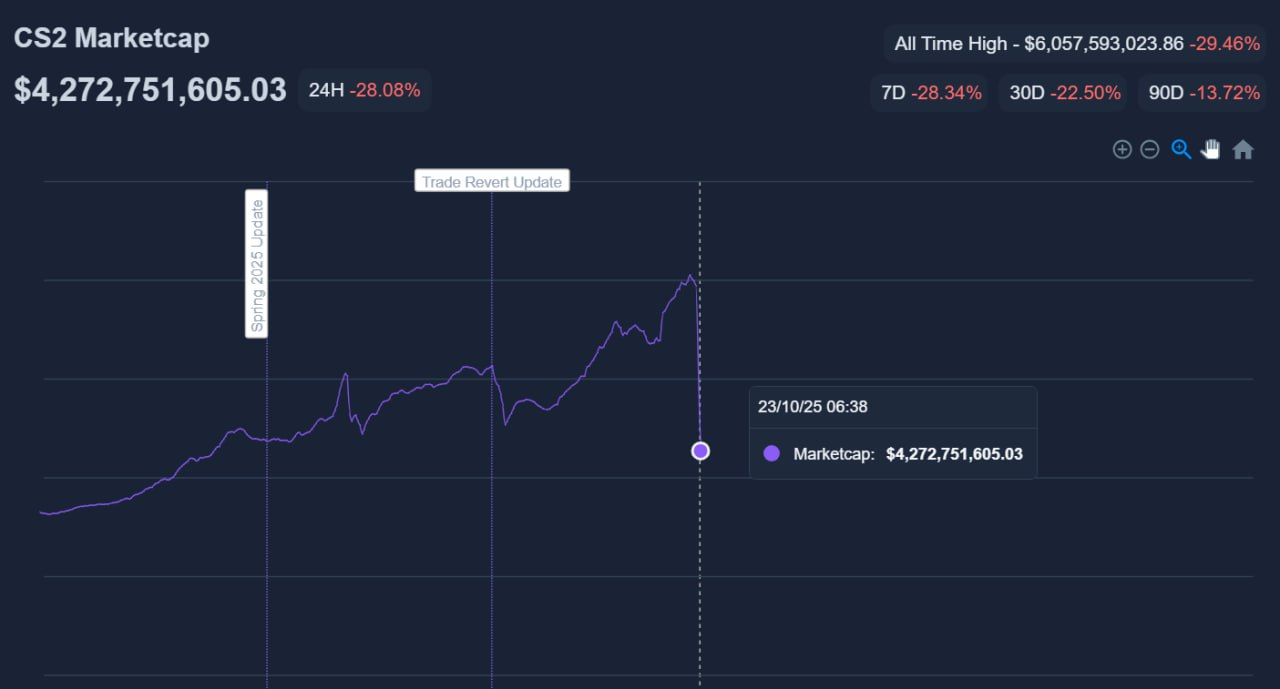
In just 24 hours, the market capitalization of CS2 skins nosedived by $1.784 billion, falling from nearly $6 billion to $4.27 billion, a drop of over 28%. The cause? An unexpected update from Valve, the developer of Steam, CS2 and Dota 2, that completely reshaped the in-game economy overnight.
The patch is now allowing players to exchange five Covert (red-tier) items for a knife or gloves from the same collection. In essence, Valve just enabled players to turn $100 skins into potential $100,000 knives, triggering an immediate flood of new high-tier items. According to CS Float, there are around 20 million Covert skins in existence, and if all were used in crafting, the number of knives and gloves could jump from 5.5 million to over 11 million, effectively doubling supply and gutting prices.
Some items have already collapsed massively: knives that sold for $1,300 just two days ago are now valued at around $200. The same is happening with premium-tier knives, with costs over $100,000.
Crypto and skins go toe to toe
But unlike decentralized assets such as Bitcoin, Valve is a centralized authority with full control over its economy. It can, at any point, inflate, restrict or destroy value within the CS2 ecosystem. And it does not really hurt them: in fact, it is likely part of a broader transition away from the loot box model (which faces regulatory scrutiny) toward a more transparent in-game shop system.
Trading volumes remain stable, though: the money has not vanished; it is just flowing from knives into other tradable skins. The value collapsed, but liquidity did not. In other words, the market did not die — it simply mutated under the guidance of Valve.