The New York Stock Exchange (NYSE) confirmed an official listing notice for Morgan Stanley’s spot Bitcoin ETF, ticker MSBT, signaling the product could launch soon.
ETF Analyst Eric Balchunas called the listing announcement a sign that the launch is “imminent.” If approved, MSBT would become the first spot Bitcoin ETF issued directly by a major U.S. bank.
Morgan Stanley Moves From BlackRock Buyer to Competitor
Morgan Stanley holds over $729 million across several Bitcoin ETFs, according to its latest SEC filing for the period ending December 31.
- Morgan Stanley has already demonstrated demand using BlackRock’s own product.
Of that total, $667.32 million sits in BlackRock’s iShares Bitcoin Trust ETF (IBIT).
That position made Morgan Stanley one of IBIT’s largest institutional holders. Now, with MSBT, the bank is shifting from distributing a competitor’s product to issuing its own.
The economics explain the pivot. By launching MSBT, Morgan Stanley captures management fees directly instead of earning distribution commissions on BlackRock’s fund.
- The fee undercut
IBIT currently dominates the spot Bitcoin ETF market with approximately $55 billion in assets under management and over $63 billion in total net flows since its January 2024 launch.
It charges a 0.25% management fee. Balchunas predicted MSBT’s fee could land around 0.24%, one basis point lower.
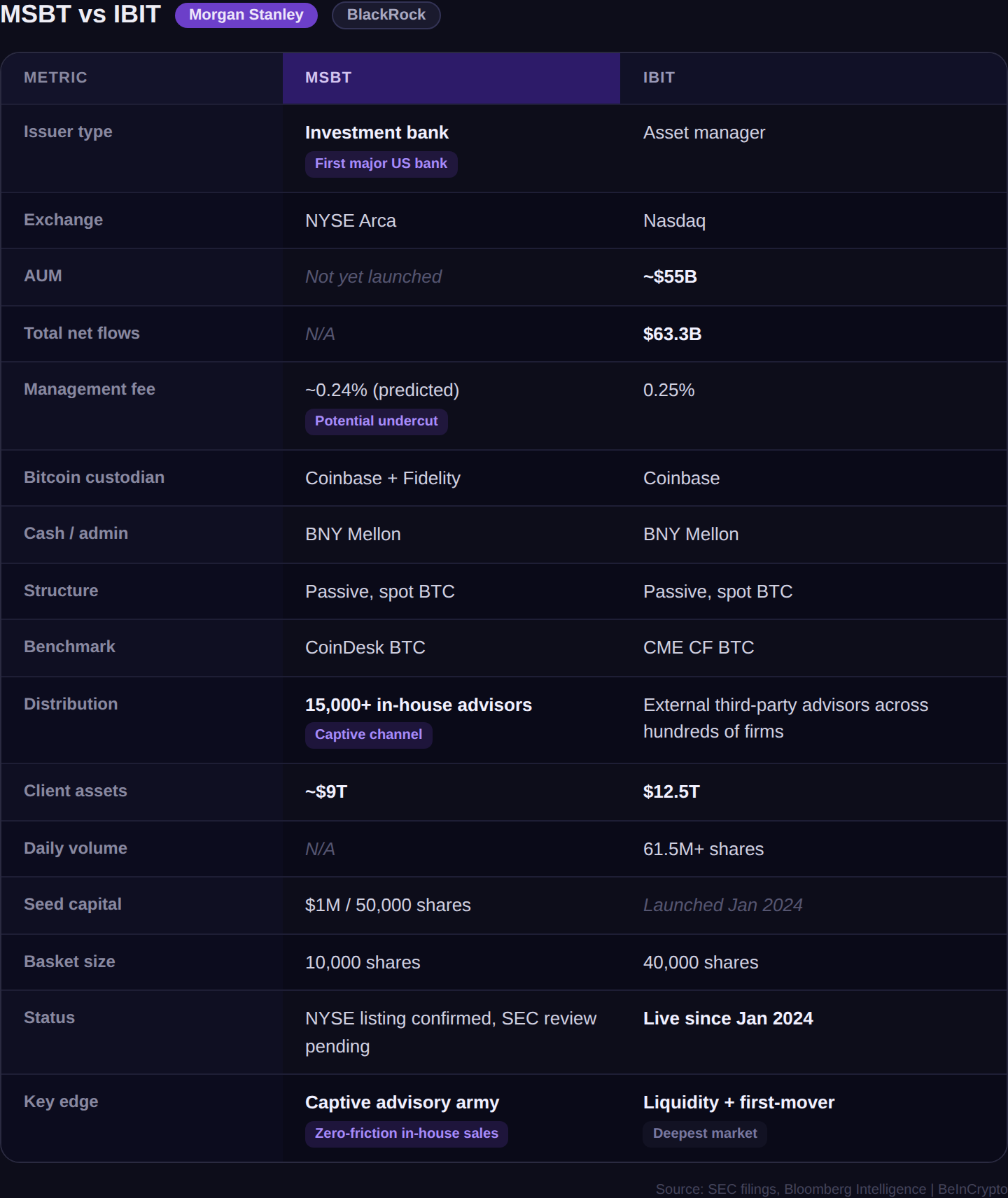
- The captive distribution army that BlackRock can’t replicate
The structural difference between MSBT and IBIT is not the product. Both hold Bitcoin in cold storage through Coinbase Custody.
Both use BNY Mellon for cash and administration. MSBT also added Fidelity as a third custodian.
The difference is distribution. Morgan Stanley operates roughly 15,000 to 16,000 financial advisors with direct access to an estimated $6.2 trillion in wealth management client assets.
“Morgan Stanley employs approximately 15,000 to 16,000 wealth management financial advisors in the US,” remarked Luis Berruga, ETF and asset management executive, and the former CEO of Global X ETFs.
When those advisors recommend MSBT, the entire transaction stays in-house. No third-party firm needs to approve or promote it.
BlackRock’s IBIT, by contrast, depends on external advisors across hundreds of firms to recommend it. That model built a $55 billion fund, but it also means BlackRock cannot control who sells the product or how aggressively.
Morgan Stanley Bitcoin ETF $MSBT got an official listing announcement from NYSE, that typically means launch imminent.. pic.twitter.com/SDDVyAGfpJ
— Eric Balchunas (@EricBalchunas) March 25, 2026
What Comes Next
The SEC has not approved MSBT. The review process for spot Bitcoin ETFs typically takes three to six months from an amended S-1 filing.
Morgan Stanley submitted its second amendment on March 20, 2026. A decision could come by mid-to-late 2026.
MSBT is also one piece of a broader crypto buildout at Morgan Stanley. The bank filed for Ethereum and Solana ETFs in January 2026 and plans to offer retail crypto trading through its E*Trade platform in the first half of the year.
It remains to be seen whether MSBT can pull significant assets from IBIT. However, the combination of a lower fee, a captive advisory network, and the Morgan Stanley brand behind the product gives BlackRock a competitor it has not faced before in the Bitcoin ETF arena.
The post 3 Reasons Why Morgan Stanley’s MSBT Might Be the ETF BlackRock Should Fear Most appeared first on BeInCrypto.