Stock market investors may be overlooking one interesting metric at Strategy (MSTR), the largest publicly traded holder of bitcoin : the capital market measure known as amplification.
Amplification compares the size of the Michael Saylor-led company’s total debt and debt-like instruments, such as preferred stock, to its stash of 766,970 $BTC. As amplification rises, like leverage, it adds more risk to the company, making the common stock more sensitive to bitcoin price movements.
Investors have tended to focus on the price of bitcoin and the multiple to net asset value (mNAV) premium when evaluating the company. But if amplification, currently about 33%, increases, it may become the dominant driver of risk.
At the top of Strategy’s capital structure is convertible debt, about $8.25 billion outstanding, the most senior claim. Below that are a number of preferred stocks, including STRC, STRK, STRD and STRF, with roughly $10.3 billion in notional value, according to the MSTR dashboard. At the bottom sits common equity, MSTR, which absorbs all residual upside and downside.
Read more: Strategy signals another bitcoin buy as company needs just 2% annual $BTC growth to cover dividends
STRC has been designed to become the primary vehicle for bitcoin accumulation for the company. Senior to equity and junior to debt, STRC pays an 11.5% annual dividend, distributed monthly in cash.
The volume of STRC, once negligible and in the low single digits relative to MSTR, has surged to around 20% on a weekly basis occasionally spiking above 25%. According to the MSTR dashboard, on Friday, MSTR traded $1.7 billion, well below its $2.5 billion 30-day average, while STRC traded $526 million, roughly double its $259 million average, almost 50% of MSTR’s volume in one day.
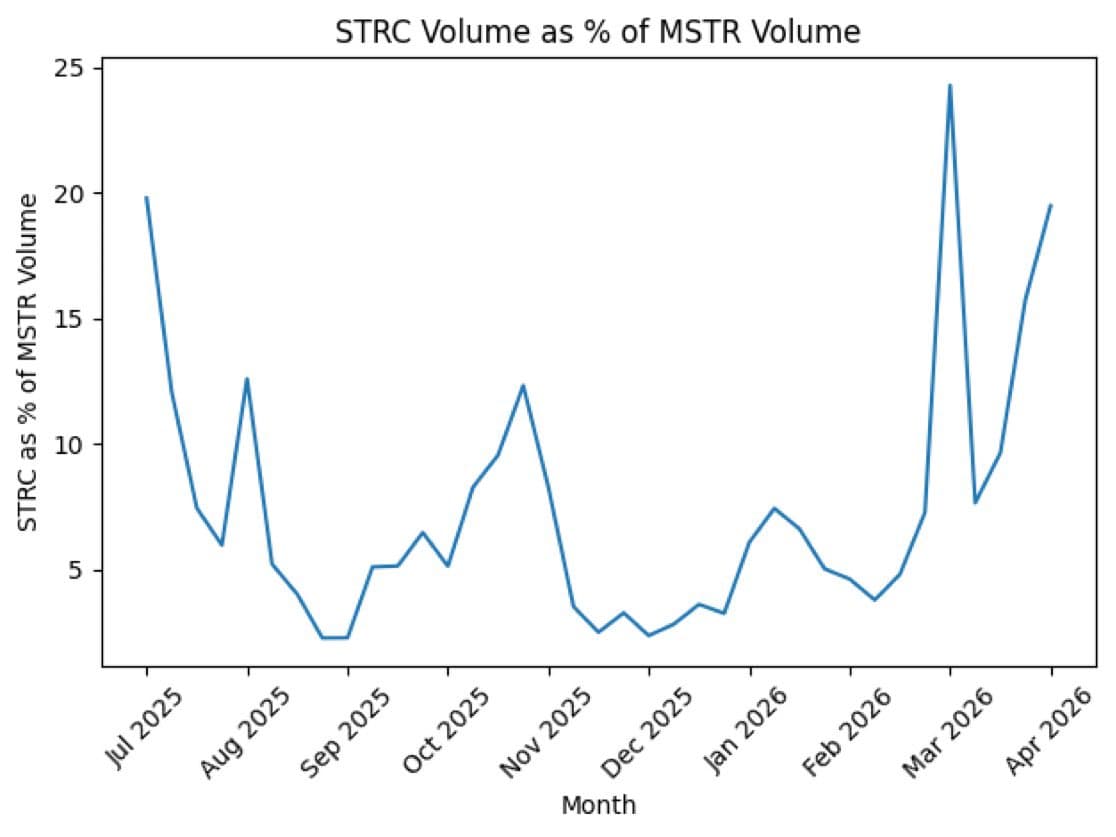
Higher STRC activity makes it harder to manage amplification without relying on common stock equity issuance, which can weigh on performance versus bitcoin. Over the past 30 days, the bitcoin price is relatively unchanged, while MSTR has fallen 11%.
At lower amplification, MSTR behaves like leveraged $BTC. At higher levels, it becomes harder to manage, on top of roughly $1.12 billion in annual obligations.