Meta’s quiet rollout last week of $USDC creator payouts in Colombia and the Philippines, four years after the company sold its failed Diem stablecoin (formerly Libra) assets to Silvergate Bank for $182 million, has revived the old question of whether Big Tech is finally coming for retail finance.
The answer in 2026 is yes, but not from Apple, Google or Mark Zuckerberg.
Singapore Summit: Meet the largest APAC brokers you know (and those you still don’t!)
The clearest competitive threats to Robinhood, Trading 212, eToro and Revolut are being assembled inside Walmart’s OnePay app, valued above $4 billion, and Elon Musk’s X Money, now licensed to handle payments across 41 US states.
Both lean on the same architecture, brokerage-as-a-service, or BaaS, plugging Zerohash and DriveWealth into apps that already reach hundreds of millions of users.
OnePay added Bitcoin and Ethereum trading via Zerohash in October 2025, then partnered with DriveWealth at the end of that month to bring stocks and ETFs into the same banking app.
X has rolled out cashtags for stock and crypto charts and signaled plans to plug trading directly into the timeline.
Meta’s $3 Billion Creator Pipeline Lands in $USDC, Not Libra
Meta confirmed on April 29 that it had begun routing creator payouts in Circle’s $USDC stablecoin via Stripe’s Link wallet, with settlement on Solana and Polygon. The pilot is currently limited to two markets selected for high creator-economy density and weak cross-border banking infrastructure.
The company paid out roughly $3 billion to creators globally in 2025, according to Fortune, with growth of about 35% year-over-year. Polygon Labs CEO Marc Boiron said the program is expected to expand to more than 160 countries by year-end 2026.
The setup explicitly avoids the central feature that doomed Libra: Meta is not issuing its own coin. Spokesperson Andy Stone has publicly pushed back on parallels to the original 2019 project.
Meta has begun testing payouts to content creators using the $USDC stablecoin on the Polygon blockchain, aiming to speed up payments and simplify cross-border transfers.
The program, currently piloted in Colombia and the Philippines, is expected to expand to over 160 countries,… pic.twitter.com/rHbAGOHjR3
— What’s Trending (@WhatsTrending) May 4, 2026
FinanceMagnates.com coverage of Meta’s stablecoin re-entry strategy flagged that the company was racing to launch before the GENIUS Act’s restrictions on Big Tech stablecoin issuance fully take effect.
OnePay Hits $4 Billion Valuation With a Stack That Looks Like Revolut
OnePay began life in January 2021 as a joint venture between Walmart and Ribbit Capital, the same VC firm behind Robinhood, Affirm and Credit Karma. After acquiring fintechs Even and ONE, it rebranded to OnePay in March 2025.
Through 2024 and 2025, the company built out a stack that now matches or exceeds Revolut on most consumer verticals. A 2024 funding round valued OnePay at $2.5 billion. A 2025 employee tender pushed the figure above $4 billion, according to Bloomberg.
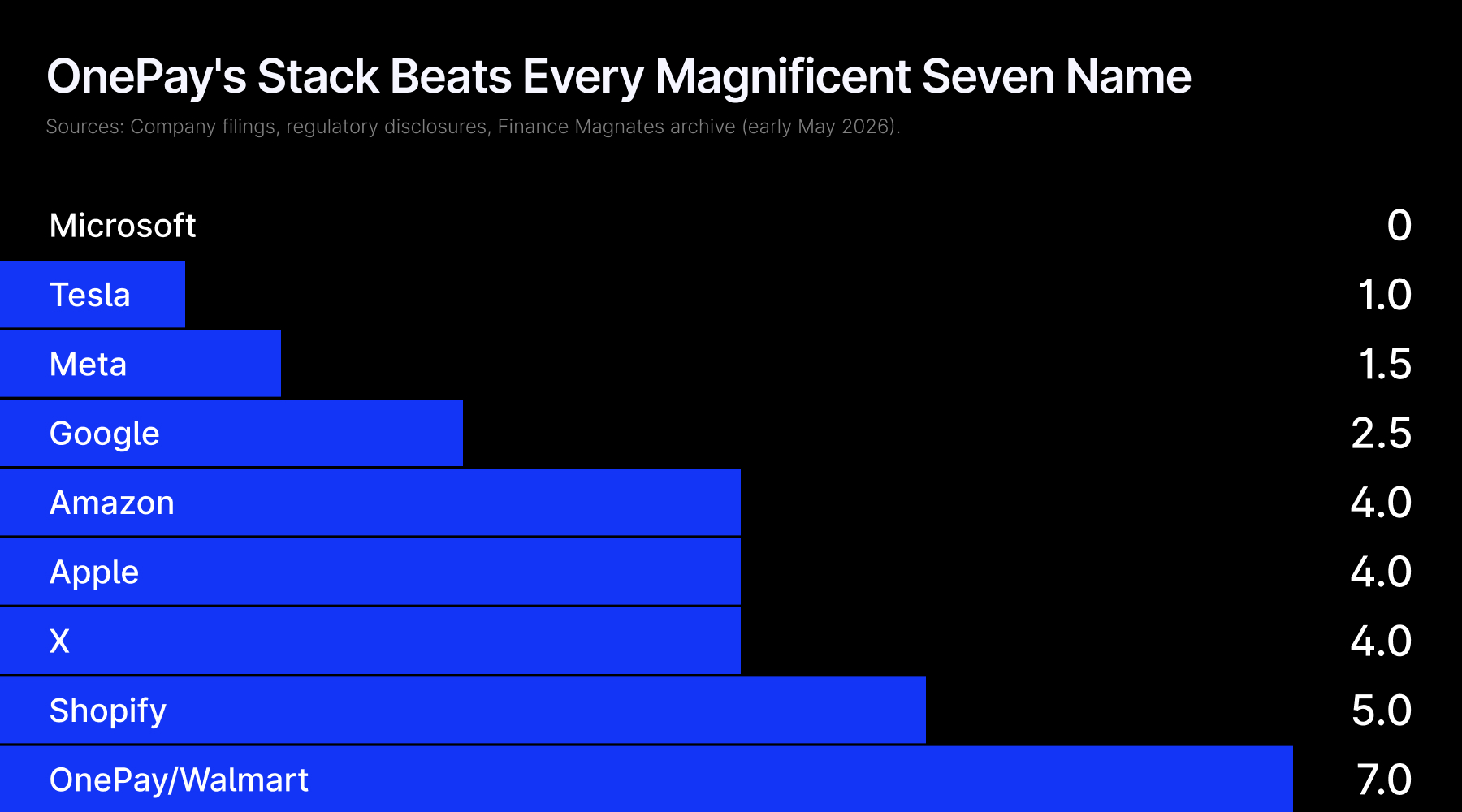
Scoring: 1.0 = live consumer product; 0.5 = exploring or in development; 0 = no product. Verticals: Payments (P2P/wallet), BNPL, Crypto trading, Brokerage (stocks/ETFs), Banking/deposits, Insurance, Card products, SMB lending.
The stack is striking. OnePay runs high-yield savings via Coastal Community Bank, BNPL through Klarna, and earned wage access for 1.6 million Walmart associates. A Synchrony-Mastercard credit card replaced Capital One inside Walmart stores last fall.
Bitcoin and Ethereum trading via Zerohash went live in October 2025, followed weeks later by equity and ETF trading powered by DriveWealth, the same firm behind Revolut’s US offering.
The app was running $15 billion in annual payment flow and over $200 million in run-rate revenue by year-end 2024.
X Money Launches in 41 States With Brokerage in the Pipeline
Musk’s X Corp has gone further than any other Magnificent-Seven-adjacent company toward owning the financial primitives. X Money’s public beta began rolling out in April after months of delays.
The product launched with FDIC-insured deposits via Cross River Bank, P2P transfers powered by Visa Direct, a Visa-issued metal debit card with cashback, and a 6% APY on deposits, though PYMNTS noted it was unclear whether the rate is permanent or promotional.
Today we’re rolling out the new Cashtags feature for web on X․com. Now X can be a core part of your trading terminal with real-time charts and posts for every asset. pic.twitter.com/QD8Tn4uj1l
— Nikita Bier (@nikitabier) April 30, 2026
The brokerage angle is in development. X rolled out cashtags in the United States and Canada on April 14, allowing users to tap “AAPL” or “BTC” inside the timeline and see real-time price charts.
Then-CEO Linda Yaccarino said at Cannes Lions in June 2025 that users would soon be able to “make investments and trades directly through the platform.” Smart Cashtags, which would route to in-app crypto buying, are reportedly in development.
Musk himself has framed X Money as “the place where all the money is.” The architectural similarity to OnePay is unmistakable: X is plugging into licensed banking and brokerage infrastructure rather than building its own.
Its distribution moat is roughly 600 million monthly active users.
Apple, Google and Amazon Quietly Pick Partnerships Over Licenses
The contrast with the larger Magnificent Seven names is stark. Apple, the Big Tech firm with the deepest financial-services footprint, has spent the past 24 months retreating to a partnership model.
In June 2024, Apple wound down Apple Pay Later, replacing it with global integration of installment offers from Affirm and Citigroup inside iOS Wallet. The CFPB fined Apple and Goldman Sachs a combined $89 million in October 2024 over Apple Card dispute-handling failures.
In January 2026, Apple confirmed JPMorgan Chase as the new Apple Card issuer, with more than $20 billion in card balances expected to transfer over a 24-month period, closing the chapter on a partnership Goldman bankers had publicly disowned.
Google has concentrated its push in India, where Flex by Google Pay, a UPI-linked co-branded credit card with Axis Bank, launched in December 2025. Amazon’s strategy is purely embedded:
Affirm provides BNPL at checkout, and Amazon Lending issues SMB loans through Goldman Sachs, Lendistry, Parafin and fintech Slope. None of the three has applied for a broker-dealer license in the past 36 months.
Why Big Tech Still Refuses to Build Retail Brokerage
Apple, Google, Amazon, Meta and Microsoft have collectively launched zero retail trading products since the failed Libra project in 2019. Regulatory friction is the most cited reason.
Broker-dealer licensing under FINRA and the SEC, Reg BI, payment-for-order-flow scrutiny, and recent best-execution reforms create higher compliance costs than money-transmitter licensing.
“European brokers don’t need to fear Apple,” Arkadiusz Jóźwiak, the financial analyst and Editor-in-Chief at Comparic.pl, told FinanceMagnates.com. “They need to watch the back door, the one Walmart and Musk are walking through with off-the-shelf brokerage stacks.”
Reputational risk is the second. Bankers who have pitched retail trading products to Big Tech executives have described meetings ending on the same point: the consumer-protection consequences of an Instagram or WhatsApp user losing money on stocks are not a fight Apple or Meta wants to pick.
The third is that brokerage-as-a-service makes ownership unnecessary. DriveWealth, Alpaca, Bitpanda Technology Solutions and Zerohash now allow distribution platforms to offer trading without holding the license.
Yahoo Finance’s one-click Coinbase trading integration, announced in February 2026, follows the same architecture.
Brokers Still See Revolut as the Bigger Threat
For European retail brokers, Big Tech remains a distant concern. Revolut, with roughly 60 million users, €8.5 billion in customer assets, and a reported $150 billion IPO target, is the closer competitor.
XTB CEO Omar Arnaout, speaking at Invest Cuffs in Warsaw, said he believed “Robinhood probably won’t achieve success in Europe,” instead pointing to Revolut as the standout competitor.
The asymmetry, however, is plain in the user-base math. Walmart and X together touch more than 850 million people on a weekly or monthly basis.
Robinhood reported roughly 26 million funded accounts at the end of 2025, while Interactive Brokers ended Q1 2026 with 4.4 million daily average trades.
If even a small share of OnePay or X users open in-app trading accounts, the customer-acquisition cost compression alone would meaningfully erode the funnel that mid-tier brokers depend on.
For brokers watching the Big Tech threat from across the Atlantic, the message of 2026 so far is that the danger is no longer about Apple or Google launching a stock-trading app.
It is about Walmart, Musk and Shopify quietly assembling what those companies will not, then turning their existing user bases into a customer-acquisition channel that traditional brokers cannot match.