Binance, OKX, and Gemini have lost 100,000 Bitcoin from their reserves since February 2026. These coins were moved to private wallets, cold storage, and ETF custody, pushing exchange reserves to their lowest levels since late 2023.
According to CryptoQuant analyst Amr Taha, the situation is dire because the reserves of multiple large exchanges fell simultaneously.
Because fewer coins on exchanges means there is less supply available for sale. According to a recent analysis, “Exchange reserves represent Bitcoin’s tradable float. The portion of supply available for buying and selling on the open market. When that number falls, it doesn’t mean Bitcoin has disappeared. It means less of it is positioned to be sold.”
Bitcoin prices are still recovering, and if history has taught us anything, it’s that when exchanges fall at the same time, whales tend to hold for extended periods rather than sell.
What exactly happened at Binance, OKX, and Gemini, and how big is the drop?
100,000 Bitcoin combined left the reserves of Binance, OKX, and Gemini in less than three months.
According to CryptoQuant data, 50,000 $BTC ($4 billion) left Binance between February 21 and May 7, leaving the platform with 620,000 $BTC.
Reserves on OKX also fell by 30,000 (about $2.4 billion) $BTC from 132,000 $BTC to 102,000 $BTC between March 2 and March 7.
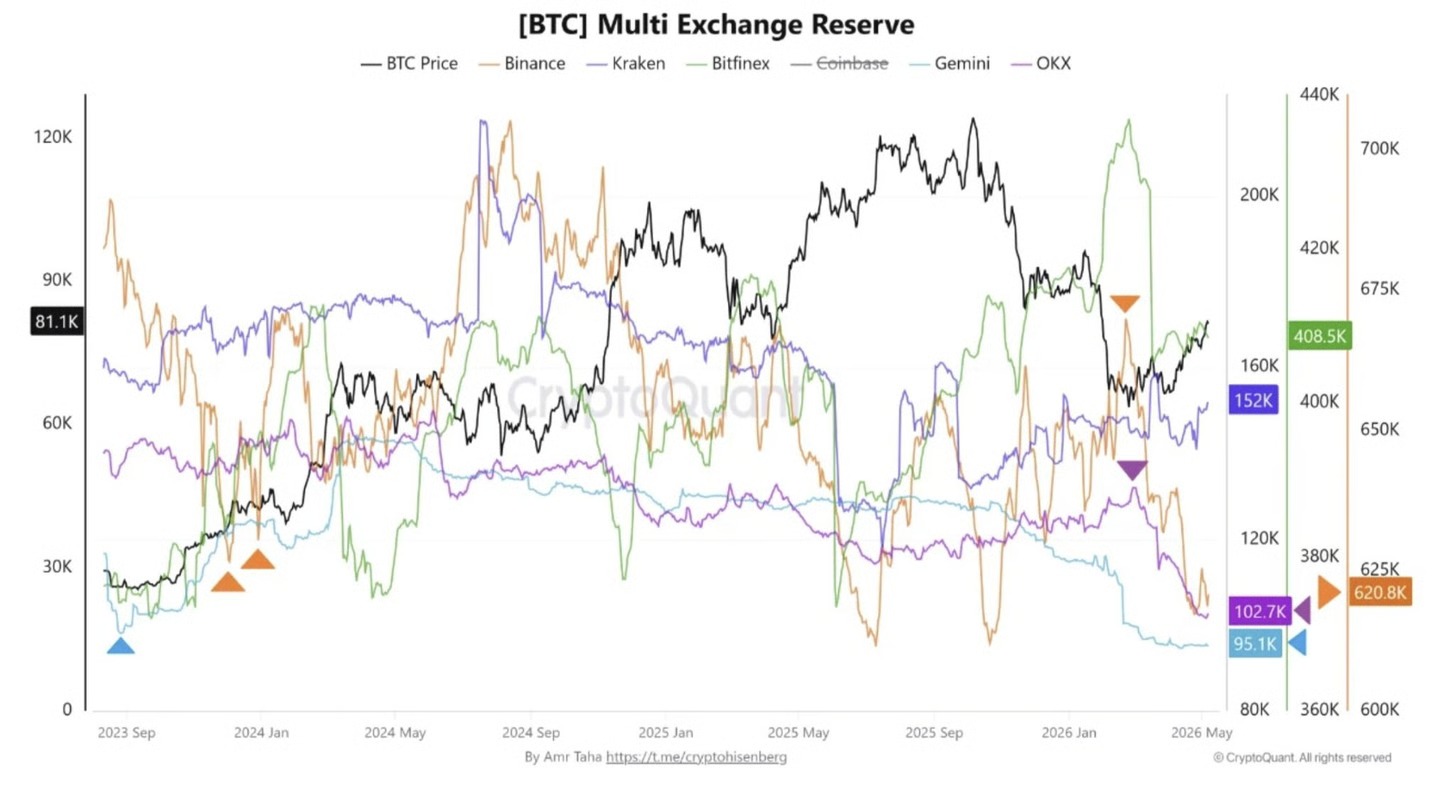
Gemini saw about 19,800 $BTC ($1.6 billion) leave its reserves between February 4 and May, leaving the platform with almost 95,000 $BTC.
Amr Taha said, “A synchronized decline across multiple exchanges carries more weight than isolated outflows from a single exchange. Fewer coins on trading platforms can amplify the price reaction when strong spot demand returns.”
According to data from CryptoQuant’s total exchange reserve tracker, $BTC reserves across all exchanges are now nearly 2.21 million, the lowest level since early 2018.
Where did the 100,000 Bitcoin go?
The Bitcoin went into private wallets, Bitcoin ETF custody, and long-term holder addresses.
According to data from the Bezinga analysis, the FTX exchange’s collapse in 2022 changed how holders behave, because many people moved their coins into hardware wallets as a more secure option.
People are also taking Bitcoin off exchanges and into ETFs because the funds collect more Bitcoin and store it safely to prevent any sales or trades. At the same time, miners today produce only small amounts of $BTC, so more coins are being stored than are being created or left for trading.
CryptoQuant refers to the third destination as “accumulator addresses.” These are wallets that keep adding Bitcoin but never sell. According to data, the number of coins on these addresses increased by 100,000 in just two weeks, indicating that long-term holders now control 78.3% of the supply.
What do analysts say about what happens next?
CryptoQuant CEO Ki Young Ju compared the current state to late 2020 and concluded, “The structure we’re seeing — exchange $BTC reserves at multi-year lows while large wallets continue absorbing supply off OTC desks — is reminiscent of Q4 2020.”
In other words, the same conditions now led to Bitcoin increasing from about $10,000 to over $60,000 back in 2020 through 2021
As per that logic, the fewer the coins in reserves, the higher the price. And when demand finally goes up, prices are likely to shoot for the stars.
However, others like CryptoQuant’s head of research, Julio Moreno, also gave his analysis that “Bitcoin is in a bear market that could extend through Q3 2026. Demand must grow for the market structure to change.”
According to him, just because there are fewer coins doesn’t mean new buyers will come out of it.