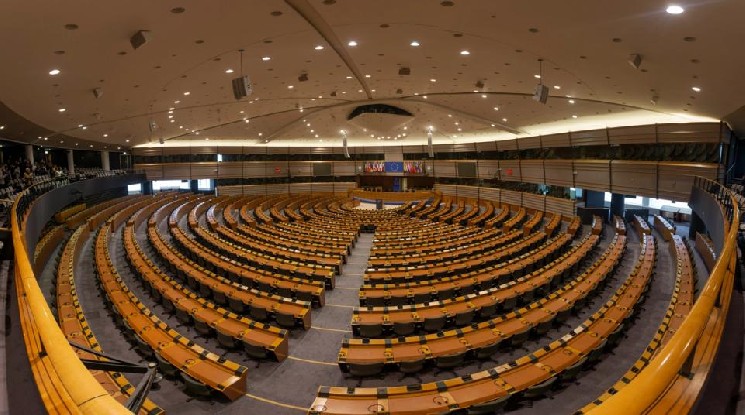
The European Central Bank (ECB) scored a major victory after the European Parliament’s influential Economic and Monetary Affairs (ECON) committee voted to approve the legal framework for a digital euro on Tuesday.
The committee also directly mandated the immediate start of final “trilogue” negotiations between European Union (EU) member states and the Parliament to hammer out the final law.
The vote ends three years of intense confrontations between central bankers and commercial lenders concerned over losing deposit revenue.
The main goal behind the deployment of a central bank digital currency (CBDC) is not just about modernizing payments, but to maintain the bloc’s autonomy of the monetary system. ECB Christine Lagarde has long-argued in favour of a CBDC to stave off the U.S. dollar-pegged stablecoin dominance in Tether’s USDT and Circle’s (CRCL) USDC.
Lagarde pushed back against public concerns over financial surveillance, asserting that cash isn’t going anywhere, adding that between the digital euro and physical banknotes, “one does not exclude the other.”
The EU has also pointed to nearly two-thirds of all card transactions in the eurozone being processed by non-European companies, mainly Visa (V) and Mastercard (MA).
“Strengthening the resilience of payments in Europe has become a geopolitical necessity,” Markus Ferber, a leading member of the ECON committee said on Tuesday.
“In a world marked by geopolitical tensions, we can no longer accept that digital payments are largely dependent on the goodwill of a few foreign providers,” he added, echoing concerns expressed across the EU.
The new rules voted by the ECON Committee cleared the way for the ECB to introduce both online and offline versions of the currency by 2029. Crucially, the offline version will allow users to swap digital euros directly from phone to phone without an internet connection, guaranteeing cash-like privacy that prevents the ECB from seeing what citizens are buying.
Commercial banks successfully lobbied for strict holding limits on how much a citizen can keep in a digital wallet to avoid a mass exodus of cash from traditional accounts during a crisis.
The ECB will now undertake a 12-month pilot phase using a beta version to test the infrastructure in real-world scenarios with select merchants and payment service providers.
“The euro must work in your pocket and on your phone,” Ferber summed up.