Strategy Chairman Michael Saylor published an annual performance report on digital credit instruments under the Strategy brand on his social media accounts, showing investors a striking divergence between the performance of the company’s structured products and the price action of the leading cryptocurrency.
According to the infographic, while “raw” Bitcoin plunged 47% over the past 12 months, the ecosystem’s defensive debt securities successfully absorbed the blow, while the flagship STRC instrument even posted a net gain of 9%.
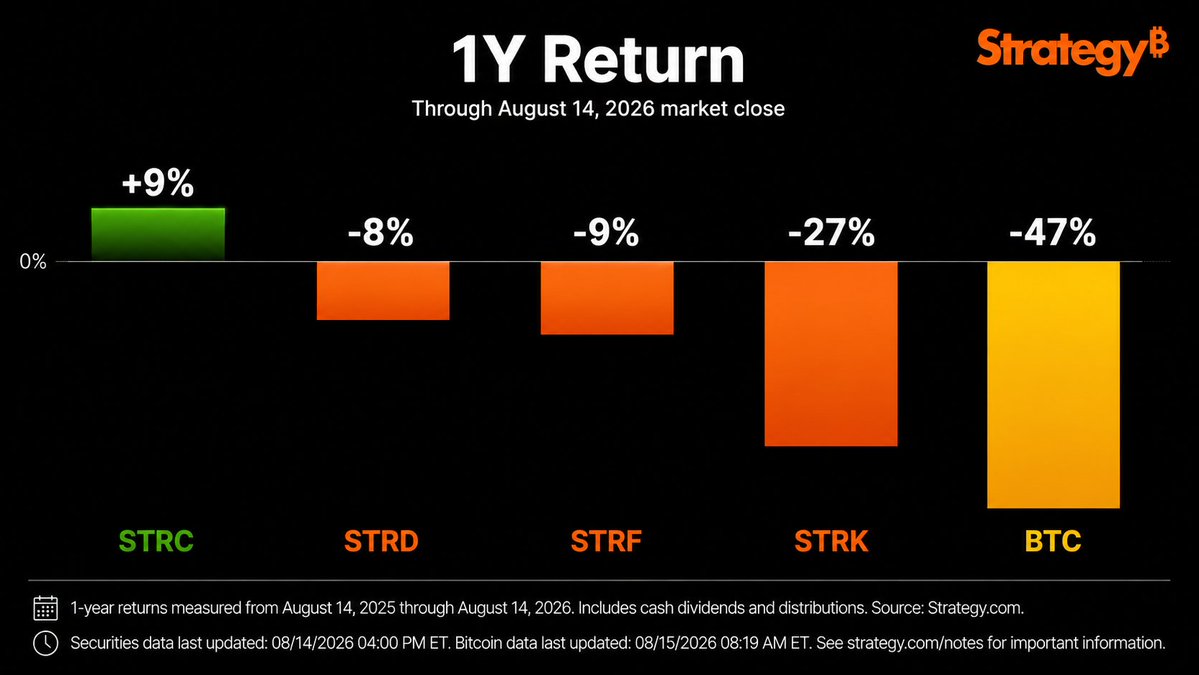
With his publication, Saylor clearly wants to prove that his team is capable of packaging volatile digital capital into predictable instruments protected against drawdowns.
The secret behind the resilience of the chart’s leader, STRC shares, lies in an aggressive dividend policy: the board of directors keeps the security’s market price near par by promptly adjusting payouts. Their rate was recently raised to 12% annually.
The Strategy lineup itself is divided into senior defensive tranches with fixed coupons (STRD, STRF) and hybrid convertible instruments (STRK), which allowed investor risks to be distributed during the market storm.
What Saylor leaves out of the performance chart
However, the stability recorded on the chart comes at a price that the company is paying right now. To provide investors with these high double-digit payouts amid the prolonged decline in the cryptocurrency, Strategy was forced to violate its core doctrine of “perpetual accumulation.”
In August 2026, the company continued regularly selling Bitcoin from its treasury, disposing of another $104 million worth of coins in its latest transactions. The company’s total annual obligations to its security holders already exceed $1.2 billion.
Considering the full context, it is unsurprising that independent analysts are urging investors to treat Saylor’s marketing with caution, pointing to a serious opportunity-cost factor.
While Strategy’s debt instruments merely minimized losses from the crypto market decline, the traditional U.S. S&P 500 index rose 22% over the same 12-month period with incomparably lower volatility.