The launch comes from Layertwo Labs, founded and led by longtime Bitcoin developer Paul Sztorc, also known as Truthcoin. The play is not to rewrite Bitcoin itself. Instead, ECX will become a separate network that copies Bitcoin’s transaction ledger at designated snapshots and hands most bitcoin holders an equal number of coins on the new chain. Someone holding 1 $BTC in a wallet they control at the snapshot will receive 1 ECX on the new network, while the original $BTC stays exactly where it was.
That distinction is critical. A hard fork creates a separate version of a blockchain after sharing the same historical record. ECX will take Bitcoin’s existing ledger as its starting point, but it will run its own software settings, mining difficulty, nodes, and economic activity. Bitcoin users do not have to participate, and their $BTC is not converted, locked, or moved. The fork simply creates another asset attached to the same wallet addresses at the snapshot.
ECX Will Leverage a 3-Phase Launch
According to Sztorc, the alpha phase is designed as a live-fire rehearsal. Participants can run software, mine, trade practice coins, test wallets, and hunt for cracks in the system. The practice coins, called pECX or alpha ECX, are not permanent.
A beta phase is scheduled around Sept. 20 at Bitcoin block height 967680. That round is expected to lean harder on exchanges, wallet providers, miners, and custodians, the companies that safeguard assets for others.
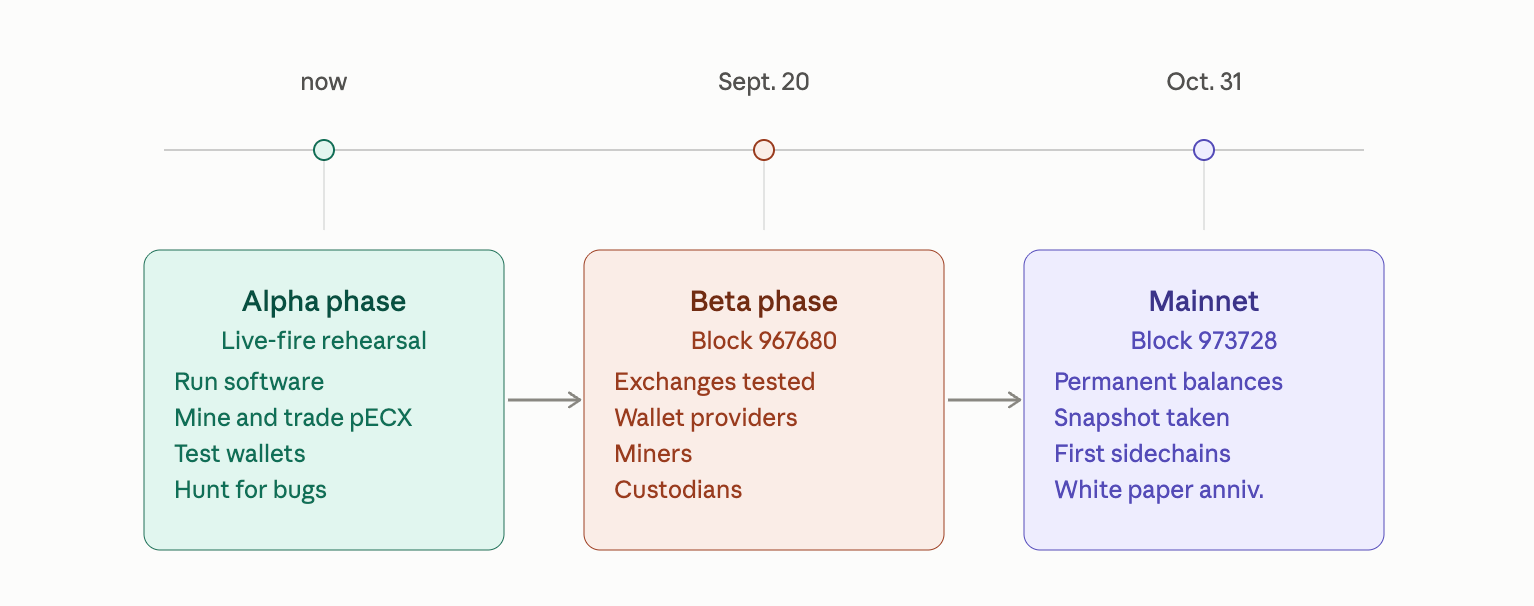
The permanent mainnet is scheduled for Oct. 31, near Bitcoin block 973728. That lands on the 18th anniversary of Satoshi’s Bitcoin white paper. At that snapshot, permanent ECX balances will be created, and the project expects its first batch of specialized sidechains to become available. The drawn-out rollout gives developers and infrastructure providers room to expose bugs, gauge mining conditions, and install safeguards before the permanent chain goes live.
Drivechains Are the Main Bet
Sztorc has spent more than a decade pushing Drivechains, a proposed way to let Bitcoin support optional sidechains without rewriting the rules for every user. A sidechain is a separate network with different features that can connect to a main blockchain. In practice, users could choose a sidechain for privacy, faster payments, or other functions while leaving the base network relatively conservative.
The proposed technology surfaced in BIP 300 and BIP 301, technical proposals Sztorc developed in 2017 and 2019. BIP 300 lays out a mechanism for moving assets between a main chain and sidechains. BIP 301 describes blind merged mining, which would let miners collect sidechain fees without running all of the software for every sidechain.
Those proposals never gathered enough support to activate on Bitcoin through a soft fork, a backward-compatible rules change. Bitcoin’s most recent major soft fork, Taproot, was activated in 2021. Layertwo Labs ultimately decided its Drivechain vision had a better shot as a separate hard fork than another campaign to win consensus from Bitcoin developers, miners, and node operators.
ECX plans to launch with seven specialized sidechains, including Thunder for high-throughput payments, Zside for shielded transactions, Bitnames for decentralized identity, Bitassets for token issuance, Photon for quantum-resistant signatures, Truthcoin for prediction markets, and Coinshift for cross-chain trading. The wager is that users can pick features without forcing every bitcoin user to swallow new base-layer rules.
Bitcoin Will Remain Unchanged
The project uses the same SHA-256d mining algorithm as Bitcoin and keeps its base layer close to Bitcoin Core, the dominant Bitcoin software. However, it will run its own network identifier and ports, keeping ECX nodes from mistakenly connecting to Bitcoin. The chain will reset mining difficulty to the minimum at launch before returning to normal adjustments, a setup likely to make early mining conditions fairly volatile.
One unique rule from the outset involves roughly 1.1 million early Bitcoin coins associated with Satoshi Nakamoto through the “Patoshi pattern,” a method researchers use to identify likely early-mined blocks. About 600,000 ECX will remain assigned to those addresses, while roughly 500,000 ECX will be redirected through special transactions to early investors and development funding. Supporters frame that as financing a new network without an initial coin offering. The move does not touch Satoshi’s $BTC on Bitcoin.
The project also stands far apart from the recent BIP-110 episode, an attempted temporary soft fork aimed at restricting some non-financial blockchain data. BIP-110 backers failed to attract meaningful miner support, node support, and infrastructure backing in any meaningful way, and the resulting minority chain stalled after a small handful of blocks. ECX is not trying to force rules onto Bitcoin. It is a separate experiment built to fight for users, miners, and capital while the Bitcoin network runs normally.
Self-Custody and Claiming Free Coins
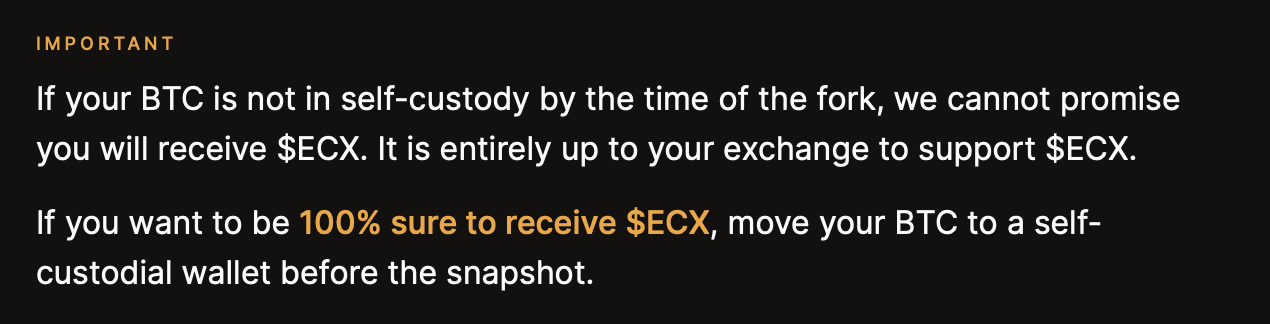
For individual holders, the crucial question is who controls the private keys at each snapshot. A private key is the secret credential proving control of a Bitcoin address. People holding $BTC in self-custody, meaning in a wallet where they control those keys, should be able to access their corresponding ECX directly. People keeping $BTC at exchanges or other custodians are stuck waiting to see whether those companies support the fork and distribute the new asset.
There is no established market price for permanent ECX because mainnet has not launched. During testing, some future-backed ECX trading could emerge, and even if exchanges list ECX, expect wildly speculative price discovery. The bigger question is whether ecash (ECX) gets warmer treatment than the recent BIP-110 fiasco. There is an ECX wallet for Apple (Testflight) and Android, while project docs also spotlight Bitwindow, an alternative Bitcoin Core frontend with native drivechain support.
The real fight starts after Oct. 31. ECX will need working sidechains, stable software, willing exchanges and enough miner participation to show that its combined fee model actually works. Bitcoin holders seeking direct access should track the snapshot heights, maintain control of their keys and stick with official guidance. They should also remember that ECX has nothing to do with XEC, the separate cryptocurrency that uses the same ecash name.