Bitcoin ($BTC) broke above $85,000, reaching a 24-hour high of $87,363.76 before pulling back toward $85,500. This powerful breakout marks a significant shift in market structure, fueled by a massive short squeeze that forced bearish traders to cover their positions, resulting in over $648 million in short liquidations.
Crypto traders are now assessing whether fresh capital is supporting the rally or whether forced short covering is amplifying the move.
Bitcoin Broke $85K as $648M in Shorts Were Liquidated
On September 21, 2026, Bitcoin peaked at nearly $87,300-$87,400, rising past $85,000, its highest price since January, before consolidating. A wave of forced liquidations in the derivatives market sharply increased the breakout.
According to CoinGlass data, roughly $648 million in short positions were liquidated over 24 hours as the price climbed. Total liquidations amounted to about $ 746.77 million, with shorts accounting for about 86%.
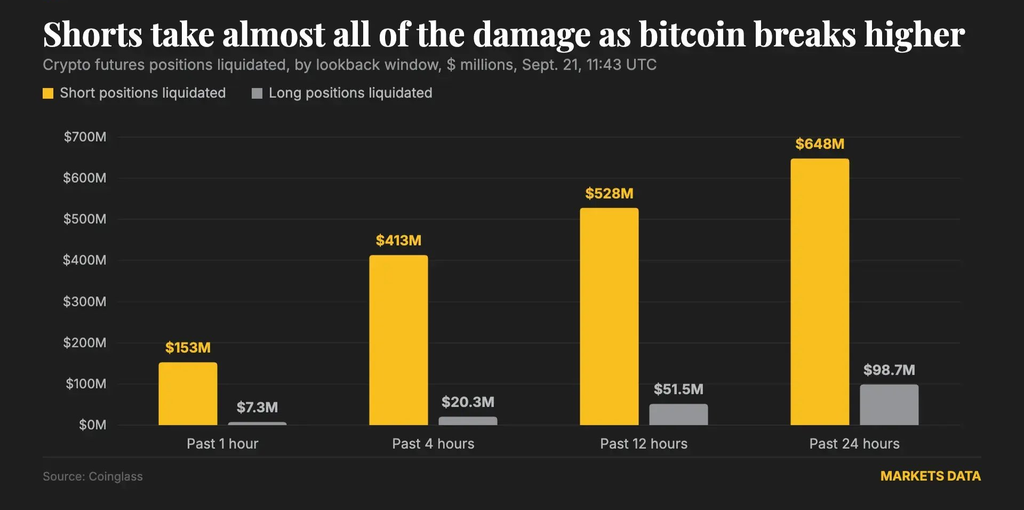
Meanwhile, the mechanics were more of a traditional short-squeeze type, with a heavy concentration of short interest concentrated in the $83,000-86,000 level. After breaking past major resistance at around $82,000- 84,000, liquidated short forced buying increased the upward momentum, triggering additional stop-outs.
In one intensive hour after the $84,000 breach, more than $260 million in short positions were wiped out. Despite heavy forced closures, total open interest in crypto derivatives soared 7.59% to around $156 billion, indicating that new leveraged positions were being opened even as existing shorts were being closed.
Was $BTC’s Breakout Real Demand or a Short Squeeze?
$BTC’s breakout was driven by a combination of genuine demand and derivatives-fueled amplification, rather than one factor alone. On the real demand side, U.S. spot Bitcoin ETFs saw around $999 million in net inflows on September 21, the highest net inflow of the year and the highest in about 11 months.
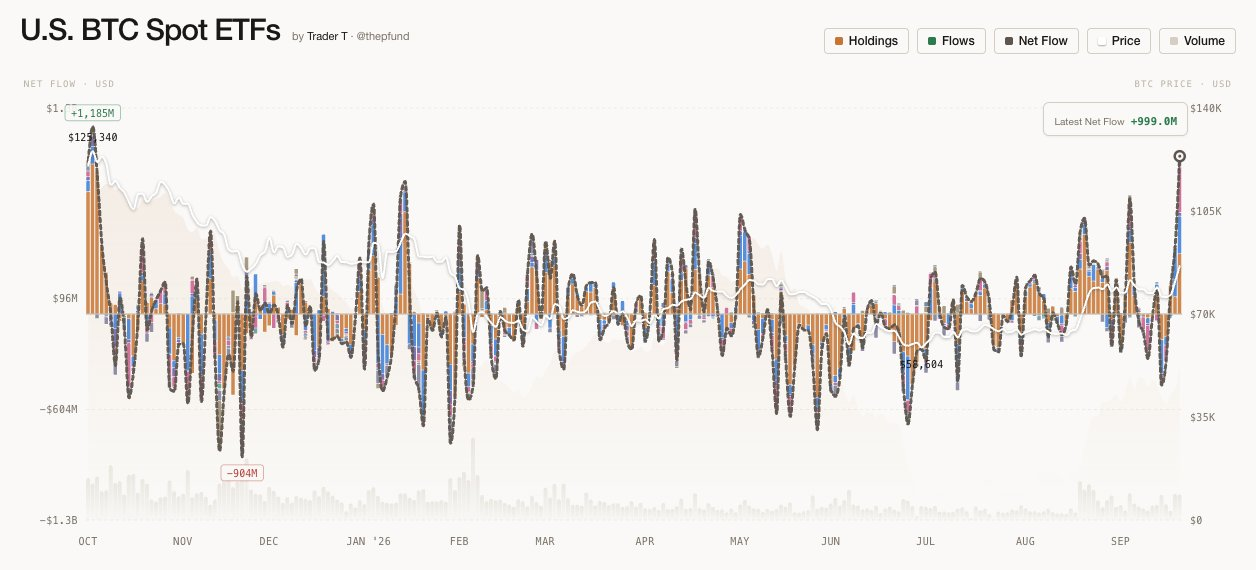
BlackRock’s IBIT raised $381 million, ARK 21Shares’ ARKB raised about $289 million, and Fidelity’s FBTC raised $239 million. These inflows signal fresh capital pouring into the market via regulated products, giving $BTC meaningful spot buying pressure and helping it break significant resistance levels.
At the same time, a short squeeze significantly amplified the breakout. The forced closure of bearish positions also increased buying pressure and drove the upward move where a dense cluster of short interest had accumulated.
What’s Next for Bitcoin Price?
At press time, $BTC was trading at $85,865.22, up 1.4% in the past 24 hours. The immediate upside target is the $87,000–$88,000 level, followed by the psychological $90,000 level. Several analysts and technical observations flag $90,000 as the key near-term test. A prolonged price action in this zone will clear the path for higher resistance zones.
Looking at the downside, the former resistance zone around $82,000-$83,000 and the wider support zone around $80,000-$82,000 are also now critical. If the breakout structure holds above these levels, the structure will remain intact; however, failure to defend them would lead to a deeper retracement. As $BTC continues to test higher levels, crypto traders should closely monitor continued real demand, sustained ETF inflows, and leverage dynamics.
Related: Bitcoin Short Squeeze Sends $BTC Toward $71,000 After $2.74B Liquidation Wave
Leave a Reply
You must be logged in to post a comment.