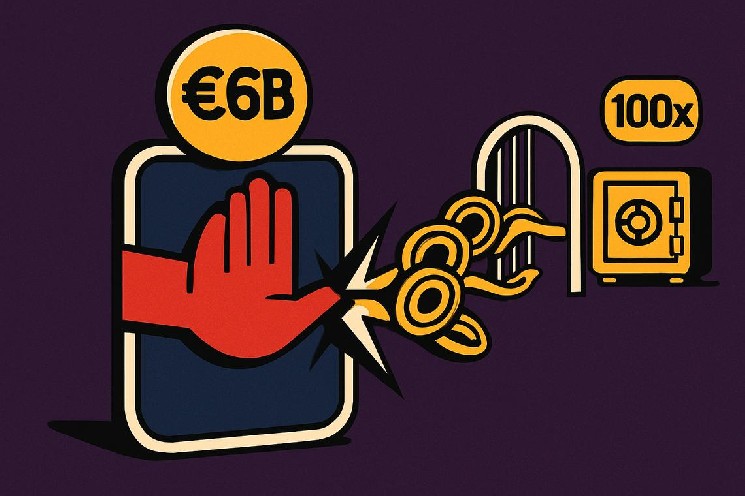
Two of the biggest names in exchange operations are telling European regulators the same uncomfortable thing: the bloc’s tokenization sandbox is too small to matter. Nasdaq and the Boerse Stuttgart Group have formally pushed the European Union to loosen or scrap the EU tokenization caps that currently box in the DLT Pilot Regime, arguing that Europe risks losing institutional-scale digital asset business to the United States if Brussels doesn’t act fast.
Key takeaways
- Nasdaq and Boerse Stuttgart Group have asked EU lawmakers to raise or eliminate the tokenized securities caps under the DLT Pilot Regime.
- The current EU limit stands at €6 billion in aggregate market value, with a hard exit threshold of €9 billion.
- The European Commission has proposed lifting that ceiling to €100 billion as part of a December 2025 revision.
- An industry coalition wants far more: caps between €150 billion and €1.5 trillion, or no caps at all.
- The US market already permits tokenization at scales roughly 100 times larger than what the EU currently allows.
Nasdaq and Boerse Stuttgart call for higher EU tokenization limits
Nasdaq and Boerse Stuttgart, joined by other financial market stakeholders, have made a direct appeal to EU lawmakers: either abolish the caps on tokenized securities under the DLT Pilot Regime or raise them dramatically. Their message is straightforward. At the current thresholds, Europe simply cannot compete for the kind of institutional-scale digital asset issuance that’s increasingly flowing toward US markets.
Current DLT Pilot Regime cap and constraints
The DLT Pilot Regime launched back in 2023 as a regulatory sandbox, giving exchanges and settlement systems room to experiment with distributed ledger technology for trading tokenized versions of traditional securities. But the experiment came with strict guardrails. Under this regime, tokenized securities cannot collectively exceed €6 billion in market value, and once €9 billion is reached, the exit threshold applies. On top of that, participation is limited to smaller securities and bonds under MiFID II rules, which narrows the pool of assets that can even enter the sandbox.
Industry coalition’s request versus European Commission proposal
Brussels has already acknowledged the bottleneck. The European Commission proposed raising the ceiling to €100 billion as part of a revision that took place in December 2025, alongside plans to expand the list of eligible assets under MiFID II. That would mark a substantial jump from where things stand today.
But the industry coalition, in a letter sent in September 2026, asked for something far more ambitious: caps ranging from €150 billion to €1.5 trillion, or no caps whatsoever. The distance between the Commission’s €100 billion figure and the industry’s request of up to €1.5 trillion says a lot about how differently regulators and market operators define “institutional scale.”
Competitive pressure from the US tokenization market
The core argument driving this lobbying push is transatlantic competition, and the numbers make the case bluntly. According to the exchange operators, the US market already permits tokenization at scales roughly 100 times larger than what Europe’s current framework allows. That’s not a marginal gap — it’s the kind of disparity that can steer where global institutional capital chooses to park its digital asset activity.
Part of that American advantage traces back to the Depository Trust & Clearing Corporation, the US clearing and settlement backbone, which has taken a considerably more permissive stance on tokenized settlements. Regulatory no-action letters have given US firms room to innovate without the constant threat of enforcement action hanging over every experiment.
This matters beyond the immediate dollar figures. If the caps stay near the Commission’s proposed €100 billion, the gap with US capabilities narrows only slightly. Institutional participants have signaled that this number falls short of what’s needed for serious, large-scale capital markets activity. For an EU trying to position itself as a credible venue for tokenized finance, that’s a competitiveness problem that won’t resolve itself through incremental adjustments.
Nasdaq and Boerse Stuttgart partnership to boost European tokenization
Lobbying letters are one thing. Operational moves are another, and Nasdaq and Boerse Stuttgart have paired their regulatory push with an actual partnership. In March 2026, Nasdaq teamed up with Boerse Stuttgart’s Seturion platform, a tie-up designed to widen the range of tokenized products available to European investors and open up more flexible settlement pathways.
Seturion is Boerse Stuttgart’s dedicated infrastructure for digital securities, and the partnership gives Nasdaq a way into the European DLT market without having to build the plumbing from scratch. For Boerse Stuttgart, the arrangement brings Nasdaq’s global distribution reach and technology stack onto a platform that was purpose-built for tokenized instruments under EU rules.
Why this matters for the broader market: the partnership suggests that even as Nasdaq and Boerse Stuttgart lobby for looser rules, they’re not waiting around for Brussels to move. They’re building the infrastructure now, positioning themselves to scale quickly the moment — and if — the EU tokenization caps actually get lifted. That’s a signal to other market participants that the regulatory fight and the commercial buildout are happening in parallel, not in sequence.
FAQ
What are the current regulatory caps on tokenized securities under the EU’s DLT Pilot Regime?
The current cap is an aggregate market value of €6 billion, with an exit threshold of €9 billion for tokenized securities.
Why are Nasdaq and Boerse Stuttgart asking the EU to raise or remove the tokenization caps?
They argue the current caps are too restrictive and hinder Europe’s ability to compete with the much larger US tokenization market for institutional-scale digital asset issuance.
How does the proposed cap by the European Commission compare to industry demands?
The Commission proposed raising the cap to €100 billion as part of a December 2025 revision, whereas the industry coalition has requested a much higher cap between €150 billion and €1.5 trillion or removal of caps entirely.
What partnership have Nasdaq and Boerse Stuttgart formed to promote tokenization in Europe?
They partnered via Boerse Stuttgart’s Seturion platform in March 2026 to expand the range of tokenized products available to European investors and create flexible settlement pathways.
Article produced with the assistance of artificial intelligence and reviewed by the editorial team.
Leave a Reply
You must be logged in to post a comment.